Russia Overtakes Ukraine as India's Top Sunflower Supplier: Anatomy of a Four-Year Reroute
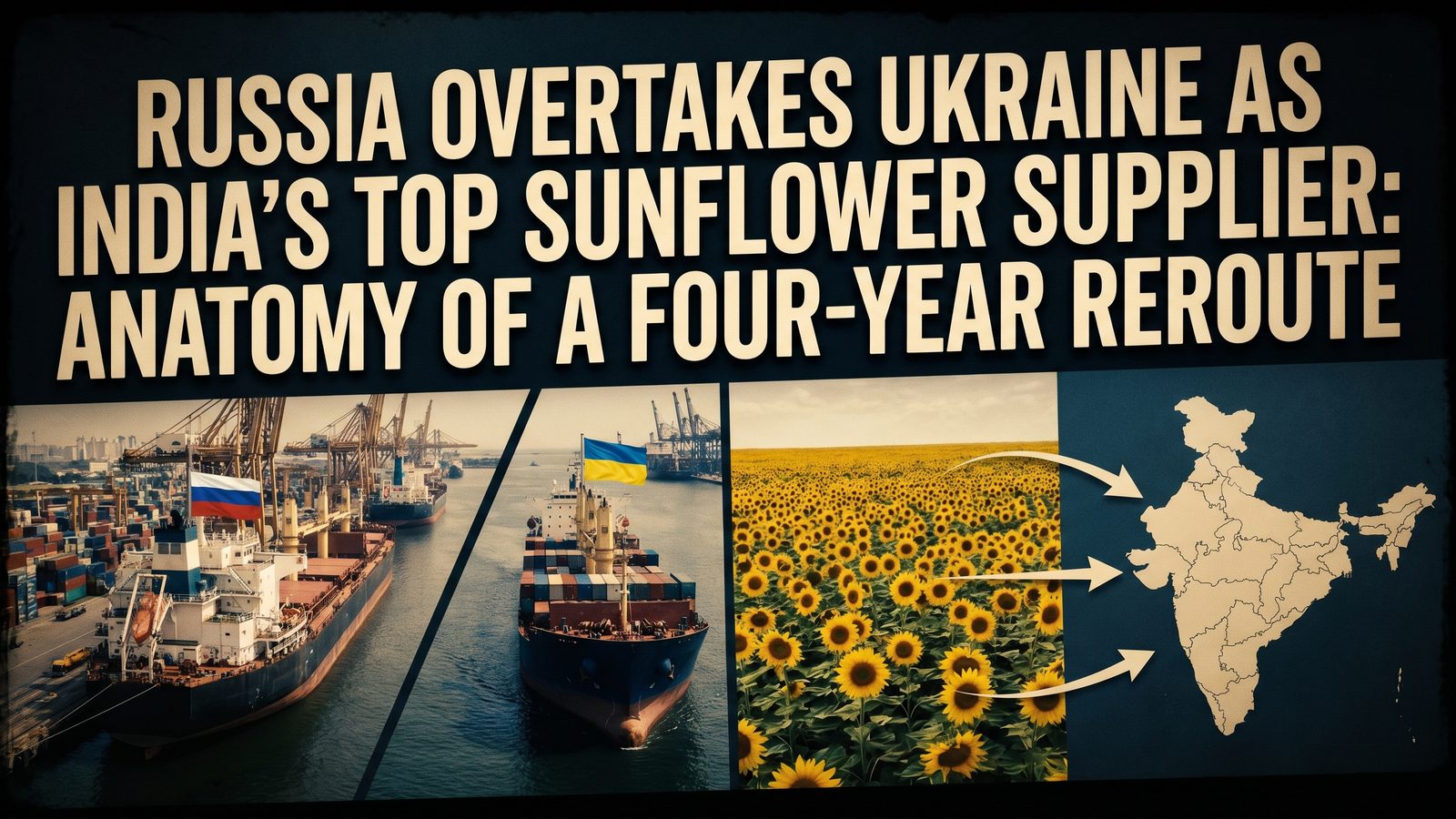
In this analysis: The Black Sea sunflower oil trade has been rewritten over four years. Russia has moved from supplying roughly 10% of India's sunflower oil imports in 2021 to approximately 56% in 2025. Ukraine, which once held nearly 90% of the Indian market, has receded to a secondary supplier role. This is not a temporary wartime pattern. It is a structural shift in sourcing, and Indian refiners and crushers now need to factor Russian export-levy risk and Black Sea security exposure into every sunflower oil procurement decision.
The numbers
Russian sunflower oil shipments to India have risen roughly twelvefold over the past four years. 2024 volumes hit 2.09 million tonnes, up from 175,000 tonnes in 2021. For the 2025 calendar year, Russia held approximately 56% of India's total sunflower oil import basket, according to industry data triangulated against SEA of India monthly import compilations and customs filings.
The global sunflower oil exporter ranking now reads: Ukraine (33% of world sunflower oil exports), Russia (30%), Argentina (14%), Turkey (5%) and Kazakhstan (5%) — data as of the BLACK SEA GRAIN.KYIV-2026 conference assessments from UkrAgroConsult. The top two, taken together, control two thirds of world export supply.
For India — which imports roughly 60% of its total edible oil requirement and sources nearly all of its sunflower oil externally — the Black Sea region is not a supplier. It is the supplier.
How Russia overtook Ukraine
Three mechanisms drove the shift.
Port logistics. Russia's Azov and Black Sea ports (Novorossiysk, Taman, Rostov-on-Don, Yeysk, Taganrog) have remained continuously operational since 2022. Ukraine's export infrastructure — principally the Greater Odesa cluster of Odesa, Pivdennyi and Chornomorsk — has operated under conditions ranging from total shutdown (March–July 2022) to intermittent strike damage (2024–2026). Even when Ukrainian ports function, ancillary infrastructure — oil extraction plants, rail connections to ports, electricity supply — has suffered recurring attacks. Within a three-week window in December 2025–January 2026, at least nine strikes hit vegetable oil processing plants and related port infrastructure.
Processing capacity relocation. Russian crushing capacity has expanded aggressively. The annual Russian crush now exceeds 18 million tonnes of sunflower seed, compared to Ukraine's domestic processing total of around 12–13 million tonnes in a normal year (and considerably less in disrupted years). The Russian industry has also invested in larger-capacity vessel loading at Azov ports, enabling the Panamax and Kamsarmax-class shipments that Indian buyers prefer for cost efficiency.
Price competitiveness. For most of 2024–25, Russian sunflower oil traded at a USD 15–40/MT discount to Ukrainian product CIF Mumbai, reflecting Russia's lower insurance, shorter uninterrupted export lanes, and favourable rouble weakness. That discount narrowed in early 2026 as Russian export taxes tightened and crush margins compressed to around 7% — but the relationship had already been established.
The 2026 picture
Sunflower oil prices FOB six European ports (Fastmarkets assessment for Rotterdam, Amsterdam, Antwerp, Ghent, Dunkirk, Dieppe basis) climbed to approximately USD 1,409/MT for February 2026 shipment — up roughly USD 80/MT from the USD 1,330/MT range seen in late December 2025. Sunflower oil CIF Mumbai is trading at USD 1,350–1,360/MT, up USD 25–30/MT on the tightening.
Approximately 25% of the Black Sea region's sunflower oil processing capacity is currently idle due to logistical disruption, electricity supply issues and security concerns. That idle capacity is not evenly distributed — it is concentrated in Ukraine. Russian processing remains largely operational but is constrained by progressive increases in the Russian export tax, which has risen through 2025–26 as Moscow seeks to fund state programmes while capping domestic seed prices.
Turkish data underscores the reroute: during January–November 2025, Turkey imported 1.1 million tonnes of sunflower oil, 64% from Russia and only 24% from Ukraine. In the same window a year earlier, the Russian share had been 56% and Ukrainian 39%.
What Indian buyers need to plan for
Russian export tax risk. Russia adjusts its sunflower seed and oil export taxes on a rolling basis. Any material change — typically driven by domestic political pressure around farmer incomes or food price inflation — can move CIF Mumbai pricing by USD 20–40/MT within weeks. Indian refiners taking positions on Russian-origin cargoes need real-time visibility on the Russian Ministry of Agriculture's export tax announcements.
Sanctions exposure. While Russian food and agricultural exports are not under direct primary sanctions from major Western jurisdictions, secondary exposure — shipping, insurance, banking — continues to evolve. Indian buyers have been able to settle Russian-origin veg oil purchases through rupee-rouble arrangements and UAE-based clearing mechanisms, but the machinery is not frictionless. Any escalation that pushes Russia deeper into secondary sanctions affects everything downstream.
Ukrainian resurgence scenarios. If the war enters a ceasefire or de-escalation phase during 2026, Ukrainian processing capacity and port flows could recover rapidly. Ukraine's 2026/27 sunflower seed production is forecast at 13.7 million tonnes by UkrAgroConsult, and planted areas have already exceeded pre-2022 levels. A Ukrainian supply return would compress prices by USD 60–100/MT within a quarter, pushing the Russian discount back out and reshuffling the import basket.
Argentine substitution. Argentina — now the world's third-largest sunflower oil exporter at 14% share — has spare capacity and could lift India exposure by 300,000–500,000 tonnes annually if price signals align. The logistics are longer and costlier than Black Sea supply, but the political risk profile is materially cleaner.
The structural question
Since the 2022 invasion, sunflower oil has become the most geopolitically exposed edible oil in the world. Every tonne that moves between the Black Sea and Indian ports touches a war zone on one end and a narrow chokepoint (the Turkish Straits) on the other. The premium on resilient supply chains will not go back to pre-2022 levels in any foreseeable scenario.
For India — the single largest sunflower oil buyer in the world — the long-run answer is not to pick winners between Russia and Ukraine. It is to maintain active sourcing relationships in at least three origins (Russia, Ukraine, Argentina), to build strategic storage cushioning for 30–45 days of forward cover, and to price Black Sea risk into hedge positions the same way it is already priced into crude oil markets. That work has begun, but it is not finished.