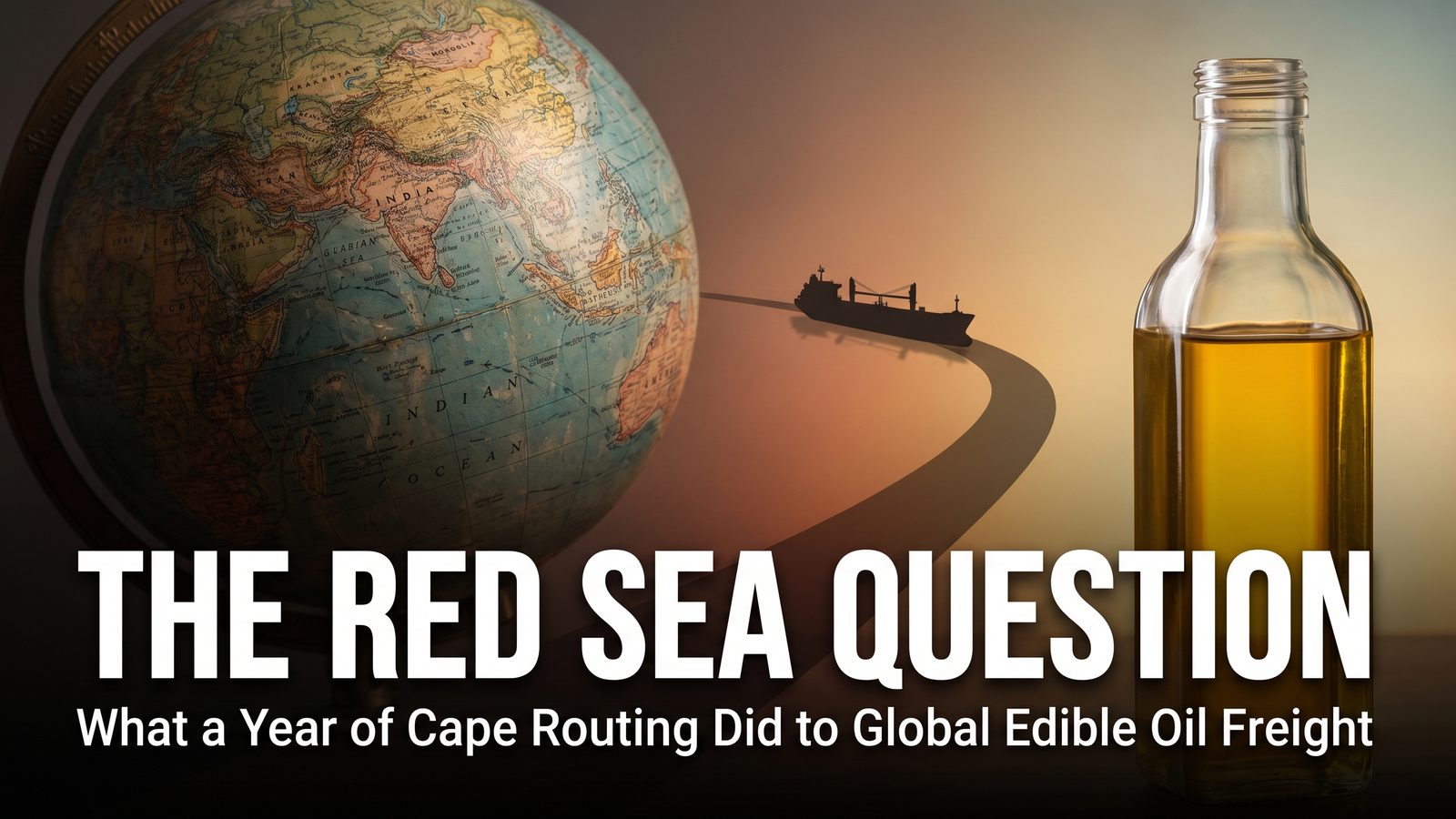
The Red Sea Question: What a Year of Cape Routing Did to Global Edible Oil Freight
In this analysis: The Suez Canal — which in normal years carries roughly 12% of global seaborne trade, including the vast bulk of Asia-to-Europe edible oil flows — has operated well below capacity since late 2023. The Red Sea security situation, the resulting diversion of tanker traffic around the Cape of Good Hope, and the compounding effect of Hormuz Strait tension in early 2026 have added structurally to the landed cost of every tonne of CPO, sunflower oil and soy oil moving between hemispheres. This is freight inflation that isn't going away quickly.
The routing shift
Before late 2023, a CPO cargo from Belawan (Indonesia) to Rotterdam transited the Strait of Malacca, the Indian Ocean, the Bab-el-Mandeb strait, the Red Sea, the Suez Canal and the Mediterranean — a voyage of roughly 19–21 days on a typical MR2-class vegetable oil tanker. Cape routing (around southern Africa via the Cape of Good Hope) extends that voyage to 32–35 days, adding roughly 3,000 nautical miles.
The direct freight cost effect: USD 35–55 per tonne of additional freight on Indonesia–Rotterdam routing, depending on bunker prices and vessel availability. The indirect effects — slower tanker turn, higher working capital tied up in inventory afloat, greater exposure to price swings during the voyage — add another USD 10–20/MT in effective carrying cost for buyers.
Time-charter rates on MR-class chemical and vegetable oil tankers have run 30–45% above their 2021–22 range through most of 2024–2026. The supply of compliant tonnage remains tight because the global veg oil tanker fleet is relatively small (roughly 900 vessels under 25,000 DWT capable of handling IMO-2 oils) and because orderbook growth has been modest.
What 2026 added
The Middle East escalation of March 2026 — driven by direct conflict risk affecting the Strait of Hormuz — did not close the strait, but it did produce two material freight effects:
Insurance premium increases. War risk underwriters have progressively widened additional premium charges for vessels transiting the northern Arabian Sea and approaches to Hormuz. Even vessels that do not call at Gulf ports but transit nearby waters are paying 15–25 basis points on hull value as additional war premium, up from 5–10 bps in mid-2025.
Crude oil price transmission. Brent crude's rally above USD 100/bbl in late March 2026 on Middle East risk pushed bunker fuel prices sharply higher. Very low sulphur fuel oil (VLSFO) at Singapore bunker prices climbed past USD 720/MT in the back half of March — adding approximately USD 4–6/MT of voyage fuel cost on an Asia–Europe vegetable oil leg. That cost passes through to freight within one charter cycle.
The routes that have rewired
Three major edible oil lanes have been materially reshaped since 2023:
Indonesia / Malaysia to Europe. Cape routing is now the default for most cargoes. A small portion of premium-traceable segregated flows still uses Suez when insurance conditions permit, but the shift has been decisive.
Ukraine / Russia (Black Sea) to India. The routing itself hasn't changed — Suez remains the only commercially viable path. But the risk profile has: Bab-el-Mandeb transit carries heightened scrutiny, and charterers increasingly demand armed security escorts for certain vessel classes. Voyage costs are roughly USD 15–25/MT above 2022 levels.
Argentina to Europe and India. This route has gained share at the margin. Atlantic routings to Europe and Pacific routings (via Panama) to Asia avoid Middle East exposure entirely. Argentina's competitive position in global soy oil and soy meal has firmed noticeably as a result — part of why Argentine soy oil has been trading at unusually tight premiums to Brazilian product through 2025–26.
Who absorbs the cost
In vegetable oils — unlike in crude oil — the buyer typically absorbs freight. Sales to major Indian and Chinese refiners are predominantly done on FOB basis, with the buyer taking voyage risk. This means the USD 40–60/MT freight inflation since 2023 has been absorbed primarily by downstream refiners and, ultimately, by end consumers through higher retail cooking oil prices.
For Indian refiners, the freight wedge has compressed processing margins to uncomfortable levels. A refiner processing imported CPO at Kandla is now paying roughly USD 1,105–1,120/MT CIF (including freight wedge) versus roughly USD 960–980/MT in a pre-Red Sea world at equivalent FOB pricing. That is a USD 140+/MT shift in landed cost — a number that has not been recovered through retail price increases because of competitive pressure and government price monitoring in India.
What to watch through H2 2026
Suez transit data. The Suez Canal Authority publishes monthly transit statistics. A sustained return of CPO tanker flows through Suez — even partial — would signal an improving security environment and could pull freight costs back by USD 20–30/MT within a quarter.
Bunker fuel prices. VLSFO Singapore is the single most important input in veg oil freight cost. Every USD 100/MT move in bunker fuel translates to roughly USD 3/MT of freight on an Asia–Europe voyage. Middle East crude dynamics drive this directly.
Fleet supply. The global orderbook for MR-class chemical tankers is growing, but deliveries through 2026–27 will only partially offset the increased tonne-mile demand created by Cape routing. Charter rates are likely to stay firm.
Hormuz and Bab-el-Mandeb incident data. Any significant escalation in either chokepoint pushes war risk premiums and can add USD 10–20/MT of freight inflation within weeks.
For analysts modelling 2026–27 vegetable oil pricing, the lesson of the last two years is that freight is no longer a rounding error in the CIF equation. It is a strategic input worth tracking at the same cadence as origin-country production and biodiesel mandate changes. The world has been routing the long way around since December 2023, and there is no clear path back to normal before 2027 at the earliest.