India's Sunflower Channel Is Jammed, and Palm Is Quietly Taking the Volume
Around 150,000 tonnes of sunflower oil bound for India is delayed at Black Sea ports, with waiting times running as long as 60 days, and August arrivals are on track to fall to their lowest since February. Refiners in the south have already switched their intake toward soyoil and palm rather than wait.
This is not a demand story. Indian consumption is running into the strongest stretch of the calendar. It is a delivery story, and delivery is where the sunflower complex is currently failing.
The July numbers already told you where this was going
India's total edible oil arrivals reached 1.481 million tonnes in July, a ten-month high and up roughly a third from June as refiners restocked ahead of the August-to-November festival window. Underneath that headline, the composition was unmistakable.
Palm oil imports jumped about 50% on the month to 730,965 tonnes, the highest in five months. Soyoil rose 31% to 498,881 tonnes, a seven-month high. Sunflower oil managed just 4%, at 251,639 tonnes — comfortably the weakest of the three.
A single month's spread can be noise. This one is not. Palm and soy were bought because they could be delivered on time. Sunflower was not bought because it could not.
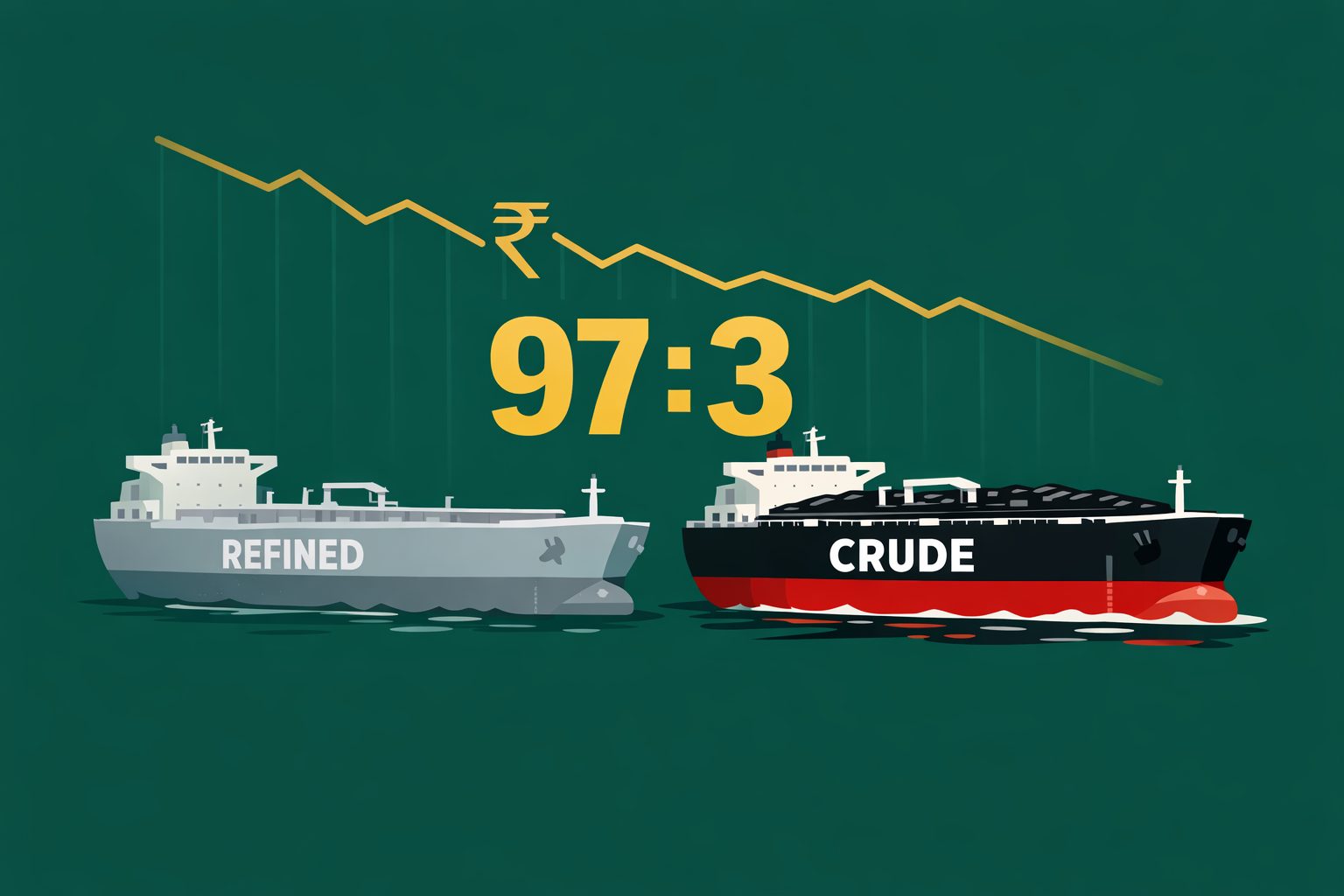
One further detail from the July data is worth flagging for refiners: the crude share of India's palm imports rose to 96% from 86%. Buyers are pulling in unrefined material and adding value domestically, which is a margin decision as much as a supply one.
What is actually broken
Ukraine's export machine for vegetable oil has been forced off the water and onto the rails. In the first 18 days of August, 71,900 tonnes of vegetable oil moved out of Ukraine by rail, up 55.9% against the same period a year earlier and 19.4% above July. Of that, 77% went through western border crossings. Only around 9,000 tonnes reached the Danube ports of Izmail and Reni.
That distribution is the story in one line. The overland corridor into Europe is now the primary route, and the maritime corridor that historically served Asian buyers has become the fallback. Rail can preserve tonnage. It cannot preserve the economics of a long-haul cargo to an Indian west-coast port, and it cannot compress a 60-day wait into a shipping schedule that a refiner can plan a festival run around.
Oilseed meal and cake tell the same story from a different angle: 104,000 tonnes moved by rail over the same 18 days, up 5.6% on July but still 13% below last year, with 69% routed through western crossings.
Why substitution is easier than it looks, and harder than it looks
India has genuine optionality in sunflower oil. Over the January-to-October period of 2025, national customs data put total sunoil imports at 2.29 million tonnes, sourced 46.5% from Russia, 23% from Argentina and 22% from Ukraine. Russian and Argentine barrels are available to Indian buyers in a way they are not to European ones, which cannot take Russian-origin material under sanctions.
That optionality is why India has not faced an outright shortage. It is also why the pain shows up as price and timing rather than absence.
The harder part is downstream. Sunflower oil is not a straight swap in every Indian channel. Southern markets in particular carry established consumer preference for sunflower in retail packs, and a refiner switching a blend or a label mid-season carries brand risk on top of procurement risk. Where the switch happens fastest is in institutional, bulk and food-service demand, which is less brand-sensitive and moves on landed cost. Retail follows later and more reluctantly.
What this does to India's cost base into the festival peak
The near-term arithmetic cuts both ways. Sunflower oil is scarce and dear because of a logistics failure. Palm and soy have simultaneously come under pressure from a separate, unrelated shock — a softening of the US biofuel compliance obligation that pulled Chicago soyoil down more than 2% on Friday and a further 2.7% on Monday, and knocked palm off its highest level since December 2024.
For an Indian buyer, that combination is unusually favourable. The oils that are actually deliverable have just become cheaper, while the oil that is not deliverable has become the one you are avoiding anyway. Import cover was already comparatively strong: cumulative arrivals for the first nine months of the 2025-26 oil year reached 11.923 million tonnes against 11.346 million a year earlier, a 5% increase.
The risk sits on the other side of the festival season. If Black Sea flows normalise late in the year while palm's own supply is being progressively absorbed by Indonesia's higher domestic blending mandate, India could find itself rebuilding sunflower cover into a market where the cheap substitute has stopped being cheap. Buyers running purely spot into Q4 should think carefully about that sequencing.
Three things to watch: the pace at which delayed Black Sea cargoes actually clear, whether the Russian and Argentine share of Indian sunoil arrivals climbs further at Ukraine's expense, and whether the crude-to-refined import ratio holds near July's 96% once refining margins normalise.
Forward-looking views here are analysis, not investment advice.