India Bought for a Festival That Has Not Turned Up
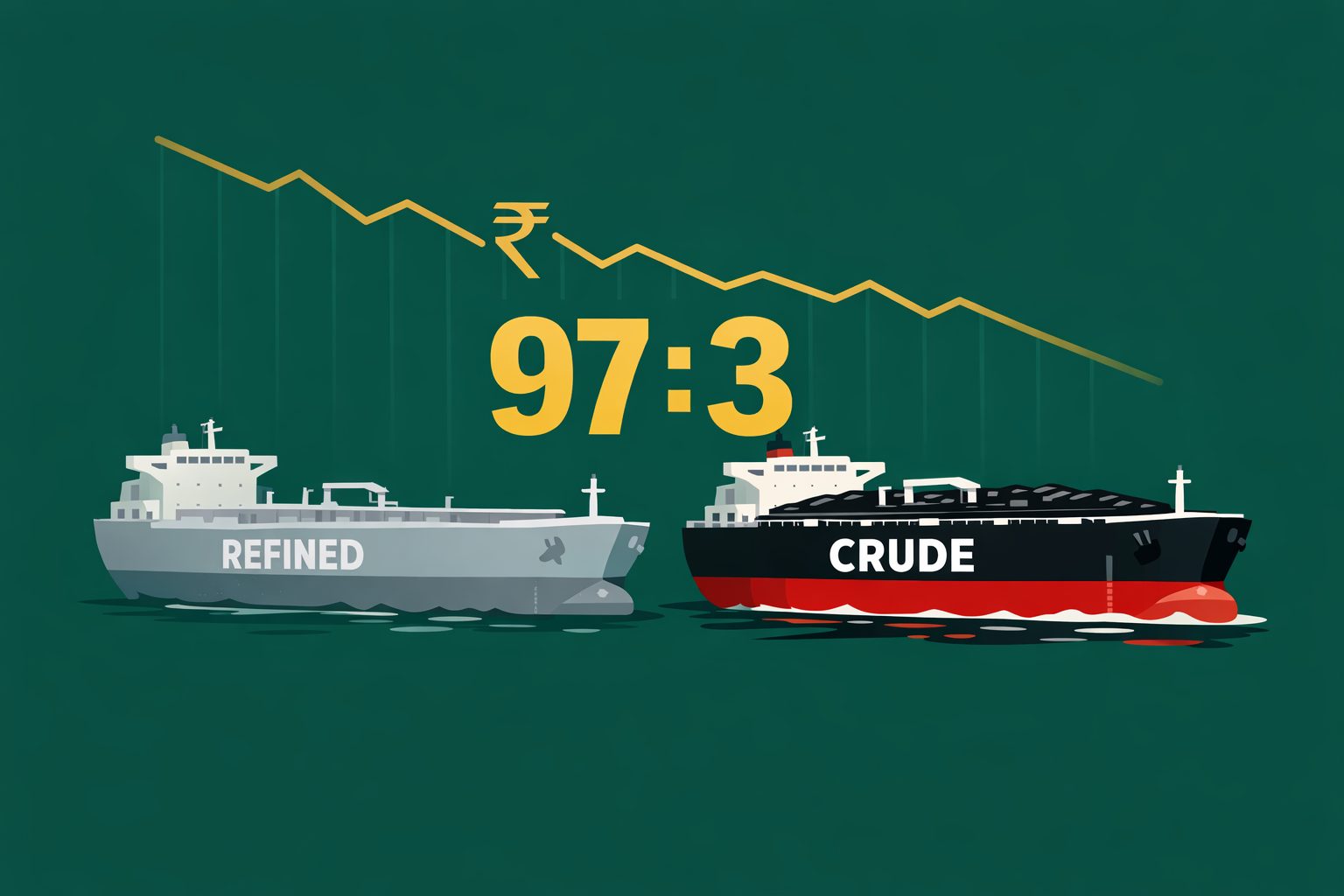
India's aggressive vegetable-oil buying has jammed its own ports. Vessel discharge is running up to ten days late as shore tanks fill and refiners struggle to clear cargo, with at least nine ships carrying around 300,000 tonnes queued at Kandla alone. The reason is not logistics failure. It is that refiners imported for a festival season whose consumption has not materialised, and they are now cutting purchases for October to December shipment.
We have written twice in the past week that Indian buyers were comfortably covered and in a strong position. That reading was half right and half wrong, and the wrong half matters more.
What is actually happening at the ports
Kandla, in Gujarat, is India's largest gateway for edible oil and handles close to a third of national arrivals. It is where the congestion is worst. Haldia, the second-biggest gateway and the main east-coast entry point, is also backed up, though less severely.
The mechanism is straightforward and physical. Shore tanks are full. Oil cannot be discharged into tanks that have no space, so vessels wait. Port-based refineries would normally draw down that storage and create room, but they are not moving product fast enough, because the demand they were buying against has not shown up in the volume expected.
The pricing signal that caused it
This started with a forward curve, not a forecast. Oil for prompt delivery was cheaper than oil for later months. When the front of the curve is discounted in an import-dependent market, the rational move is to pull purchases forward — buy August and September rather than October and November, and take the saving.
Everyone did the rational thing at once. August arrivals came in at 1.54 million tonnes, an eleven-month high, with a similar quantity expected in September. Roughly three million tonnes across two months, arriving into a fixed amount of tank capacity.
The bet embedded in that was straightforward: India celebrates a run of festivals from August to November, edible oil consumption normally peaks across that stretch, and the cover would be drawn down as it came. The first half of that has happened. The second half has not.
Where our earlier read was wrong
On 3 September we characterised the record August imports as refiners restocking hard into the festival window, and on 7 September we described Indian buyers as sitting comfortably with full tanks. Both described the import side accurately. Neither tested the consumption side, and that is where the story actually turned.
Full tanks are an asset when demand arrives on schedule and a liability when it does not. Working capital is tied up in oil that is not moving, storage is unavailable for cargo already contracted and floating, and demurrage accrues on ships that cannot discharge. The same position that looked like strength a week ago now looks like an overhang.
The correction is worth stating plainly because the same logic applies to anyone reading Indian import data as a demand signal. Arrivals measure buying, not consumption. In a month where the curve rewards front-loading, the gap between those two things can get very wide.
What it means for origin markets
The consequence is already in motion: refiners are reducing purchases for October to December shipment. That is expected to lift inventories in Indonesia, Malaysia and Argentina and to weigh on both palm and soyoil futures.
The timing is awkward for palm specifically. Malaysian August stocks are expected to print at a seven-month high on the strongest output in nine months when official data lands this week. Losing Indian demand into that is the least helpful sequence available — a stock build at origin meeting a buying pause at destination.
Two things soften it. Crude is at a six-week high after attacks on Saudi energy facilities, which supports palm's biodiesel economics. And Indonesian domestic absorption continues regardless of what India does, which puts a floor under the physical balance even when export demand stalls.
The read for buyers
For Indian refiners the near-term job is inventory management rather than procurement. The useful question is how quickly festival offtake catches up, because that determines whether this is a two-month digestion or a genuine demand shortfall.
For anyone selling into India, the buying pause is real but its duration is not yet knowable. If consumption picks up through October and November, the deferred purchases return as restocking demand in Q4 and the pause is a timing shift rather than a loss. If it does not, the country enters 2027 with elevated stocks and a structurally lighter import requirement, which is a different and more bearish proposition for origin.
The honest position is that nobody knows yet which of those it is, and the next four to six weeks of Indian offtake data will settle it.
Watch three things: whether the Kandla queue clears or lengthens, whether September arrivals actually come in near the expected 1.54 million tonnes or get deferred at the last minute, and whether the prompt-versus-deferred discount that started this has now closed.
Forward-looking views here are analysis, not investment advice.