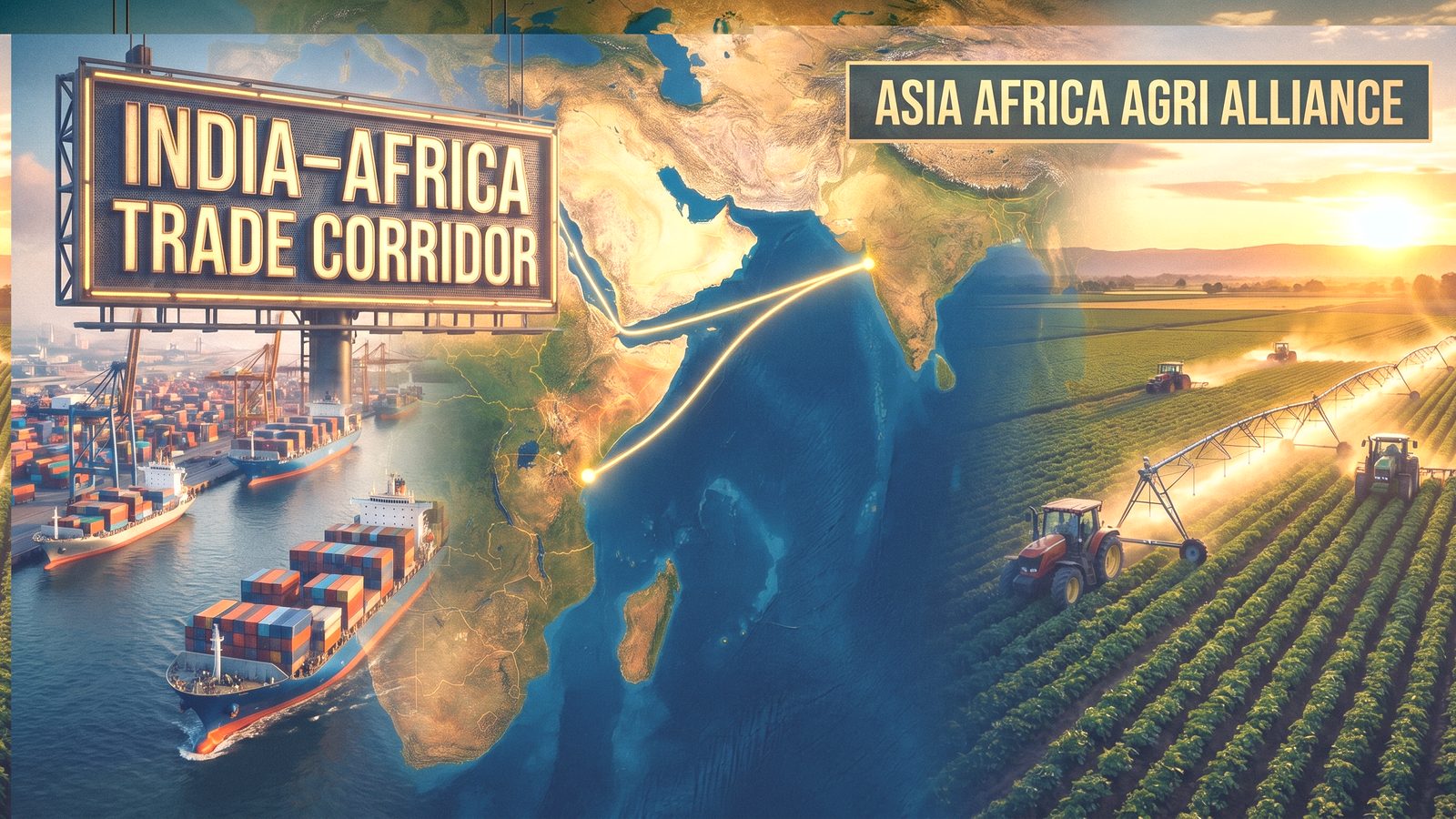
Asia Africa Agri Alliance: The India–Africa Trade Corridor Takes Shape
For three decades, India**'**s edible oil story has been a bilateral conversation with Southeast Asia — Indonesia and Malaysia for palm, Ukraine and Russia for sunflower, South America for soybean. Africa has been largely absent from the picture. That is changing.
The Asia Africa Agri Alliance (AAAA), formally launched in March 2026 as a Section 8 not-for-profit, is the most visible institutional expression of an India-Africa agri-trade conversation that has been quietly building across the value chain. For GLOBOIL India 2026, Africa is no longer a marginal entry on the delegate list — it is a stream of the programme.
The demographic and demand backdrop
Sub-Saharan Africa's population is projected to double by 2050, from roughly 1.1 billion to more than 2 billion. Per-capita edible oil consumption across the continent remains below 15 kg per person annually — roughly half the global average, and a fraction of India's 19 kg. The structural demand runway is unmistakable.
At the same time, African arable land is among the world's most under-utilised. West African countries — Nigeria, Ghana, Côte d'Ivoire — have historically been palm oil producers (Nigeria and Malaysia began as peers in the 1960s), but the continent's palm oil export base remains fragmented. East African countries, particularly Tanzania, have emerging sunflower and rapeseed cultivation.
For Indian trading houses, this creates two complementary opportunities: Africa as an incremental demand market (absorbing production that can't profitably reach saturated Asian markets) and Africa as a secondary supply base (diversifying away from Southeast Asian dependence for palm).
Mahesh Patel's ETG Group — which attended GLOBOIL India 2025 — operates across 30 African countries and is the largest example of this integrated Africa-India trading model.
Who is already there
ETG Group, founded and chaired by Mahesh Patel (a 2025 GLOBOIL speaker), has been the longest-standing visible example of Indian-origin capital operating integrated agri-trade infrastructure across 30 African countries. Olam Agri and Wilmar have significant African plantation and trading assets. SD Guthrie — a 2025 GLOBOIL Event Partner — has Africa-facing trading operations through its Singapore hub.
On the Indian side, companies like Africa & Middle East General Trading LLC (a 2025 GLOBOIL Gold sponsor) represent the second wave — Indian-origin but Africa-headquartered — building trading, distribution, and blending operations across West and East Africa.
Government engagement has also deepened. India's Ministry of External Affairs and the Ministry of Commerce have signed agri-trade MOUs with Tanzania, Kenya, Mozambique, and Senegal since 2023. The India-Africa Forum Summit has reinstated agri-trade as a priority focus area.
What the AAAA launch changes
The Asia Africa Agri Alliance, structured as a Section 8 not-for-profit, positions itself as a commercial and policy bridge rather than a trade organisation or an event body. Its stated agenda focuses on:
-
Commodity intelligence and price discovery infrastructure for India-Africa agri-trade flows
-
Institutional buyer-seller matchmaking across the continent
-
Sustainability and certification alignment (particularly for African palm and oilseed production aiming at EUDR compliance)
-
Capacity building for African agri-business associations engaging with Indian buyers
Kailash Singh (MD, Tefla's) serves as Convenor of the Alliance. The AAAA stream at GLOBOIL India 2026 will feature the first formal commercial plenary of the Alliance alongside African ministerial voices and Indian industry leadership.
The palm-specific story
For palm oil specifically, Africa matters most as a secondary supply base. Nigeria, Côte d'Ivoire, Ghana, and Cameroon produce approximately 4 to 5 million tonnes of palm oil annually combined — still mostly for domestic consumption, but with a growing surplus available for export.
The EUDR compliance dynamic is particularly relevant here. African palm oil, where deforestation mapping is cleaner and supply chains are often simpler, is positioned to command premium pricing in the EU market once the December 2026 enforcement window opens. Indian trading houses positioned to aggregate West African palm and route it to European buyers — with or without an intermediate Indian processing step — are building that play through 2026.
The practical GLOBOIL 2026 implication
Delegates with African trade exposure — or aspirations thereof — have two reasons to plan for GLOBOIL India 2026 differently from prior editions. First, the AAAA plenary provides the first structured commercial engagement opportunity. Second, the speaker and delegate profile has shifted: African trade missions, commodity ministry representatives, and Africa-focused Indian trading houses are attending in greater numbers than in any previous edition.
For Indian buyers, the implication is that supplier diversification conversations that were strategic theory in 2023 are becoming operational reality in 2026. Africa is no longer a future opportunity. It is a present one — and GLOBOIL India 2026 is where those conversations are happening.