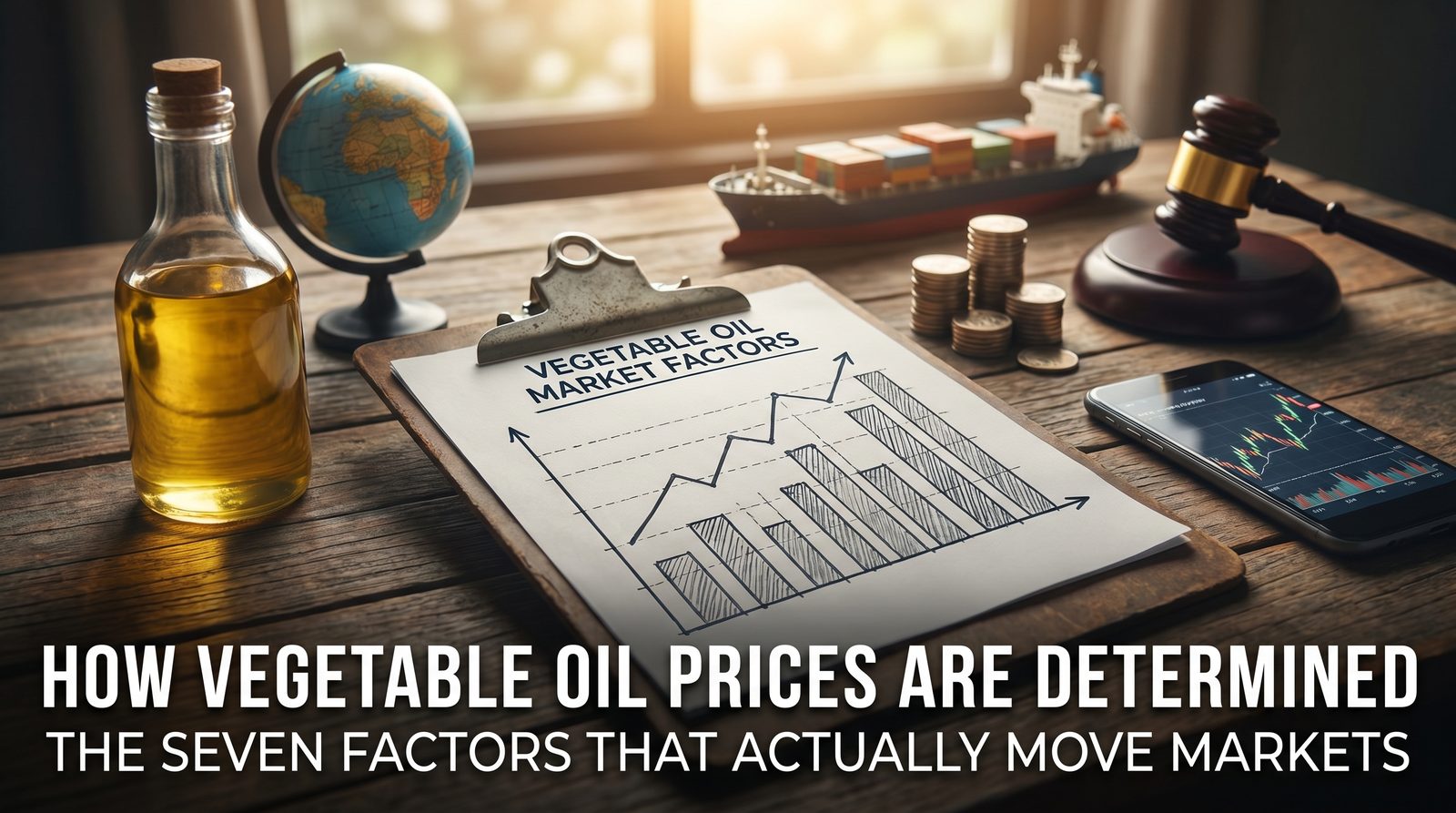
How Vegetable Oil Prices Are Determined: The Seven Factors That Actually Move Markets
When Indian retail edible oil prices change, the drivers are rarely a single factor. They are the combined result of international benchmarks, foreign exchange movements, import duty decisions, shipping costs, taxes, and distribution margins. This guide lays out the full price-formation chain — from producer origin to retail shelf — and how each component behaves.
The five-layer price stack
An Indian retail edible oil price contains five identifiable layers. Using RBD palm olein as an illustrative example:
-
Layer 1: International benchmark price (e.g., CPO Bursa Malaysia + palm olein FOB premium)
-
Layer 2: Shipping and insurance (CIF adjustment)
-
Layer 3: Customs duty (basic customs duty + AIDC + SWS)
-
Layer 4: Domestic GST (5% on most edible oils) + distribution margin
-
Layer 5: Retail margin and packaging
Understanding which layer is moving is the key to understanding any given price action.
Layer 1: International benchmarks
The most-watched international price benchmarks for edible oils are:
Crude palm oil
-
Bursa Malaysia Derivatives CPO futures (FCPOc3)
-
Indonesian KPBN CPO auction prices
-
CIF India palm oil (Rotterdam settlement convention)
Soybean oil
-
CBOT Soybean Oil futures
-
Argentina FOB Rosario premium
-
Brazil FOB Paranaguá premium
Sunflower oil
-
FOB Black Sea (Russia and Ukraine)
-
CIF India sunflower oil
Prices at origin move in response to supply dynamics (harvest size, productivity, weather), demand dynamics (biodiesel mandates, retail consumption, China-buying), and derivative market positioning (speculative flows, ETF rebalancing, fund activity).
Layer 2: Shipping and insurance
Freight costs and marine insurance translate FOB (free on board, origin) prices into CIF (cost, insurance, freight, destination) prices. For palm oil from Indonesia or Malaysia to Indian west coast ports, this typically adds $30 to $60 per tonne depending on vessel availability, fuel costs, and any route disruption. For soy oil from South America and sunflower oil from the Black Sea, CIF costs are higher, reflecting longer transit distances.
Two current factors affecting this layer in 2026: Red Sea disruption (see: 'Cape Routing and the Palm Oil Logistics Equation') and general shipping-industry overcapacity dynamics that are putting downward pressure on container and parcel tanker rates overall.
Layer 3: Customs duty
India's customs duty regime on edible oils is actively managed by the government. As of April 2026:
-
Crude oils (palm, soy, sunflower): Effective duty ~16.5%
-
Refined oils (palm olein, soy, sunflower): Effective duty ~32.5%
The 16-percentage-point differential between crude and refined oils is designed to favour Indian domestic refining. Duty changes are among the most politically active policy levers — India has adjusted edible oil duties at least seven times in the last decade in response to retail inflation and farm-gate oilseed prices.
Layer 4: GST and distribution
Most edible oils attract 5% GST. Distribution margins from port to wholesale and from wholesale to retail add additional cost. Branded, packaged, and value-added edible oils may incur additional cost layers.
Layer 5: Retail margin and packaging
The final 10-20% of retail price is typically retailer margin, packaging cost, and brand premium. This layer varies significantly by brand, SKU, and retail channel (traditional grocery vs organised retail vs e-commerce).
For Indian consumers, a 10% move in the international benchmark translates to roughly a 3-5% move in retail price — the other layers dampen the transmission.
Foreign exchange: the INR-USD lever
India imports edible oils in US dollars. Fluctuations in the INR-USD exchange rate directly affect the cost of imports in rupee terms. A 1% depreciation of the rupee raises import costs by 1%, other things equal.
Through 2025-26, the INR has traded in a range of approximately 83 to 88 to the US dollar. This range is narrower than some periods, reducing forex-driven price volatility but not eliminating it. For Indian refiners and traders, forex hedging is a routine component of procurement planning.
The MSP and domestic oilseed linkage
India's edible oil prices are also influenced — indirectly but meaningfully — by domestic oilseed production and Minimum Support Price (MSP) dynamics. When domestic oilseed production is strong and farm-gate prices are above MSP, policy pressure to maintain high import duties reduces. When production is weak or prices below MSP, duty support tends to stay or rise.
This is why the National Mission on Edible Oils (NMEO-OP and NMEO-OS) progress is so significant for long-term price dynamics. Successful domestic production expansion would reduce the need for high duty walls.
The B50 and biodiesel linkage
Since roughly 2020, global biodiesel mandates have become an increasingly important factor in edible oil price formation. Indonesia's B40 (operating) and B50 (launching July 2026) mandates absorb very significant volumes of palm oil into the domestic energy system. Brazil's B15 absorbs significant soy oil volumes. The US Renewable Fuel Standard absorbs both soy oil and used cooking oil.
For Indian consumers and refiners, the practical implication is that edible oil prices are now substantially linked to energy market dynamics. An oil price shock that increases the incentive for palm oil to be used as biodiesel feedstock can push up palm edible oil prices even if food demand is stable.
How to read an Indian edible oil price move
A practical diagnostic framework when an Indian edible oil price moves:
-
If Bursa Malaysia CPO futures moved in the same direction — it is a supply-side global move.
-
If INR-USD weakened (or strengthened) — it is a forex move.
-
If there was a recent government notification — it is a policy move.
-
If retail prices moved but wholesale did not — it is a distribution or retail margin move.
-
If only packaged/branded prices moved but loose oil did not — it is a packaging or brand move.
Most significant moves involve multiple layers. The skill is weighting each.
Where to follow edible oil price moves
-
Bursa Malaysia Derivatives: www.bursamalaysia.com for CPO futures
-
Solvent Extractors' Association of India: seaofindia.com for industry data
-
Department of Consumer Affairs (Price Monitoring): consumeraffairs.nic.in for retail price tracking
-
Ministry of Commerce DGCIS: for monthly trade statistics
-
Real-time media: Reuters, Bloomberg, Fastmarkets, Palm Oil Magazine
-
Industry forums: GLOBOIL India (annual), GAPKI IPOC (annual)
Further reading
GLOBOIL India 2026's price outlook session — traditionally the most-cited analyst session for Indian and global edible oil price forecasts — is scheduled for 30 September 2026, exactly 90 days after Indonesia's B50 launch. Confirmed speakers include Dorab Mistry (Godrej International), Thomas Mielke (Oil World), and Dr. Julian McGill (Glenauk Economics).