America Stops Exporting Its Soybean Oil, and the World Feels the Pull
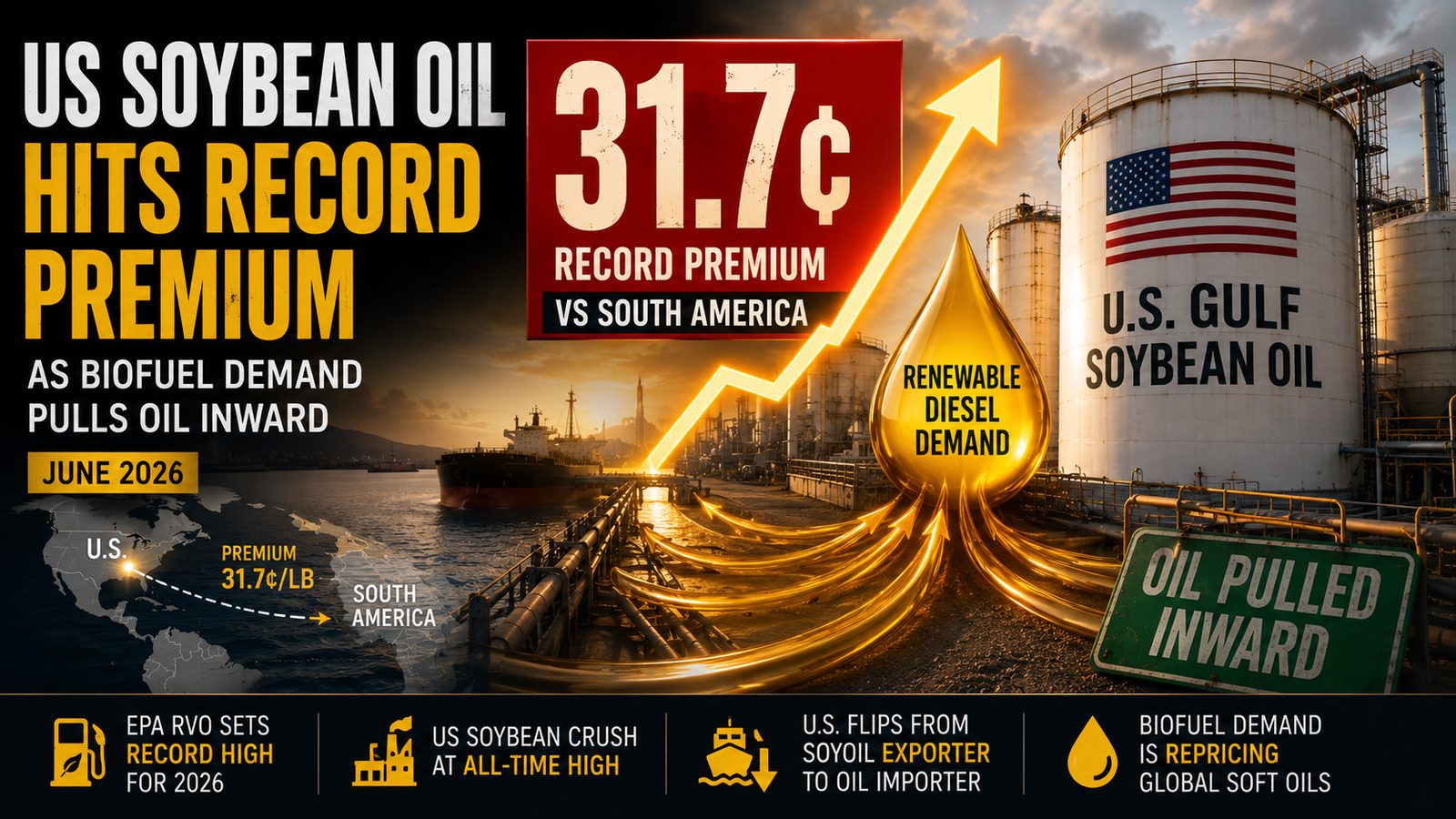
The United States is a major soybean grower, but this year it is behaving like a country that wants to keep its soybean oil at home. A record biofuel mandate has vaulted US soyoil to the highest premium over South American supply in the market's recorded history, and the ripple runs all the way to the Indian coast.
Policy is the driver
The EPA's renewable volume obligations require 5.4 billion gallons of biomass-based diesel for 2026 and 5.7 billion for 2027, a steep lift that turns soybean oil into a feedstock the fuel industry has to secure. Since January, Chicago soyoil futures have climbed roughly 50%, pushing toward 80 cents a pound by early June. When a food oil starts trading like an energy input, its price stops answering to the kitchen.
The record premium
The premium tells the story better than any forecast. In early June the spread between US Gulf soyoil and Argentine supply hit 31.7 cents a pound, a record, and the gap to Brazilian oil out of Paranaguá was nearly as wide. American oil has become the expensive oil, priced to stay home and feed domestic renewable diesel rather than load onto export vessels. US crush ran at record levels to meet that demand, even as US soyoil exports thinned.
The supply twist
On 30 June, the US crop report put soybean planted area at 85.4 million acres, up 5% on the year, with stocks around 1.06 billion bushels. A bigger crop would normally mean more oil for everyone. But if the crusher is running flat out to feed biofuel, much of that extra oil gets absorbed at home before it can reach the world market. More beans do not automatically mean more exportable oil when a mandate sits between the field and the port.
The redrawn map
For importers, the practical effect is a redrawn map. With US soyoil pricing itself out of the export race, buyers lean harder on South America, which pushes Argentine and Brazilian oil and, by extension, firms the whole soft-oil complex that India depends on. It also narrows the cushion the world used to get from American supply when palm or sunflower ran tight.
The bigger lesson
There is a broader lesson in the American premium. Biofuel policy is quietly rewiring which countries export edible oil and which hoard it. The US is the clearest case: a large producer turning inward because its own rules make the domestic fuel outlet more valuable than the export sale. Indonesia is doing the same with palm and B50. Two of the biggest oil producers on the planet are both walling off supply for fuel at the same time.
What to watch
- Whether the record US premium holds or corrects as the new crop comes in
- How fast renewable diesel capacity actually consumes the mandated volumes
- Whether South America can keep filling the export gap without straining its own balance
For a market used to treating the US as a reliable oil exporter, that assumption is the one being rewritten this year.
The convening point
The food-versus-fuel contest over soybean oil is now a global pricing force, and GLOBOIL India 2026 is built to untangle it. The 29th edition takes place 29 September to 1 October at The Westin Mumbai Powai Lake, where traders read US biofuel policy, South American supply and Indian demand side by side.