Four-Year Highs, and a Floor Made of Fuel: Why Edible Oil Prices Stopped Listening to the Dinner Table
Vegetable oil prices spent the first part of 2026 climbing to levels they had not seen in years, and the reasons had less to do with food than with fuel, energy and regulation. The global benchmark for edible oil prices reached its highest point since mid-2022 in April before easing in May, the first monthly dip of the year. The retreat was small. The bigger picture is a market that has found a new floor.
Biofuel: the structural change
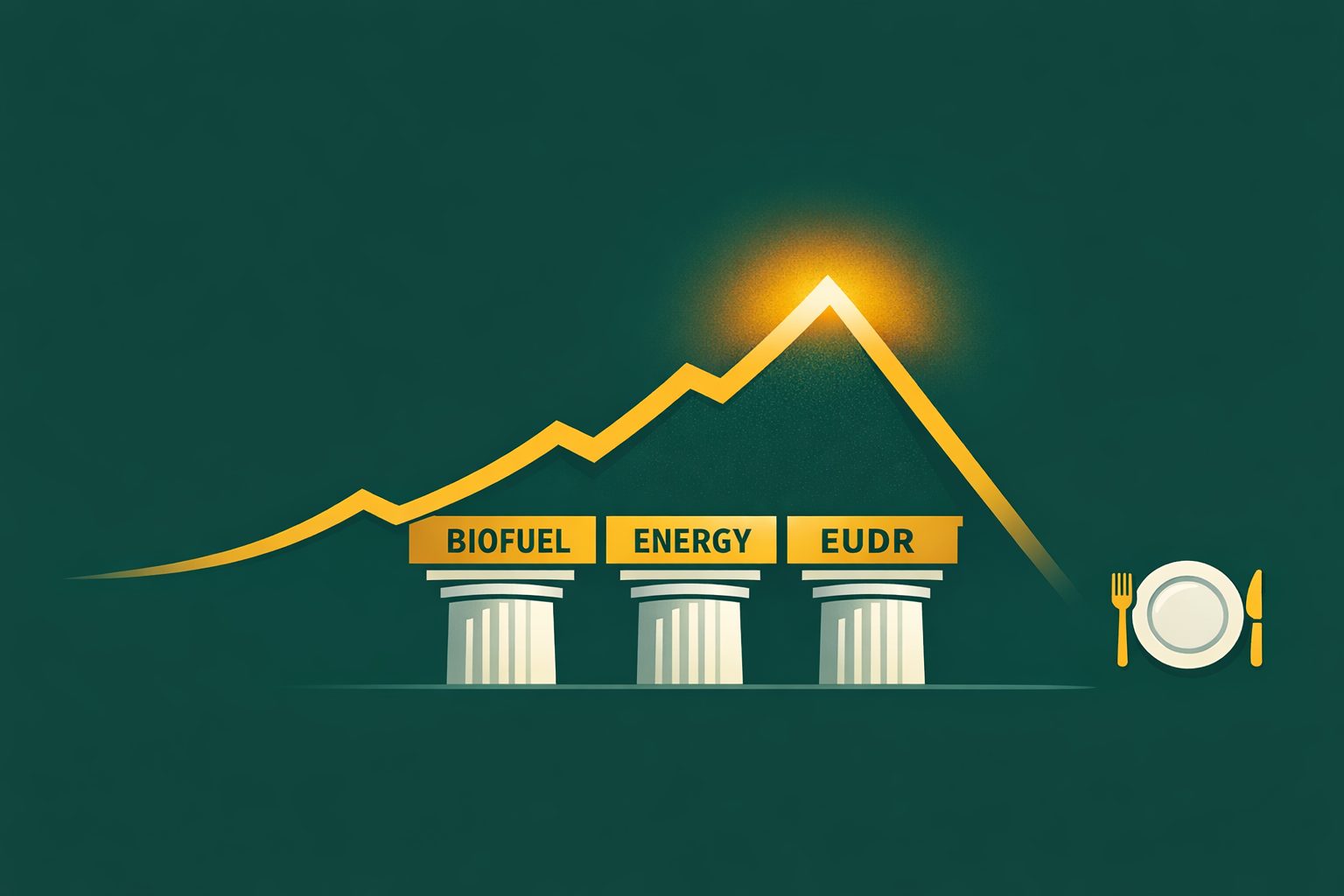
Start with biofuel, because it is the structural change. A widening share of the world's palm, soybean and rapeseed oil is being burned as biodiesel rather than eaten. Indonesia is moving to a 50% palm-biodiesel blend. Brazil keeps lifting its own mandate. These programs convert edible oil into a substitute for diesel, which links its price to crude oil. When fossil fuel is expensive, mandated biofuel demand puts a floor under vegetable oil that food demand alone never did.
Energy makes the link bite
Energy made that link bite this year. An effective closure of the Strait of Hormuz pushed up crude oil, freight and fertiliser costs, and the effects spilled straight into agricultural commodities. Higher diesel prices make biodiesel blending more valuable, which pulls more oil out of the food supply, which lifts the price of what is left. The chain runs from a shipping lane to the cooking-oil shelf in a few steps.
EUDR: the regulation no exporter can ignore
The European Union's deforestation rule, the EUDR, enters force for large operators on 30 December 2026, with smaller firms following in mid-2027. It bars from the EU market any palm or soybean oil grown on land cleared after the end of 2020, and it demands geolocation data to prove it.
Palm and soy account for most of the deforestation tied to European consumption, so the rule lands hardest on exactly the two oils that dominate global trade. Brussels has simplified the paperwork and pushed the dates back more than once, but the direction is fixed: traceable oil sells into Europe, untraceable oil does not.
The old mental model breaks
Put these forces together and the old mental model breaks. Edible oil used to be priced mainly off harvests and food demand, with weather as the swing factor. Now it sits at the intersection of three markets it does not control:
- Energy, which sets the value of the biofuel outlet
- Policy, which decides how much oil gets diverted into fuel
- Compliance, which determines which oil can be sold where
Harvests still matter. They are no longer the whole story.
The practical takeaway for importers
For importers, the practical takeaway is that cheap is getting harder to find. The soft-oil glut out of South America and China pulls one way, while biodiesel mandates and the EUDR pull the other. The May price dip suggests the rally is not a straight line, but the floor underneath it is firmer than it was even two years ago.
What to watch through the rest of 2026
- How high energy prices stay and whether the Hormuz disruption eases
- Whether Indonesia's B50 holds to schedule
- How the first EUDR deadline reshapes which cargoes flow to Europe and which get redirected to price-sensitive buyers in Asia
The dinner table still has a vote. It just no longer has the only one.
The convening point
Energy, mandates and trade rules now move edible oil as much as any harvest, and untangling them is what GLOBOIL India 2026 is built for. The 29th edition runs 29 September to 1 October at The Westin Mumbai Powai Lake, where 2,000-plus decision-makers from 60 countries connect the policy, the price and the flow.