Indonesia Cuts Palm Oil Reference Price as the State Prepares to Seize the Export Gate
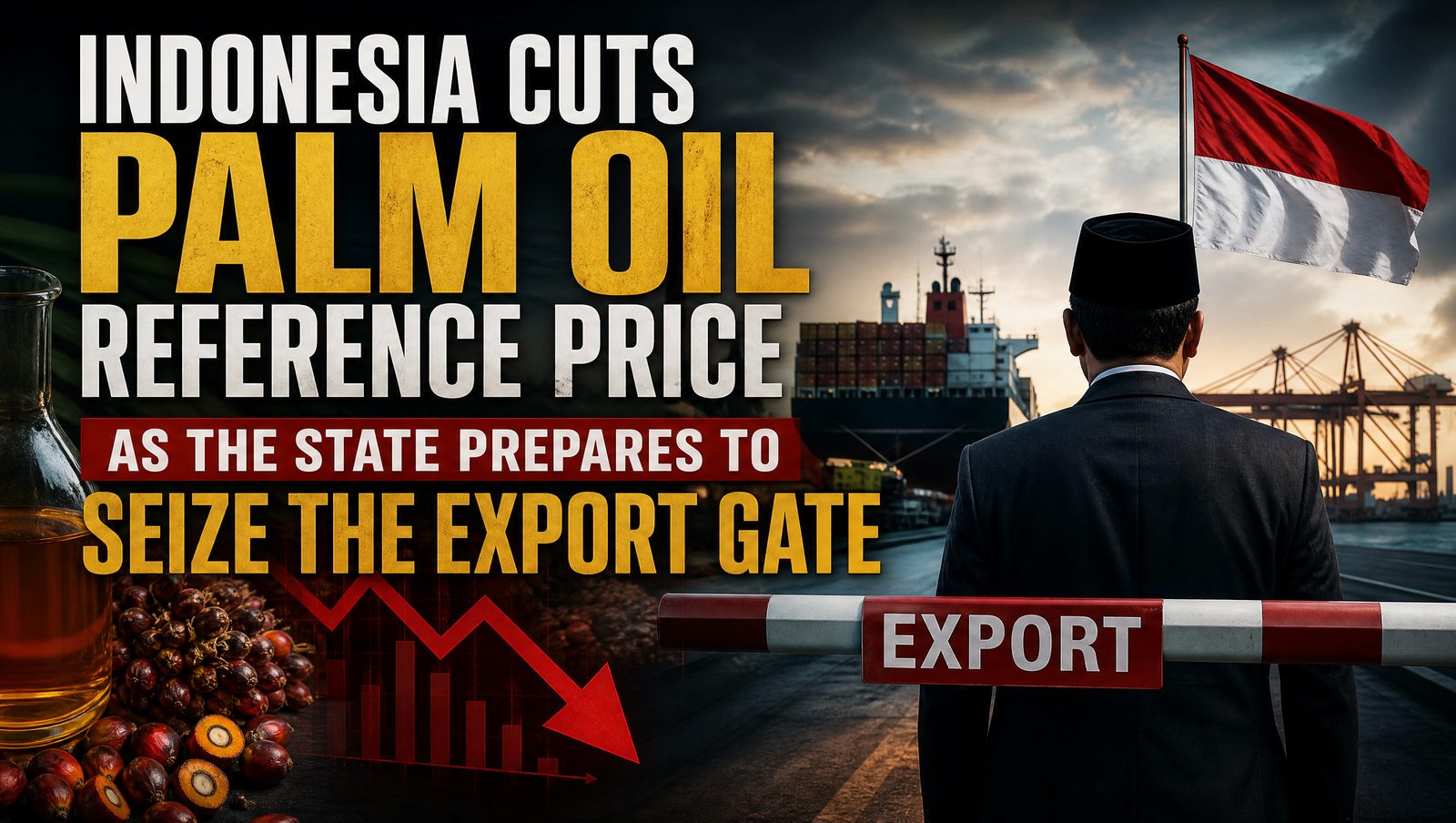
Indonesia cut its reference price for crude palm oil for June, trimming export duties just as the most consequential restructuring of its palm oil trade in a generation begins. The move is small in dollar terms and large in what it signals: the world's biggest palm oil supplier is easing the cost of shipping product abroad at the precise moment it prepares to route every tonne of that product through a single state-controlled gate.
The Trade Ministry set the June CPO reference price at $1,029.51 per tonne, down $20.07, or 1.9%, from May's $1,049.58. The benchmark, recalculated monthly from major exchange prices, determines what exporters pay in duties and levies — so a lower reference mechanically lowers the cost of exporting. The headline export duty falls to $148 per tonne in June from $178 in May. The separate export levy, fixed at 12.5% of the reference price, eases to roughly $128.69 per tonne from $131.20. Packaged palm olein in consumer packs of 25 kilograms or less carries an additional $33-per-tonne levy.
The official explanation was demand, and it pointed directly at one country. "We cut the benchmark price following declining demand from our main importers, such as India," Trade Ministry senior official Tommy Andana said. That single sentence is the whole macro story in miniature: the price of the world's most traded vegetable oil is being set, at the margin, by the buying behaviour of the world's largest importer — and right now India is not buying the way Jakarta needs it to.
The cut is the small story
A 1.9% trim to a reference price is routine. Indonesia recalculates the benchmark every month, and it moves up and down with the market. On its own, the June cut would barely merit a paragraph.
What makes it matter is the timing. June is the month Indonesia's "one-gate" export policy begins its transition — and the reference-price cut reads less like routine maintenance and more like a government smoothing the runway before the most disruptive policy change the sector has faced since the 2022 export ban.
President Prabowo Subianto's plan, announced to parliament on 20 May, is to channel all palm oil exports through a single state-run entity. The country's sovereign wealth fund has established an entirely new body — Danantara Sumberdaya Indonesia, or DSI — to oversee those exports. From Monday, the transition begins: exporters will be required to report their sales to DSI. The agency is scheduled to take over all export functions outright by early 2027.
Set the two events side by side and the logic resolves. A government about to insert a brand-new state intermediary between producers and world markets — an intermediary with no track record, untested systems, and the potential to slow everything down — has every incentive to keep exports flowing freely in the handover period. Cutting the duty burden in June is one way to keep cargoes moving while the machinery of state control is bolted into place.
What "one gate" actually means
Under the current system, roughly 200 licensed exporters compete to sell Indonesian palm oil into the world. Under the one-gate model, all of that funnels through DSI. The state entity becomes the counterparty, the price-setter, the allocator and the revenue collector. Producers and refiners sell into DSI; DSI sells onward to the world.
The official rationale is fiscal sovereignty. Prabowo has repeatedly invoked the figure of $908 billion in tax revenue he claims Indonesia has lost over 34 years to under-invoicing and export manipulation across its natural-resource commodities. Palm oil, routinely under-declared at the port to shift value into offshore accounts, is the first commodity to be brought under state control — with coal and ferroalloys to follow.
The transition is staged rather than instant, which matters. A reporting requirement from June is a soft start; full DSI control by early 2027 is the hard deadline. That gives the market roughly six to eight months to learn whether the new architecture functions smoothly or seizes up — and to price the difference.
The farmers are not convinced
The fault line running under this policy is the same one that ran under it from day one: who actually pays.
POPSI, the Indonesian palm oil farmers' association, has been blunt. Its chairman, Mansuetus Darto, warned that DSI will worsen pressures that have already squeezed growers hard. "Farmers are already dealing with so much pressure," he said. "The lengthy supply chain, coupled with the export duties and levies, has lowered the price of fresh fruit bunches. DSI will only worsen it."
The mechanics behind his complaint are straightforward. Every dollar of export duty and levy is a cost that works its way back down the chain, and at the bottom of that chain sits the smallholder selling fresh fruit bunches — the raw harvested palm — to mills. When the export economics tighten, mills pay less for fruit, and the grower absorbs the squeeze. Inserting a state monopoly into the export function, POPSI fears, adds another margin-taking layer between the farmer and the world price, with no guarantee that the farmer sees any of the efficiency the government promises.
Roughly 40% of Indonesia's planted palm area is held by smallholders. A policy that visibly disadvantages that constituency carries real political friction, regardless of how cleanly it is announced in parliament.
What it means for buyers
For India — the buyer Jakarta named explicitly — the June cut offers marginal relief on landed cost at a moment when Indian demand is already soft, port stocks are high and refiners have been substituting toward other oils. A $30-per-tonne reduction in duty does not, on its own, reverse that. It nudges the arbitrage; it does not reset it.
The larger question for every importer is the one DSI raises and does not yet answer: what does buying Indonesian palm oil look like in 2027, when there is exactly one seller? A single state counterparty can offer standardised terms and cleaner documentation. It can also concentrate risk, reduce flexibility, and remove the competitive tension between exporters that buyers have relied on for decades to sharpen pricing. Until DSI demonstrates how it will operate in practice, importers are negotiating with a question mark.
For now, the signal to read is the juxtaposition itself. Indonesia is making it cheaper to export in the same month it begins taking control of exports. The price cut keeps the cargoes moving; the one-gate policy decides who controls them next. The first is routine. The second reshapes the market.
What to watch
- The DSI transition mechanics from Monday — how the reporting requirement works in practice, and whether it slows physical shipments
- July's reference price — whether the June cut was a one-off demand adjustment or the start of a softening trend
- Indian buying through June — the demand variable Jakarta is explicitly tracking; SEA's monthly data is the tell
- Fresh fruit bunch prices at the farm gate — the clearest read on whether POPSI's warning is materialising
- Any clarification on DSI's pricing and allocation model — the single biggest unknown for global buyers planning 2027 procurement
The convening point
The structural questions raised here — state control of palm oil exports, the duty burden on smallholders, and what single-gate procurement means for importers — will be live on the agenda at GLOBOIL India 2026, 29 September – 1 October, The Westin Mumbai Powai Lake. Senior representatives from CPOPC, MPOC, the Indonesian palm sector, SEA of India and India's major refiners will share the stage in the producer-country and policy tracks.
Editorial analysis by the GLOBOIL Intelligence Desk. Reference-price, duty and levy figures and official quotes as reported by Jakarta Globe (30 May 2026); policy context on the one-gate transition and DSI per Indonesian government announcements through May 2026. Not investment advice.