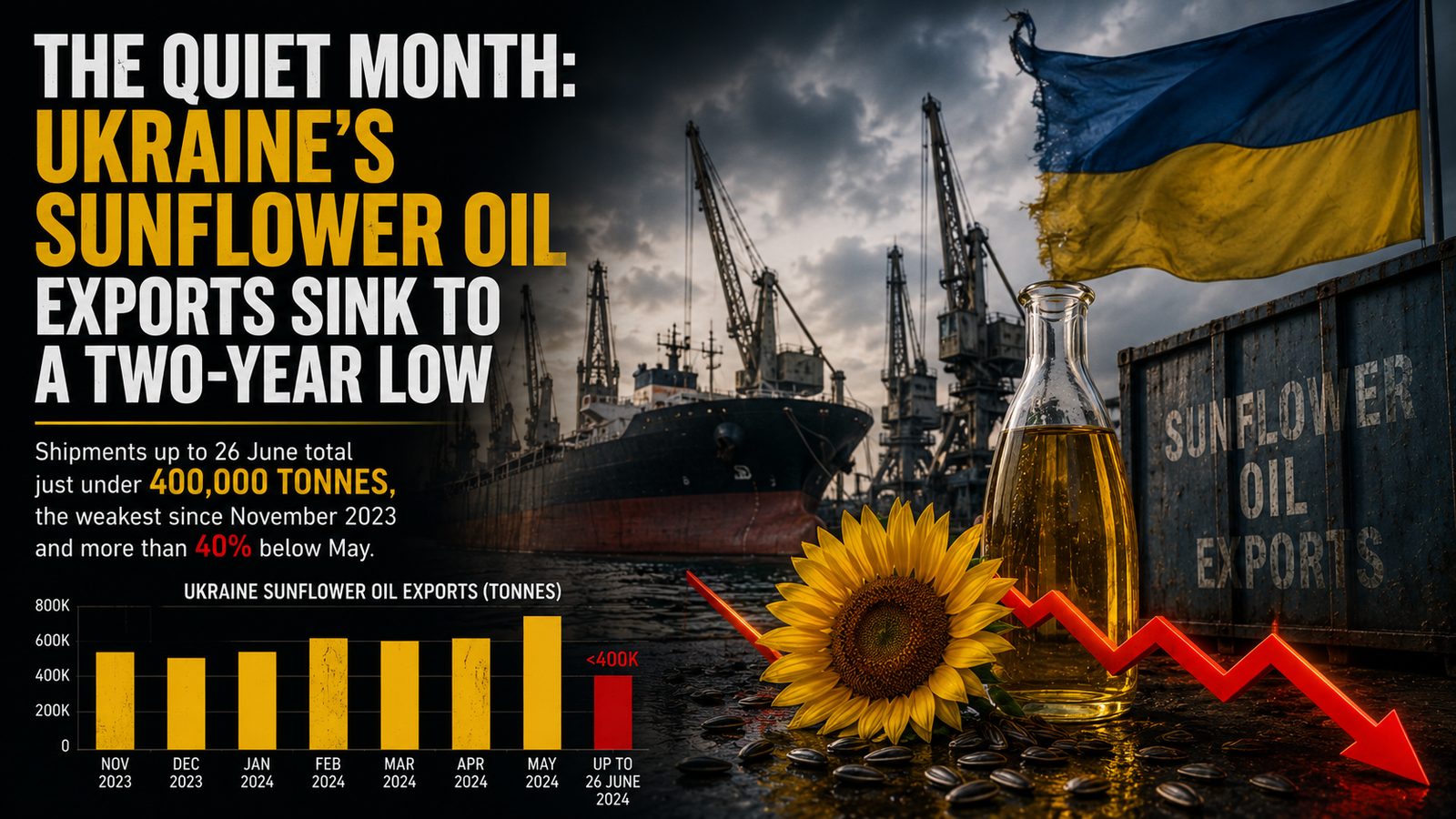
The Quiet Month: Ukraine's Sunflower Oil Exports Sink to a Two-Year Low
Ukraine's sunflower oil is barely moving. Exports up to 26 June totalled just under 400,000 tonnes, which puts the month on track to be the weakest since November 2023 and more than 40% below May, when shipments topped 714,000 tonnes. For an oil that Ukraine has dominated for a decade, a month this quiet is a signal, not a blip.
Physical, not commercial
The cause is physical, not commercial. Around a quarter of the Black Sea region's sunflower crushing capacity is idle, and most of that idled capacity sits in Ukraine, knocked out by damage to processing plants and port infrastructure, power outages and the ordinary risk of operating near a war. You cannot ship oil you cannot crush, and you cannot crush seed when the plant has no power and the berth is unsafe.
The market map shifts
Ukraine still leads global sunflower oil exports at around a third of world supply, with Russia close behind near 30%. But buyers who need reliable delivery are drifting toward Russian cargoes, which have moved more smoothly this season, while European importers — tied by habit and logistics to Ukrainian oil — absorb the volatility. India and Turkey, the price-sensitive giants, have both leaned toward Russian supply.
The counterintuitive tape
Here is the counterintuitive part. Even with Ukrainian volumes collapsing, Black Sea sunflower oil prices softened into late June rather than spiking. The wider vegetable oil complex was heavy, with palm and soyoil under pressure, and sunflower could not hold a premium against falling competitors. Thin supply usually lifts prices, but when every neighbouring oil is sliding, a small market gets dragged along. It is a reminder that sunflower does not price in isolation; it trades in the shadow of palm and soy.
The India read
Sunflower makes up roughly a fifth of India's edible oil basket, and Russia now supplies the bulk of it. When Ukrainian supply seizes up, India's buyers rotate toward Russian oil or lean back on palm and soybean, whichever prices best that week. The flexibility is there, but it comes with a cost: a staple oil has become a swing supply that can shrink 40% in a month on factors no buyer controls.
Structural, not seasonal
The deeper worry is that this is structural, not seasonal. Idle plants and damaged ports take months or years to rebuild, and lenders and insurers price Black Sea risk long after any lull in the fighting. Even a calmer stretch would not instantly restore the capacity now sitting dark. The market that treated sunflower oil as the dependable cheap option is learning to treat it as the one that can vanish on a headline.
What to watch
- The new-season harvest and how much seed reaches working crushers
- Whether Russia keeps gaining share as the steadier supplier
- Whether the broader oils complex firms enough to let thin sunflower supply finally show up in price
Until the region stabilises, expect more quiet months like June.
The convening point
When one origin can swing global supply in a single month, buyers need the room where that risk gets priced. GLOBOIL India 2026, the 29th edition, runs 29 September to 1 October at The Westin Mumbai Powai Lake, connecting the analysts who track Black Sea flows with the Indian importers who feel them first.