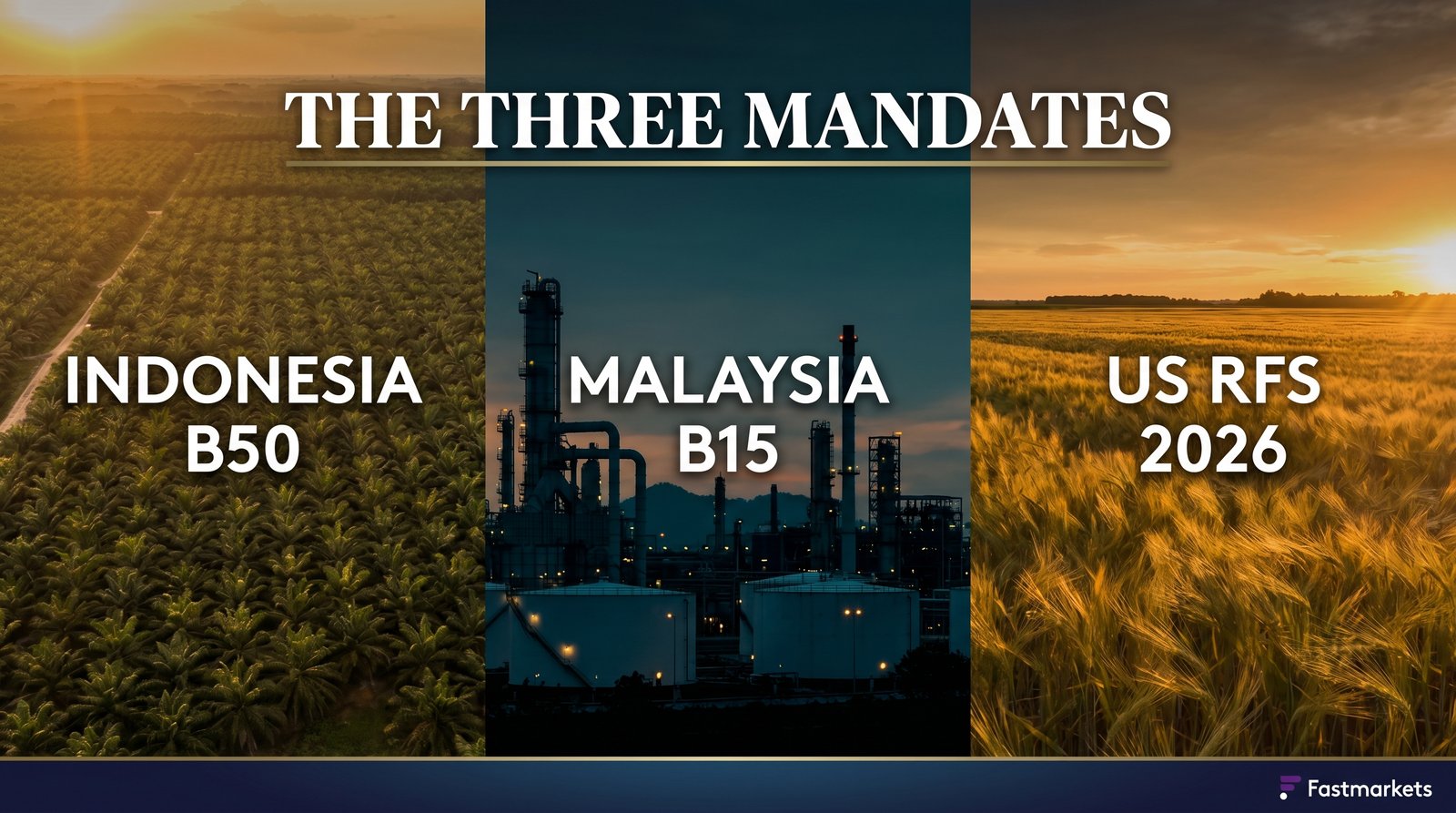
The Three Mandates: How 30 Days Reshape Global Vegetable Oils
Between 1 June and 1 July 2026 — a single 30-day window — three biofuel mandates will land simultaneously across the United States, Malaysia and Indonesia. Each was negotiated separately. Each was justified on different national grounds. Each carries its own implementation timeline and political logic. But the cumulative effect on global vegetable oil markets is now unambiguous: approximately 4 to 4.5 million tonnes of oil will be pulled out of the food economy and into the fuel economy in the second half of 2026 — against global vegetable oil production growth forecast at just 4 million tonnes for the full marketing year. The math leaves nothing on the table for residual food demand growth, and the price tape has begun to register it.
This is the most consequential 30-day window for edible oil markets since the 2022 Black Sea disruption. And unlike 2022, this one is not a shock — it is a policy convergence that has been telegraphed in advance, and that the market is still in the process of pricing.
Mandate one: Malaysia's B15 from 1 June
Starting 1 June 2026, Malaysia raises its biodiesel blend from B10 to B15. The Plantation and Commodities Ministry confirmed the timeline last month, with phased rollout beginning at B12 and scaling to B15 through the year. The Malaysian Palm Oil Council estimates the move absorbs an additional 300,000 tonnes of palm oil annually within Malaysia, primarily by removing exportable surplus.
The strategic rationale is energy security. Malaysia imports a meaningful share of its fossil diesel; B15 reduces that import dependency while raising domestic palm consumption. Crude palm oil reference pricing was raised in early April, lifting the export duty to 10% — a complementary measure that further constrains export supply.
The numbers are small in global terms. The signal is not. Malaysia is the world's second-largest producer, and after three consecutive years of production capped near 19.6–20 million tonnes by ageing trees and labour constraints, removing even 300,000 tonnes of exportable surplus tightens an already constrained market.
Mandate two: Indonesia's B50 from 1 July
Indonesia's B50 announcement on 6 May 2026 is the centrepiece of the policy stack. The biodiesel blending requirement rises from B40 to B50 effective 1 July, raising the mandatory palm-based diesel content to 50% of national diesel volumes.
The arithmetic is what matters. Under B40, approximately 23% of Indonesian crude palm oil output — roughly 12 million tonnes annually — flows into biodiesel production. Under B50, that share rises to 41%, or roughly 21 million tonnes of palm absorbed domestically. The incremental palm oil pulled out of export markets versus the B40 baseline is approximately 3 million tonnes annually.
Three million tonnes is not a marginal number. It represents:
- Roughly 18% of Malaysia's total annual production
- Roughly 30% of India's annual palm oil import requirement
- Approximately 3.7% of global vegetable oil production
The mandate is materially supply-tightening at a scale that cannot be offset by South American soybean substitution alone. And the economics now favour Indonesia carrying through. Brent crude at $114–126/bbl has narrowed the POGO spread (palm oil minus gasoil) to its tightest level in over three years, making B50 fiscally sustainable for the BPDP subsidy fund for the first time since the mandate was first announced.
The execution risk that historically dogged Indonesian biofuel announcements — subsidy budget gaps, refinery scale-up lag, political pushback from food-cost-sensitive constituencies — has not vanished. But it is significantly reduced compared to the deferral phase of late 2025 and early 2026.
Mandate three: US EPA's Set 2 already activated
The US Environmental Protection Agency finalised its Renewable Fuel Standard "Set 2" rule on 27 March, establishing Renewable Volume Obligations for 2026 and 2027 at levels that materially exceed industry expectations. The biomass-based diesel requirement is 5.61 billion US gallons in 2026 (a 67% increase YoY) and 5.86 billion in 2027 (a 75% increase). EPA's own estimates project a 60% rise in biodiesel and renewable diesel production versus 2025 baseline.
The market response was immediate. CBOT soybean oil futures rallied to multi-year highs. D4 biomass-diesel RIN credits traded as high as 117.75¢. Mistry himself, speaking last week, observed that the US announcement "has, as expected, lit a fuse under soybean oil futures."
The implication for the vegetable oil complex is structural. Soybean oil and palm oil have historically traded at a calibrated discount-premium relationship, with palm typically trading at a discount to soy to reflect lower-quality applications. The US biodiesel mandate has pulled soybean oil higher; palm oil is being pulled up alongside as substitution at the margin restores the spread. US renewable diesel and SAF (sustainable aviation fuel) demand will absorb approximately 6.5–7 million tonnes of soybean oil equivalent in 2026, up from 5.8 million in 2025. That additional ~1 million tonnes of soybean oil pulled into fuel cascades through the global complex.
The cumulative arithmetic
Stack the three mandates and the total incremental vegetable oil demand for fuel in H2 2026 versus first-half baselines breaks down approximately as follows:
- Malaysia B15 (effective 1 June 2026): ~300,000 MT palm oil
- Indonesia B50 (effective 1 July 2026): ~3,000,000 MT palm oil
- US EPA RFS Set 2 (already active in 2026): ~1,000,000 MT soybean oil incremental
- Total: ~4.3 million MT
Against this, global vegetable oil supply is forecast to grow by approximately 4 million tonnes for the 2025/26 marketing year. Consumption growth from food markets — China, India, Africa, Southeast Asia — is forecast at roughly 3 million tonnes. The biofuel demand growth therefore claims more than the entire incremental supply for the year, with the food market expected to absorb the resulting tightness through price.
This is the structural deficit case in its cleanest form. It has been telegraphed in advance. The policy stack is now formal. The mechanism — biofuel mandates as the marginal price-setter for vegetable oils — has been validated through three converging announcements rather than one.
The crude oil dependency
Every assumption above rests on a single variable: Brent crude oil holding above approximately $90/bbl. The biofuel mandate economics are crude-price-elastic in a non-linear way. At $114 crude, palm biodiesel is competitive with fossil diesel in many jurisdictions without subsidy. At $75 crude, every mandate becomes fiscally expensive, politically vulnerable and economically marginal.
President Trump's mid-May signal of potential diplomatic framework discussions with Iran is therefore the single most important variable to watch for the next 60 days. A genuine de-escalation that pushes Brent below $90 within 30 days would:
- Widen the POGO spread, weakening palm biodiesel economics
- Increase the fiscal cost of subsidising Indonesia's B50, raising slippage risk
- Reduce the urgency behind Malaysia's B15 phase-up timing
- Compress the soybean oil rally as the US biodiesel premium fades
A retracement to MYR 4,200–4,300 in BMD CPO would be plausible within 30–45 days under that scenario. The current price level reflects a market that has assigned material probability to the Iran tensions persisting.
The receiving markets
The three mandates redirect vegetable oil flows out of global trade and into domestic biofuel production. Which import markets absorb the resulting price pressure first?
India is the structural variable. As the world's largest vegetable oil importer (approximately 16 million tonnes annually, of which roughly 9 million tonnes is palm oil), Indian demand response sets the global clearing price. April 2026 saw Indian palm oil imports fall to a 12-month low — a complicated signal driven partly by the LPG-driven HORECA demand shock, partly by elevated prices, and partly by domestic substitution to soft oils. SEA of India's May data, due in mid-June, becomes the critical confirmation point. If India returns to the market in June and July, the bullish supply structure prevails. If demand stays soft, the price ceiling holds lower.
China, Pakistan, Egypt and Nigeria absorb residual flows. None has the scale to move the global price meaningfully on its own, but cumulative response across the 50%+ of palm imports going to non-Indian destinations matters.
The EU is the most insulated. Rapeseed oil dominates the cooking oil basket, and EUDR enforcement from 30 December 2026 will further reshape palm import flows into the bloc. Europe is now a slow buyer at the margin rather than a swing demand source.
What this means for pricing
The price translation through H2 2026 depends on three scenarios:
Scenario A — All three mandates execute cleanly, Brent holds above $100. BMD CPO targets MYR 5,000–5,200 by mid-July, holding above MYR 4,800 through September. CBOT soybean oil holds at multi-year highs. Indian retail edible oil inflation runs 8–15% through H2.
Scenario B — Partial mandate slippage, Brent at $90–100. BMD CPO consolidates in MYR 4,400–4,700. Soybean oil drifts lower. Indian inflation runs 4–8%. The bullish case is partially priced but not fully realised.
Scenario C — Iran de-escalation, Brent below $90. BMD CPO retraces to MYR 4,200–4,400. Mandate enforcement softens. Soybean oil retreats. Indian inflation moderates. The market spends Q3 unwinding the speculative premium.
The base case, weighted by current data, is Scenario A with material probability of Scenario B. Scenario C remains the binary downside.
What to watch through July
- MPOB monthly data, 10 June — will reveal whether Malaysian stocks extended their fourth-consecutive-month drawdown
- SEA of India May data, mid-June — confirms Indian demand response
- Indonesia BPDP subsidy disbursements through June — leading indicator of B50 execution capacity
- Brent weekly closes around US-Iran diplomatic news — the single most important price variable
- CBOT soybean oil open interest — institutional positioning leading indicator
The convening point
GLOBOIL India 2026 lands at The Westin Mumbai Powai Lake from 29 September to 1 October — 90 days after the Indonesian B50 mandate activates, 120 days after Malaysian B15, and at the precise inflection where the H2 2026 market structure becomes fully visible. The conference theme — "At the Inflection Point: Energy, Sustainability & India's Demand Future" — was set six months ago. The market has now caught up to it.
Dorab Mistry's price outlook, Thomas Mielke's Oil World forecast, and the analyst panels with Glenauk Economics, CPOPC, MPOC, SEA of India, USSEC, CME Group and Fastmarkets will set the framework for the rest of the year. Every procurement, trading and risk management desk modelling H2 2026 needs to be in the room.
The three mandates have done their work. What comes next is price discovery — and that conversation happens in Mumbai.
Editorial analysis by the GLOBOIL Intelligence Desk based on EPA, MPOB, MPOC, USDA and policy announcement data through 12 May 2026. Not investment advice.