Reading Malaysia: The April MPOB Data and What B15 Really Signals
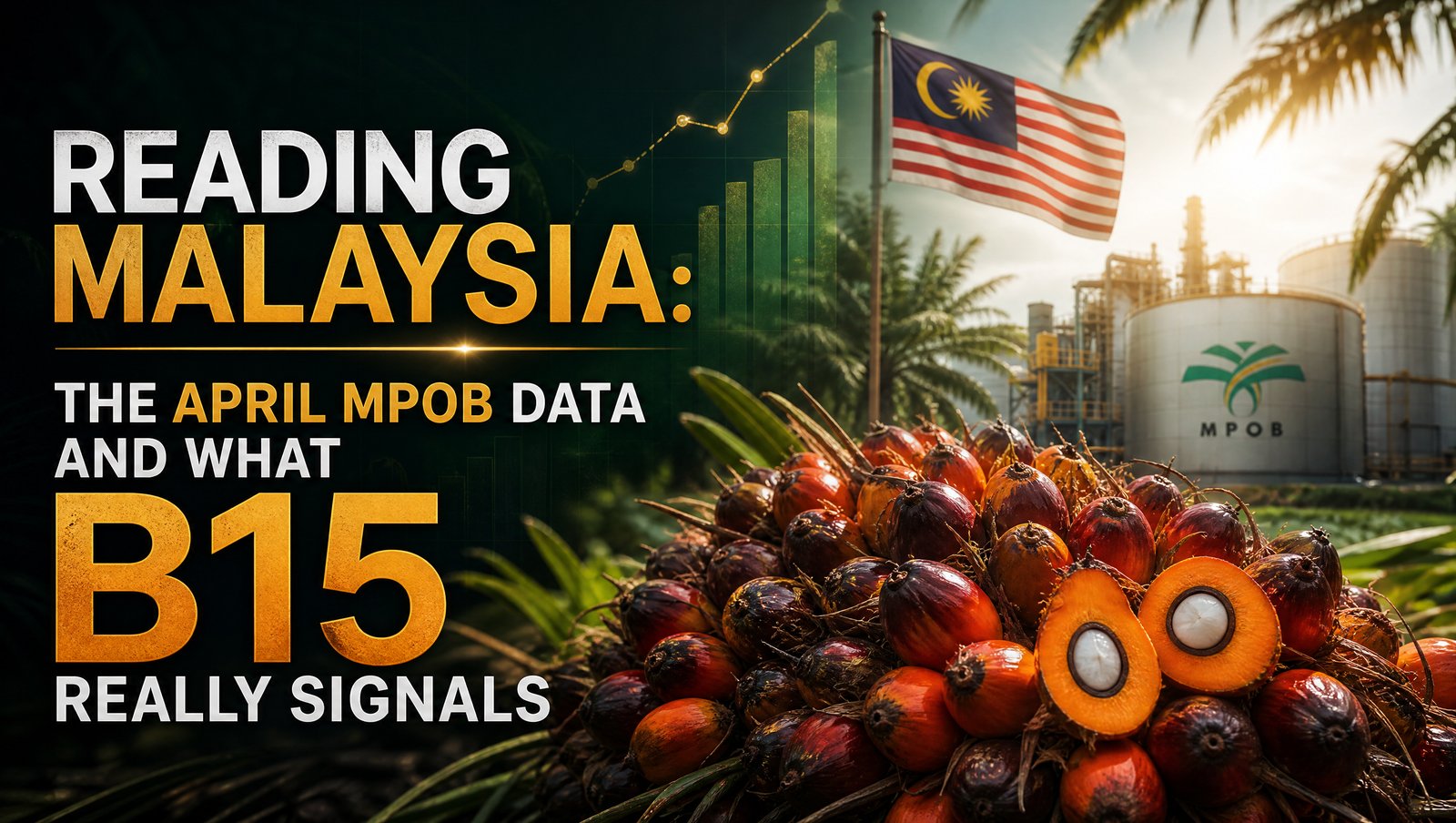
Malaysia's April 2026 industry performance report from the Malaysian Palm Oil Board, released on 11 May, broke a four-month pattern. After consecutive monthly declines from December 2025 through March 2026, palm oil stocks rose. Production surged sharply. Exports softened. Biodiesel exports tripled. Each data point matters, but the combination tells a single coherent story: Malaysia is repositioning the structure of its palm oil economy in preparation for the 1 June 2026 activation of the B15 biodiesel mandate — and the structural implications extend well beyond the headline numbers.
The data, decoded
Headline figures from the MPOB April 2026 release:
- Total palm oil stocks: 2.30 million tonnes (up 1.71% MoM, up 38,900 tonnes from March)
- CPO stocks: 1.26 million tonnes (up 0.54%, up 6,844 tonnes)
- Processed palm oil stocks: 1.04 million tonnes (up 3.16%)
- CPO production: 1.63 million tonnes (up 18.37% MoM, an increase of 252,952 tonnes)
- Palm kernel output: 390,124 tonnes (up 19.92%)
- Crude palm kernel oil production: 192,268 tonnes (up 18.59%)
- Palm oil exports: 1.30 million tonnes (down 14.34% MoM)
- Biodiesel exports: 37,825 tonnes (up 193.04% MoM, from 12,908 tonnes)
- Oleochemical exports: 310,510 tonnes (up 23.83%)
- CPO imports: zero
Three signals from the data
Signal one: Production is recovering structurally. The 18.37% month-on-month surge in CPO production — adding 252,952 tonnes from March's level — confirms that Malaysian palm oil production is back into structural growth after Q1 weakness. The Q1 weakness had been attributed to tree-resting cycles following strong October and November 2025 yields and post-Eid harvesting disruption. April's recovery validates that the underlying production capacity remains intact, supported by adequate labour availability and improved fertiliser application.
This matters for the H2 2026 supply picture. Earlier projections from major analysts had pencilled in Malaysian 2026 output at roughly 19.6 million tonnes — a 400,000-tonne reduction from 2025's record-near 20 million tonnes. If April's production strength extends through Q2 and into Q3, the full-year output could surprise to the upside, modestly softening the structural tightness narrative.
Signal two: Export weakness is real, not temporary. Malaysian palm oil exports fell 14.34% month-on-month in April. The pattern continued into early May — cargo surveyor data showed Malaysian palm product exports during the 1–20 May period falling between 13.9% and 20.5% versus the comparable April window. This is not noise. This is two consecutive months of materially weaker outbound demand.
The drivers are clear: Indian buyers slowed near-term purchases following the H1 import surge (inventory rebuild complete, awaiting price clarity, palm trading at a premium to soft oils); Chinese demand has been structurally soft through 2026; and elevated price levels in March and April caused price-sensitive markets to delay purchases.
None of these are durable bearish signals on their own. Combined, they explain the export softness and suggest a measured recovery as buyers return in late May and June, particularly if Bursa CPO continues to soften from the Indonesian export reform sell-off.
Signal three: Biodiesel exports tripling is the most important signal nobody is talking about. Malaysian biodiesel exports surged 193.04% in April — from 12,908 tonnes in March to 37,825 tonnes. In absolute terms this remains small, but the directional signal is consequential. With the B15 domestic biodiesel mandate taking effect 1 June 2026, Malaysia is positioning itself as both a domestic biodiesel consumer and an emerging biodiesel exporter, particularly to markets in Africa, the Middle East, and Southeast Asia where regional biodiesel mandates are accelerating.
The strategic implication: Malaysia is not simply absorbing more domestic palm oil into B15. It is building out integrated biodiesel manufacturing capacity that creates a second-derivative export business for the palm oil industry — selling refined biodiesel rather than only refined or crude palm oil. This is a structural margin upgrade and a competitive differentiation versus Indonesia's mandate-focused but export-restricted approach.
What B15 actually does
The Malaysian B15 mandate, effective 1 June 2026, raises the mandatory biodiesel blending requirement from B10 to B15. Initial rollout will phase through B12 before reaching full B15 within the calendar year. The Malaysian Palm Oil Council estimates B15 absorbs approximately 300,000 tonnes of additional palm oil annually within Malaysia.
With elevated crude oil prices supporting biodiesel economics — and the B20 conversation now active at the policy level — there is upside optionality for higher absorption rates through 2027. The April biodiesel export surge suggests Malaysian refiners have been pre-positioning capacity ahead of the B15 activation date. Expect biodiesel exports to remain elevated through June and July, with the domestic B15 absorption building gradually from July onward.
The comparison that matters: Malaysia vs Indonesia
Malaysia and Indonesia are now operating in fundamentally different policy frameworks for the first time in over a decade.
Indonesia is restructuring its export trade architecture under the single-gate framework announced 20 May, maintaining B40 through end-2026 with B50 deferred (though some industry sources continue to expect B50 activation in H2), and operating under elevated CPO export levies at 12.5%. The combined effect is heightened export uncertainty, reduced commercial flexibility, and elevated counterparty risk for global buyers.
Malaysia is operating under a conventional market-based export structure, with no announced changes to commercial trade architecture. CPO export duty was raised to 10% for May 2026 (from prior 9%) following the higher reference price — a routine adjustment, not a structural change. The B15 biodiesel implementation is gradual and well-telegraphed. The combined effect is procurement predictability, commercial flexibility, and Malaysian gaining premium positioning in the buyer mindshare.
Through Q3 and Q4 2026, expect Malaysian palm oil export market share to gain meaningfully versus Indonesia, particularly in price-sensitive markets like India, Pakistan, Bangladesh, and East Africa where procurement teams will be hedging Indonesian policy uncertainty by diversifying toward Malaysian sourcing.
What to watch in May–July
- Malaysia MPOB May 2026 data, due 10 June — production sustainability, stock direction, export recovery
- Malaysian B15 implementation reports from 1 June onward — domestic palm oil absorption tracking
- Malaysian biodiesel export volume data — second-derivative growth
- Malaysia-India palm oil trade volume data — market share capture from Indonesia
- CPO reference price and export duty adjustments — pricing transmission
- Plantation and Commodities Ministry commentary on B20 — any signal of further mandate upgrades
The convening point
GLOBOIL India 2026 at The Westin Mumbai Powai Lake from 29 September to 1 October will host senior representatives from MPOC, MPOB, GAPKI, the Malaysian and Indonesian Ministries of Plantation and Commodities, alongside Malaysian palm oil majors. With the production-export-mandate triangulation now in active reshaping mode, the panel discussions in Mumbai will set the framework for global procurement teams to navigate H2 2026 and into 2027.
Dorab Mistry's annual outlook and Thomas Mielke's Oil World forecast will integrate Malaysian production data into their broader vegetable oil pricing models. For procurement, trading, and risk management teams, the Malaysian repositioning story is one of the most important to understand before pricing forward contracts through year-end.
Malaysia is quietly reshaping its position in the global palm oil hierarchy. Production is recovering, biodiesel exports are tripling, market share is being captured. The numbers from one MPOB release tell the whole story.
Editorial analysis by the GLOBOIL Intelligence Desk based on MPOB April 2026 industry performance report (11 May), cargo surveyor data, MPOC commentary, and government export-duty notices through 25 May 2026. Not investment advice.