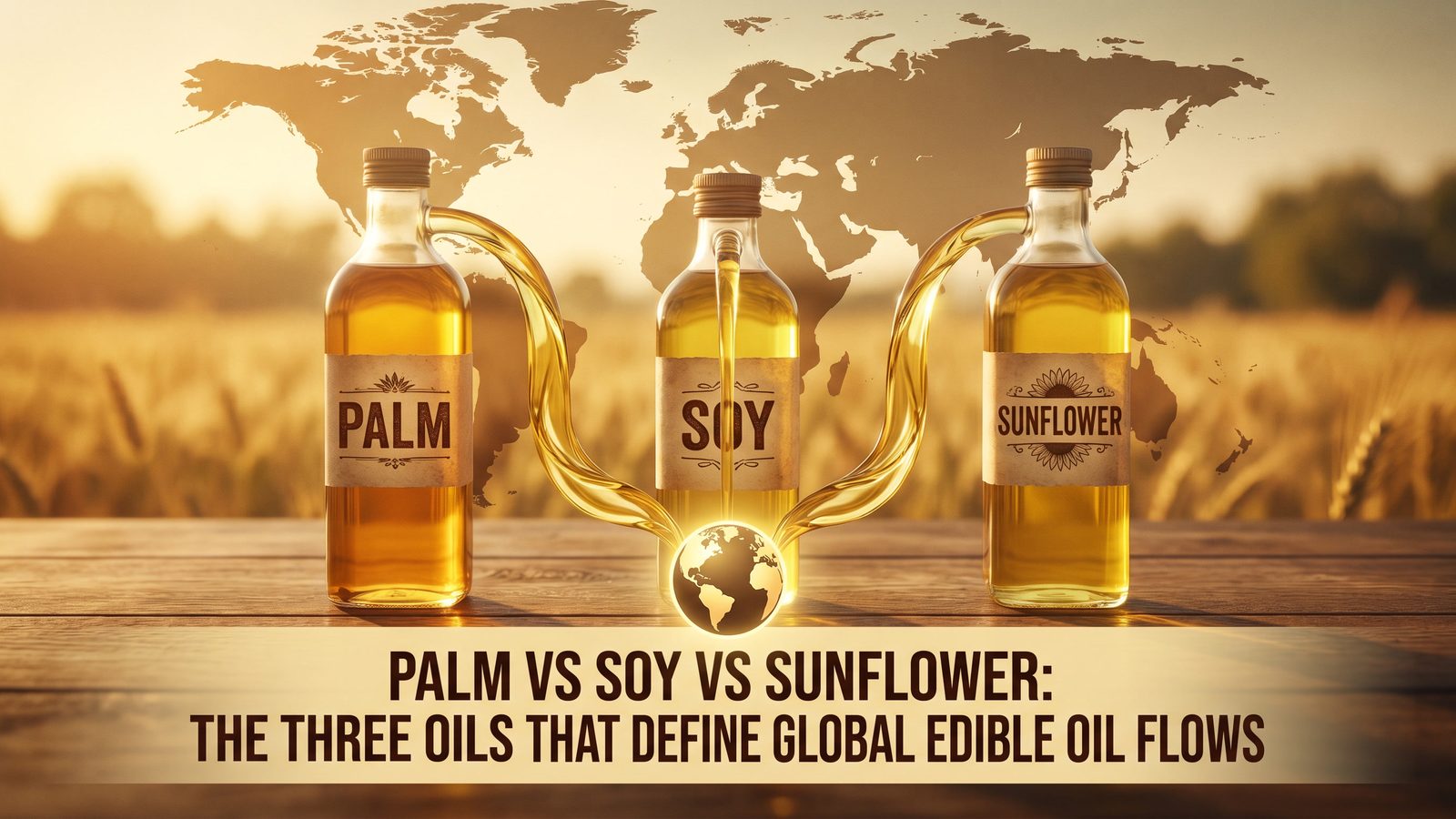
Palm vs Soy vs Sunflower: The Three Oils That Define Global Edible Oil Flows
The global edible oil market is dominated by three vegetable oils — palm, soybean, and sunflower — which together account for roughly 75% of worldwide consumption. Each has distinct supply chains, pricing dynamics, nutritional profiles, and geopolitical exposures. For India, which imports roughly 56% of its edible oil, the balance between these three oils shapes food security, retail inflation, and trade strategy.
This guide lays out the fundamentals of each oil, the supply and demand balance for 2025-26, and India**'**s specific dependency map.
Palm oil: the world**'**s most-consumed vegetable oil
Palm oil is the highest-yielding edible oil by area cultivated. A single hectare of oil palm yields 3 to 4 tonnes of crude palm oil (CPO) plus 400 to 500 kg of palm kernel oil (PKO) — yields that are 4 to 6 times those of rapeseed, sunflower, or soybean oil per hectare. This productivity advantage is the primary reason palm accounts for about 35% of global vegetable oil production despite occupying less than 10% of the oilseed-cultivating land.
Global production (2025-26, approximate)
-
Total: 79-81 million tonnes
-
Indonesia: 48-50 million tonnes
-
Malaysia: 19-20 million tonnes
-
Thailand: 3-3.5 million tonnes
-
Colombia: 1.7-1.8 million tonnes
-
Others (Nigeria, Guatemala, Honduras, Papua New Guinea): 5-6 million tonnes combined
Key uses
-
Cooking oil in Asia (especially India, Indonesia, Pakistan, Bangladesh)
-
Margarine, bakery shortenings, and processed food manufacturing globally
-
Biodiesel feedstock (Indonesia's B40/B50, Malaysia's B10, Brazil's B15)
-
Oleochemicals for soaps, cosmetics, personal care
Price benchmark
Crude palm oil futures on Bursa Malaysia Derivatives Exchange (ticker: FCPOc3) is the global reference price. Typical Q1 2026 range: 4,200 to 4,800 ringgit per tonne.
Palm oil yields 4 to 6 times the edible oil per hectare of any other oilseed — which is why it dominates global vegetable oil supply despite covering less land.
Soybean oil: the co-product of the world**'**s largest oilseed crush
Soybean oil is the second most-produced vegetable oil globally, accounting for approximately 28% of world production. Unlike palm, it is primarily a co-product of soybean crushing — soybeans are crushed for protein meal (for animal feed), with oil as an ~18% yield co-product. This co-product economics means soy oil supply is more closely tied to soybean meal demand than to edible oil demand directly.
Global production (2025-26, approximate)
-
Total: 63-65 million tonnes
-
China: 18-19 million tonnes (mostly for domestic consumption)
-
United States: 11-12 million tonnes
-
Argentina: 8-9 million tonnes (the world's largest soy oil exporter)
-
Brazil: 10-11 million tonnes
-
India: 1.5-2 million tonnes (from imported and domestic soybeans)
Key uses
-
Cooking oil in North America, South America, and India
-
Food manufacturing (mayonnaise, salad dressings, margarine)
-
Biodiesel feedstock (US Renewable Fuel Standard, Brazil B15)
-
Industrial uses (plastics, paints, inks)
Price benchmark
CBOT (Chicago Board of Trade) Soybean Oil futures is the global reference. Also tracked: Argentine FOB Rosario premium, Brazilian FOB Paranaguá premium.
Sunflower oil: the premium-positioned oil with geopolitical exposure
Sunflower oil is the third-largest vegetable oil by global production, accounting for approximately 10% of world output. It is concentrated in a geographically narrow band — Ukraine, Russia, Argentina, Romania, and Turkey account for 80% of global production. This concentration has made sunflower oil uniquely exposed to the Ukraine-Russia conflict since 2022.
Global production (2025-26, approximate)
-
Total: 20-22 million tonnes
-
Russia: 6.5-7 million tonnes
-
Ukraine: 5-6 million tonnes (reduced from pre-war levels of 6.5-7 million tonnes)
-
Argentina: 1.5-1.7 million tonnes
-
EU (Romania, Bulgaria, France, Hungary): 3.5-4 million tonnes
-
Turkey: 0.9-1 million tonnes
Key uses
-
Premium cooking oil (especially in India, China, EU, Middle East, North Africa)
-
Food manufacturing, particularly health-positioned products
-
Limited biofuel use (mostly in EU)
Price benchmark
Typically tracked as Sunflower Oil CIF India (for Indian import benchmark), Sunflower Oil FOB Black Sea (for export origin benchmark).
India**'**s dependency map
India imports approximately 16 million tonnes of edible oil annually. The split by oil type is roughly:
-
Palm oil: 9-10 million tonnes (~60%)
-
Soybean oil: 3.5-4 million tonnes (~22%)
-
Sunflower oil: 3-3.5 million tonnes (~18%)
Geographic dependencies
-
Palm: Indonesia (55-60% of palm imports), Malaysia (30-35%)
-
Soy: Argentina (45-50% of soy imports), Brazil (30-35%)
-
Sunflower: Russia (45-50% of sunflower imports), Ukraine (25-30%)
This means India's edible oil security is structurally tied to the stability of just a handful of supplier countries: Indonesia and Malaysia for palm, Argentina and Brazil for soy, Russia and Ukraine for sunflower. Any disruption in any of these six countries has direct price and availability consequences in India.
The structural shift (2020-2026)
India's sunflower oil imports expanded significantly from 2020 to 2023 as a substitution for palm oil during periods of palm price spikes and Indonesian export restrictions. Sunflower's share of Indian edible oil imports rose from under 15% to nearly 25% at one point. This share has since normalised as palm oil supply stabilised and sunflower pricing became less competitive.
Pricing relationships
The three oils do not trade independently — they are partial substitutes in food and biofuel applications, and their prices tend to correlate over longer time horizons. Key spreads to watch:
-
CPO-SBO spread (Crude Palm Oil vs Soybean Oil): Historically palm trades at a discount to soy, reflecting higher yields and lower production costs. Periods when palm trades at a premium (as occurred in 2022) signal significant palm-specific supply stress.
-
SFO-SBO spread (Sunflower Oil vs Soybean Oil): Sunflower typically commands a modest premium to soy, reflecting cleaner taste and higher-value positioning. The Ukraine war temporarily widened this spread substantially.
What changes in 2026
Three major 2026 dynamics will shift these market relationships:
-
Indonesia's B50 biodiesel mandate absorbing 2-3 million additional tonnes of palm into biodiesel production, tightening global palm availability.
-
Brazil's record ~180 million tonne soybean harvest delivering abundant soy oil supply, cushioning the global vegetable oils complex.
-
Ongoing Russia-Ukraine conflict keeping sunflower supply vulnerable, with periodic disruptions to Black Sea shipping.
The practical implication: palm is the tightest market in H2 2026, soy is the most abundant, and sunflower remains exposed to geopolitical shocks. Trading strategies that have been calibrated to the 2022-24 market dynamics need recalibration for the 2026-27 period.
Further reading
GLOBOIL India 2026 (29 September – 1 October, Mumbai) features dedicated streams on palm oil markets (B50 post-launch analysis), soybean and sunflower markets (South America and Black Sea dynamics), and CPO price outlook (Dorab Mistry, Thomas Mielke, Dr. Julian McGill). This is the single industry forum where all three oil complexes are analysed together with the analysts whose forecasts move markets.