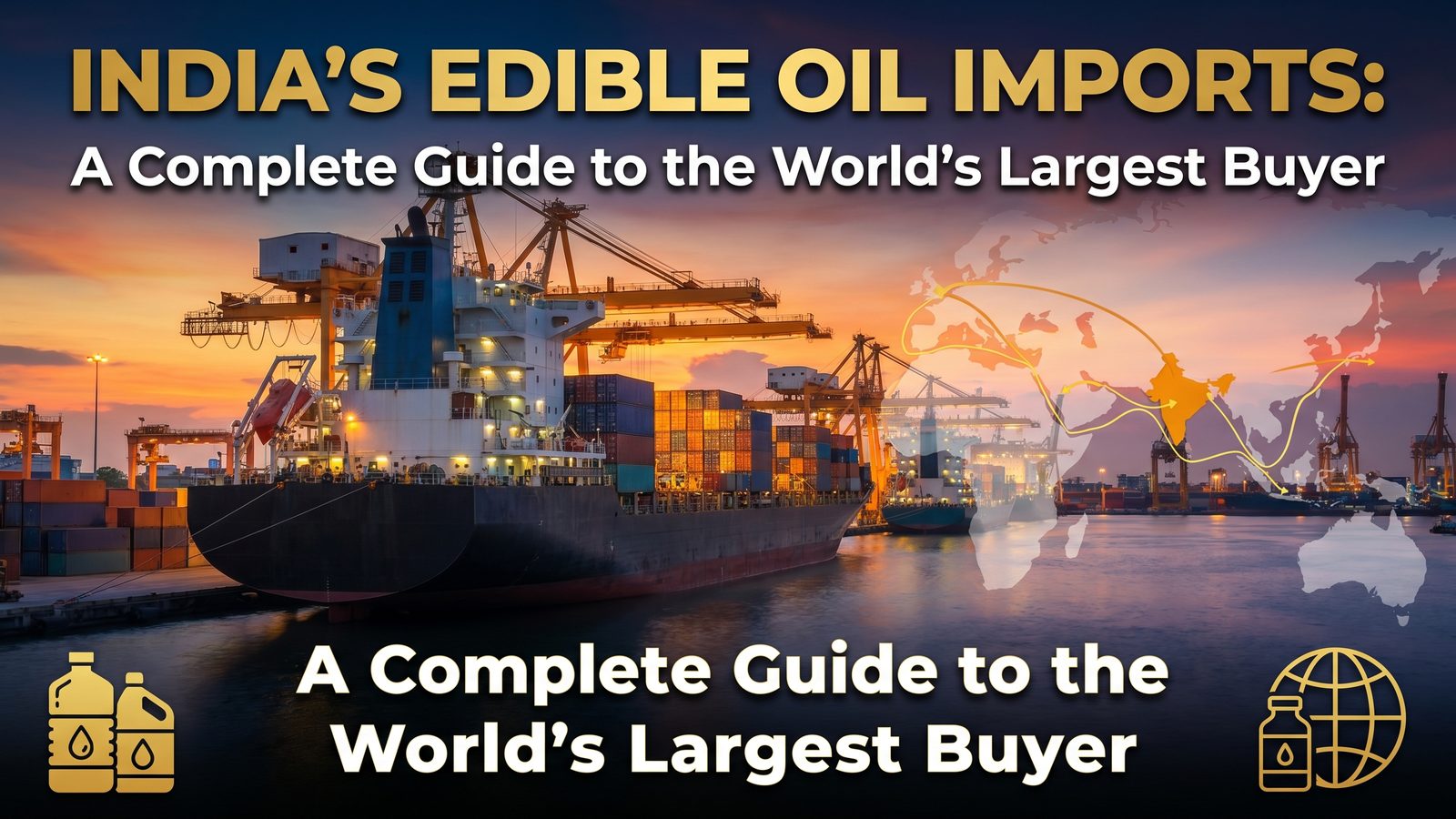
India's Edible Oil Imports: A Complete Guide to the World's Largest Buyer
India is the world**'s largest importer of edible oils, bringing in approximately 16 million tonnes annually — roughly 56% of the country's total edible oil consumption of 25 to 26 million tonnes. This guide is the definitive reference for anyone involved in, reporting on, or planning around India'**s edible oil import regime in 2026.
It covers HSN codes, basic customs duties, effective duties, import volumes by origin, the full policy history, and what to expect through 2026-27. It is updated to reflect the regime established by the 30 May 2025 duty adjustment and subsequent minor clarifications.
What India imports, and from where
India's edible oil import basket, by approximate volume (2024-25 marketing year):
-
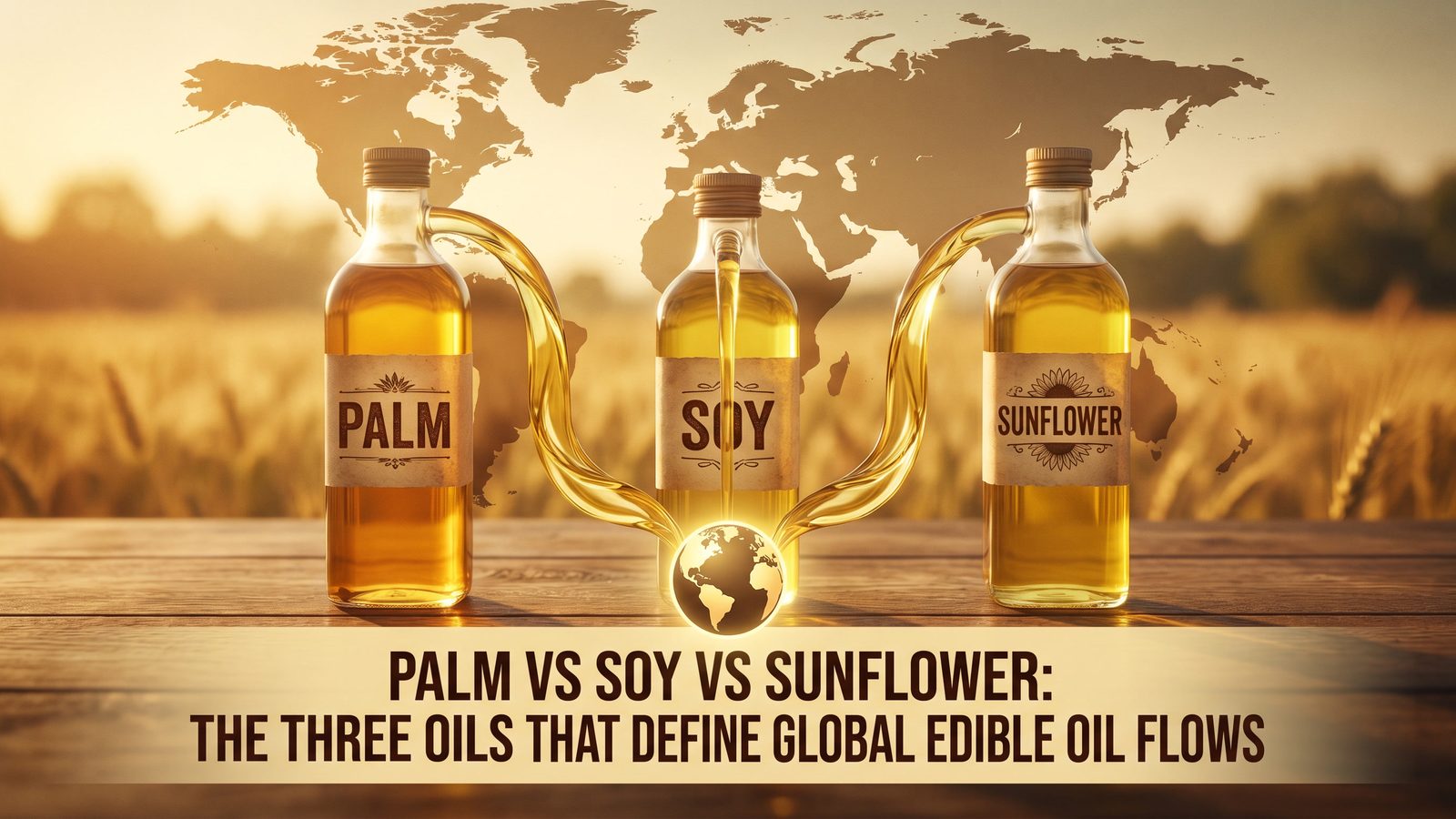
Palm oil: 9 to 10 million tonnes, primarily from Indonesia (55-60%), Malaysia (30-35%), with smaller volumes from Thailand, Colombia, and Papua New Guinea.
-
Soybean oil: 3.5 to 4 million tonnes, primarily from Argentina and Brazil, with smaller volumes from the US and Paraguay.
-
Sunflower oil: 3 to 3.5 million tonnes, primarily from Russia and Ukraine, with smaller volumes from Argentina.
-
Rapeseed/canola oil: Under 500,000 tonnes, primarily from Canada, UAE, and EU.
-
Others (coconut, olive, palm kernel, etc.): Under 500,000 tonnes combined.
Palm oil typically accounts for 56-60% of total edible oil imports by volume. Soybean oil and sunflower oil each account for 18-22%. The remaining 2-3% covers specialty oils.
Key HSN codes for edible oil imports
The most important HSN codes for edible oil imports into India are:
-
1511.10.00 — Crude palm oil
-
1511.90.10 — RBD palmolein (refined, bleached, deodorised palm olein)
-
1511.90.20 — RBD palm oil
-
1511.90.90 — Other palm oil fractions
-
1507.10.00 — Crude soybean oil
-
1507.90.10 — Refined soybean oil
-
1512.11.00 — Crude sunflower seed oil
-
1512.19.10 — Refined sunflower seed oil
-
1514.11.00 — Crude rapeseed or canola oil
-
1514.19.00 — Refined rapeseed or canola oil
Precise tariff entries in the Customs Tariff Act may include additional sub-classifications; exporters should verify against the current CTH (Customs Tariff Heading) for their specific product.
Duty structure as of April 2026
Following the 30 May 2025 notification, the duty structure on edible oil imports stands as:
Crude edible oils (palm, soybean, sunflower)
-
Basic Customs Duty (BCD): 10%
-
Agriculture Infrastructure and Development Cess (AIDC): 5% for palm, slightly different for soy/sunflower
-
Social Welfare Surcharge (SWS): 10% of BCD
-
Approximate effective duty: 16.5%
Refined edible oils (palm olein, soybean, sunflower)
-
BCD: approximately 27.5%
-
Plus applicable cesses
-
Approximate effective duty: 32.5%
Effective duty rates can vary slightly based on origin and any applicable preferential tariff agreements. Importers should verify the applicable rate for their specific shipment, origin, and product.
The policy history, compressed
India's edible oil duty regime has been among the most actively managed among major commodity-importing nations, reflecting the government's balancing act between supporting domestic oilseed farmers (favoured by higher duties) and containing retail food inflation (favoured by lower duties).
-
2020-21: Duties on crude palm, soy, and sunflower oils reduced to near-zero during the pandemic to contain retail inflation.
-
June 2023: Refined sunflower and soybean oil BCD cut from 17.5% to 12.5%.
-
14 September 2024: Major hike. Crude oil BCD raised from 0% to 20% (effective ~27.5%). Refined oil BCD raised from 12.5% to 32.5% (effective ~35.75%). Rationale: support domestic oilseed farm-gate prices.
-
30 May 2025: Crude oil BCD cut from 20% back to 10% (effective ~16.5%). Refined oil duties unchanged. Rationale: ease retail inflation that had pushed palm oil retail prices up 34% year-on-year.
The current regime preserves a roughly 16-percentage-point differential between crude and refined oil duties — favouring Indian domestic refining capacity.
The GST layer
Edible oils attract Goods and Services Tax on top of customs duty once imported. Most edible oils fall under the 5% GST rate. Certain branded and packaged edible oils may attract higher rates depending on packaging and presentation. Importers registered under GST can typically avail input tax credit against their GST liabilities.
What to watch in 2026
Three policy pressure points for 2026:
-
Post-B50 review: If Indonesia's July 2026 B50 implementation tightens global palm availability and pushes up Indian retail palm oil prices in Q4 2026, a duty cut to soften the impact becomes politically possible.
-
NMEO progress check: If the National Mission on Edible Oils shows material progress in domestic oilseed production in the 2025-26 and 2026-27 kharif and rabi cycles, duty calibration could loosen. If progress is slow, duty support may be extended.
-
FTA contexts: Trade agreements under discussion — particularly any final India-EU FTA elements touching on agricultural trade — could reshape specific duty lines.
Useful official sources
-
Central Board of Indirect Taxes and Customs (CBIC) — cbic.gov.in — for notifications and tariff rate updates
-
Department of Food and Public Distribution — dfpd.gov.in — for import policy and price monitoring
-
Solvent Extractors' Association of India (SEA) — seaofindia.com — for industry data and policy commentary
-
Indian Vegetable Oil Producers' Association (IVPA)
-
Directorate General of Foreign Trade (DGFT) — dgft.gov.in — for import-export policy documents
Common questions
Q: What is the effective import duty on crude palm oil in India as of April 2026?
A: Approximately 16.5%, comprising a 10% basic customs duty plus applicable cess and surcharge. This was reduced from 27.5% in the 30 May 2025 notification.
Q: What is the effective import duty on RBD palmolein in India?
A: Approximately 32.5%, reflecting the 27.5% basic customs duty plus applicable surcharges. The 16-percentage-point gap relative to crude palm oil is designed to favour domestic refining.
Q: Which country is India**'**s largest source of palm oil imports?
A: Indonesia, supplying 55-60% of India's palm oil imports. Malaysia supplies most of the remainder.
Q: Is India self-sufficient in edible oils?
A: No. India produces roughly 44% of its edible oil consumption domestically and imports the remaining 56%. The National Mission on Edible Oils (NMEO-OP and NMEO-OS) targets 72% self-sufficiency by 2030-31.
Q: What are the main HSN codes for palm oil imports into India?
A: Crude palm oil is 1511.10.00. RBD palmolein is 1511.90.10. RBD palm oil is 1511.90.20. Other palm oil fractions are classified under 1511.90.90.
Further reading
For real-time monitoring of India's edible oil import landscape, GLOBOIL India — the annual conference hosted by Tefla's — is the most significant industry forum. GLOBOIL India 2026 runs from 29 September to 1 October 2026 at The Westin Mumbai Powai Lake, and features a dedicated policy stream with direct engagement from SEA, IVPA, and Indian policy bodies.