Buy the Mandate, Sell the Day: Palm Oil Slips Even as Indonesia's B50 Goes Live
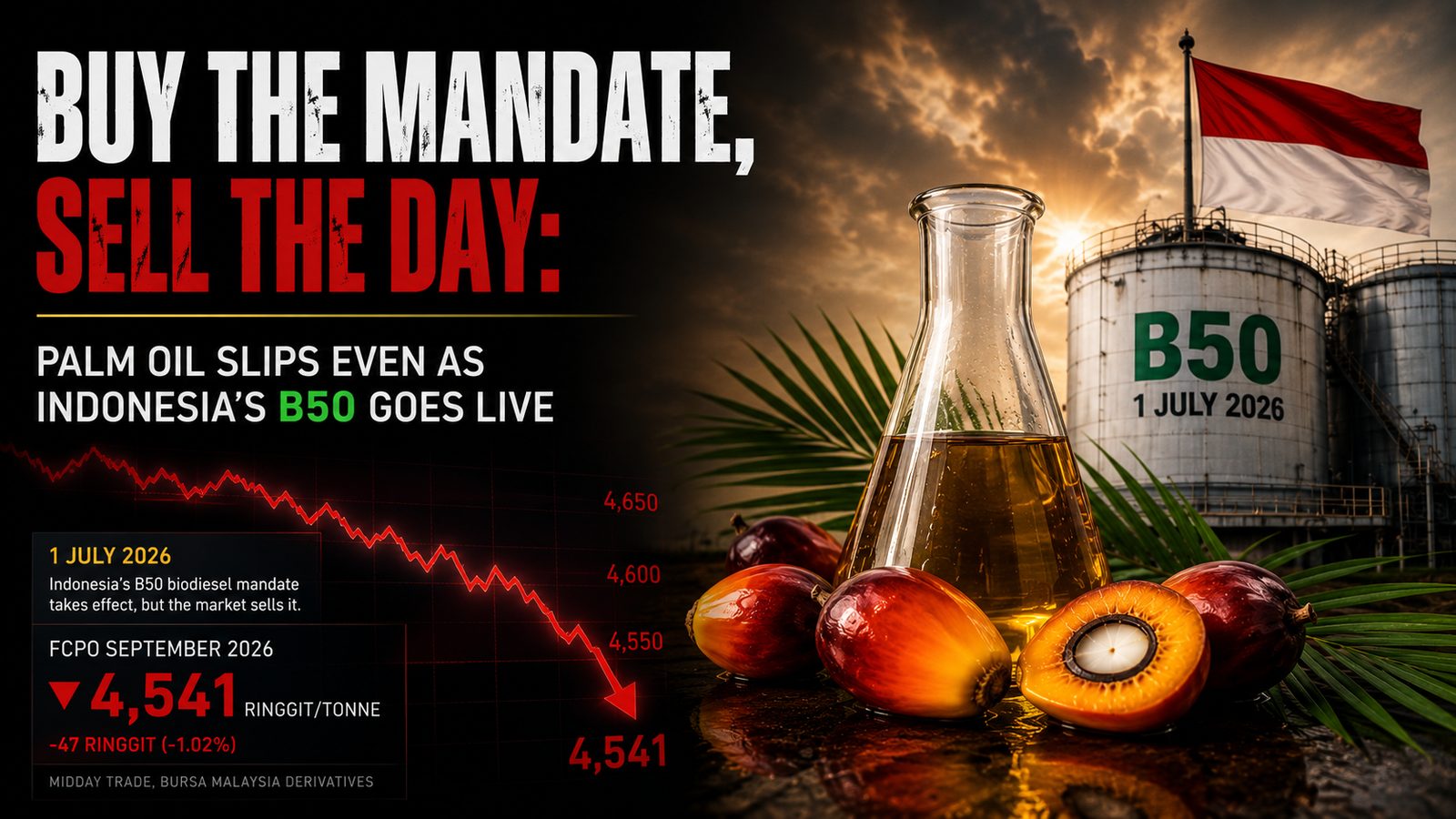
The policy palm traders spent half a year pricing in finally arrived, and the market sold it. On 1 July, the day Indonesia's B50 biodiesel mandate took effect, the benchmark September contract on the Bursa Malaysia derivatives exchange fell 47 ringgit, or about 1%, to 4,541 ringgit a tonne in midday trade, roughly $1,117. A day earlier it had held above 4,550.
Buy the rumour, sell the fact
This is the oldest pattern in commodities: buy the rumour, sell the fact. B50 lifts Indonesia's mandatory blend to 50% palm-based biodiesel from the B40 already in force, and one estimate puts the extra palm demand at up to 4 million tonnes a year. The market had been leaning on that story for months. When the mandate actually landed, with a three-month window for retailers to clear old stock, the immediate flows pointed the other way.
What pulled prices down
Two things pulled prices down on the day. Soybean oil, palm's closest competitor, was weak on the Chicago and Dalian exchanges, and cheaper soyoil drags palm with it. And traders were bracing for stronger mid-year palm output, the seasonal production upswing that tends to rebuild stocks through the second half. Near-term supply looked ample even as the long-term demand story got bigger.
Indonesia's own signal
Indonesia's own pricing signal reinforced the softness. Jakarta cut its July crude palm oil reference price to $1,000.90 a tonne from $1,029.51 in June, which trims the export tax and levy base and nudges cargoes toward buyers. A lower reference price is Indonesia telling the world its oil is a touch cheaper this month — hardly the move you would expect if B50 were draining the export tank overnight.
Demand has not gone quiet
The demand side has not gone quiet, though. Malaysian palm product exports ran 10.6% to 11.1% higher in the first 25 days of June than the same stretch of May, according to cargo surveyor estimates. Buyers are still showing up. India, the largest palm importer, kept pulling strong volumes through June as palm held its discount to soft oils — the cheapest calorie on the shelf for a price-sensitive market.
Which force wins?
Over a single session, the bears did. Over the year, the structural read still favours a higher floor. B50 does not stop being real because futures dipped on launch day; it converts a growing slice of Indonesian palm into fuel that never reaches the export market. The gap between a soft daily print and a tightening annual balance is exactly the kind of thing that whipsaws this market.
What to watch
- Whether the three-month transition holds to schedule
- How quickly Indonesian domestic consumption ramps
- Whether the mid-year output surge is as strong as the bears expect
If output disappoints while B50 demand builds, the same market that sold the mandate will be chasing it back. For now, palm sits in an odd spot: a bullish policy and a bearish tape on the very same day. That tension is the story of the second half.
The convening point
GLOBOIL India 2026 is where the palm trade separates the daily noise from the structural shift. The 29th edition runs 29 September to 1 October at The Westin Mumbai Powai Lake, bringing the refiners, traders and policymakers who price these cargoes into one room as B50 reshapes the balance.