A Softer Close to June: Why the Oils Complex Cooled Just as the Mandates Kicked In
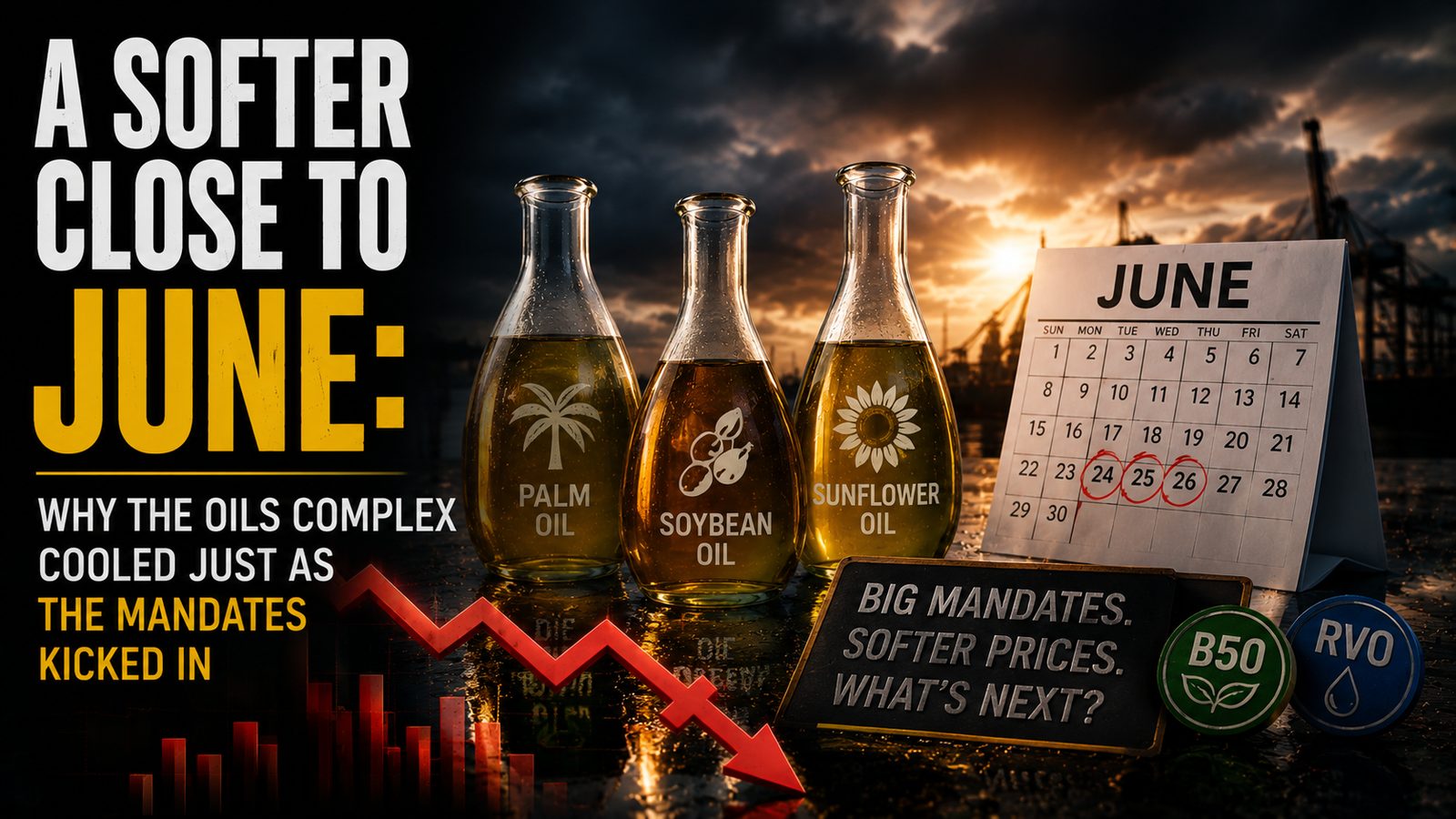
The last week of June served up a paradox. Two of the biggest demand policies the vegetable oil market has ever seen were taking effect, yet palm, soybean and sunflower oil all drifted lower into month-end. Understanding that gap is the key to reading the second half of 2026.
Start with the tape
Malaysian palm futures slipped on 1 July, the very day Indonesia's B50 biodiesel mandate went live, weighed down by weaker soybean oil and expectations of a mid-year output rise. Chicago soyoil sold off from the record highs it had hit on US biofuel demand. Black Sea sunflower oil softened even though Ukrainian exports were collapsing to a two-year low. Everywhere you looked, near-term flows pointed down.
The structural side
Indonesia's B50 lifts its mandatory palm-biodiesel blend to 50%, capable of pulling millions of tonnes of palm into fuel each year. The US biofuel mandate requires 5.4 billion gallons of biomass-based diesel this year, a figure that has already sent American soyoil to a record premium and turned the country inward. These are not one-off events. They are permanent demand, wired into law, that competes with the dinner plate for every tonne of oil.
Why did prices fall?
Because markets trade the next month, not the next decade. The mandates were long anticipated and largely priced in, and once they arrived, traders booked profits and turned to the immediate picture: ample palm output ahead, a big US soybean crop just confirmed at 85.4 million acres, and a heavy overall complex. Structural demand is a floor, not a rocket. It stops prices falling far; it does not stop them falling at all.
The tension importers must hold
The bearish case is real and near: seasonal palm supply, a large American crop, soft daily prints. The bullish case is real and slow: biodiesel mandates that keep converting food oil into fuel, an energy backdrop that makes blending attractive, and export supply being walled off in Indonesia and the US at the same time. The two are not contradictions. They are different time horizons pointing in different directions.
The India read
For a buyer like India, the month-end dip is a window, not a trend reversal. The country imports well over half its edible oil, and the smart read is to use soft patches to cover forward rather than to assume the biofuel floor has cracked. The floor is exactly what makes deep, lasting price drops unlikely; every time oil gets cheap enough, the fuel outlet absorbs it.
What to watch through Q3
- Whether palm's seasonal output surge actually materialises
- How fast Indonesian and US biofuel demand ramps in practice
- Whether the soft complex firms once the crop reports are digested
June closed soft. The forces underneath it are anything but.
The convening point
Reading the gap between a soft tape and a tightening balance is what GLOBOIL India 2026 is built for. The 29th edition runs 29 September to 1 October at The Westin Mumbai Powai Lake, bringing 2,000-plus decision-makers from 60 countries to connect the policy, the price and the flow.