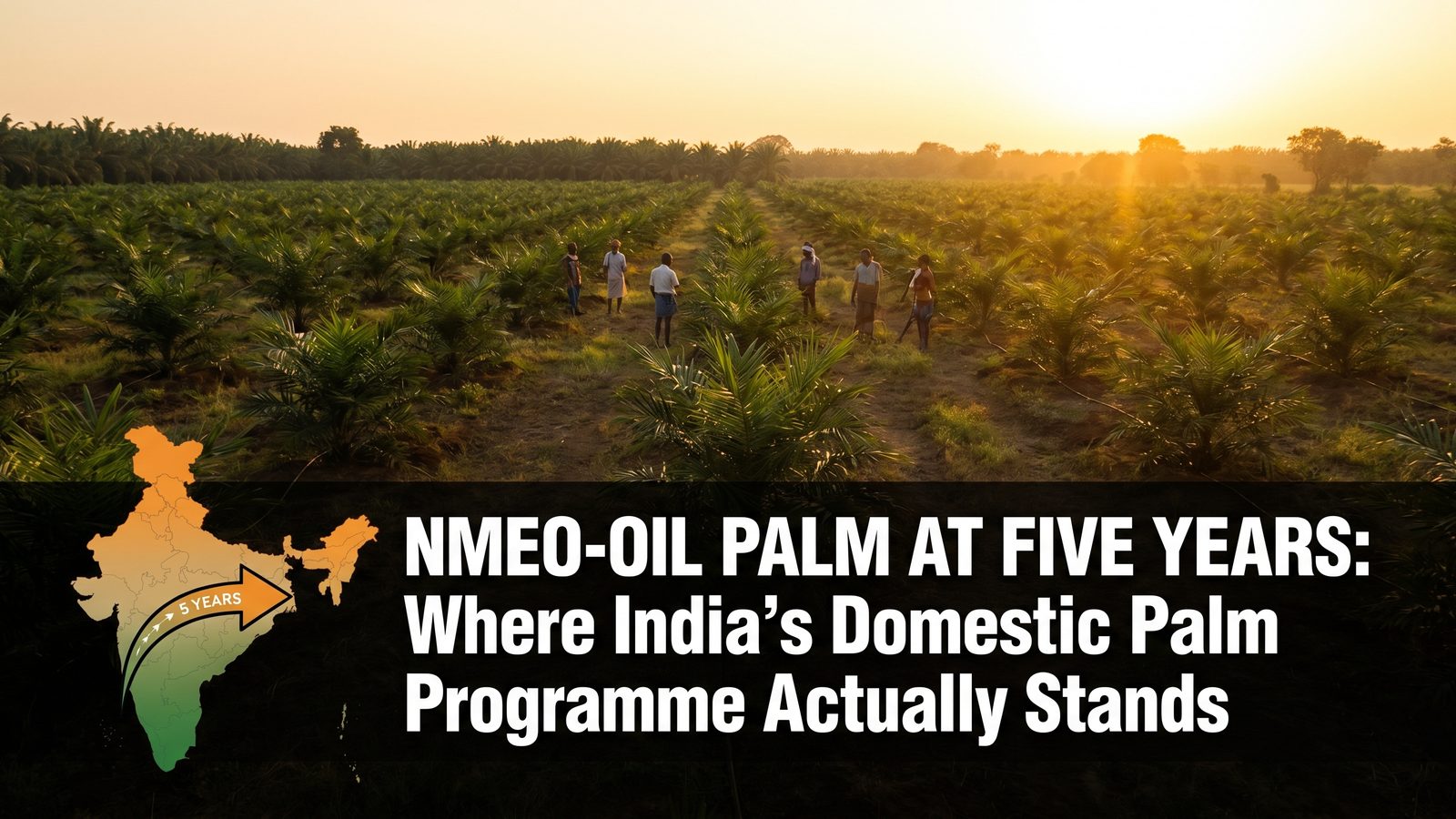
NMEO-Oil Palm at Five Years: Where India's Domestic Palm Programme Actually Stands
POLICY & REGULATION
The National Mission on Edible Oils — Oil Palm (NMEO-OP) was approved by India**'**s Union Cabinet in August 2021, with a financial outlay of ₹11,040 crore and a declared target of bringing 6.5 lakh hectares under oil palm cultivation by 2025-26. The follow-on National Mission on Edible Oils — Oilseeds (NMEO-OS) was approved in 2024 for the 2024-25 to 2030-31 period, targeting 72% self-sufficiency in edible oils by 2030-31.
Five years into NMEO-OP, the progress picture is mixed — better than critics predicted, worse than the original policy documents projected. Here is what the numbers actually show heading into GLOBOIL India 2026.
The 2025-26 oil palm coverage numbers
As of November 2025, total oil palm coverage in India had reached approximately 6.20 lakh hectares. Of that, 2.50 lakh hectares had been brought under cultivation specifically through NMEO-OP since its 2021 launch — meaning the scheme has added roughly 50,000 hectares per year on average.
Telangana, Andhra Pradesh, and Kerala remain the dominant oil palm states, accounting for 98% of total production. Northeast states — Arunachal Pradesh, Assam, Manipur, Nagaland, Tripura — have begun meaningful plantation programmes but remain small in volume terms.
For the 2025-26 fiscal year alone, India expanded oil palm cultivation by 52,113 hectares, with Telangana contributing 12,005 hectares. That pace matches the long-run NMEO trajectory but falls short of what the scheme's original ambition would have required.
At 2.50 lakh hectares achieved against a 6.5 lakh hectare target, NMEO-OP is approximately 38% complete against its stated 2025-26 goal.
Crude palm oil production: a slower-than-target climb
CPO production in India has risen from 1.91 lakh tonnes in 2014-15 to 3.80 lakh tonnes in 2024-25 — effectively a doubling over a decade. The NMEO-OP target for 2025-26 was 11.20 lakh tonnes; for 2029-30, 28 lakh tonnes.
The gap between current production and the 2025-26 target is substantial. Industry analysts have long viewed the 2025-26 targets as politically ambitious rather than operationally realistic. The 2030 target of 2.3 million tonnes of domestic CPO is more plausibly reached as a 2031-32 number, subject to planting completion and yield performance.
The fundamental economics of oil palm in India have been the binding constraint. Palm takes 3 to 4 years to start yielding after planting, and another 6 to 7 years to reach full productivity. A hectare planted in 2022 will yield meaningfully only in 2026 to 2028. A hectare planted in 2025 will yield meaningfully only in 2029 to 2031.
The NMEO-OS layer
NMEO-Oilseeds, approved in 2024, is the more ambitious cousin of NMEO-OP. It targets the full oilseeds complex — groundnut, mustard, soybean, sunflower, sesame, linseed — alongside secondary oil sources like cottonseed, rice bran, and tree-borne oils.
The financial outlay is significant (₹10,103 crore over the 2024-25 to 2030-31 period). The operational model uses Krishi Sakhis — community-level agricultural extension workers — for last-mile delivery. The stated goal: raising oilseeds production from 39 million tonnes to 69.7 million tonnes by 2030-31.
Early implementation reports from 2024-25 focused on seed distribution, cluster-based farmer cooperatives, and MSP signalling. Yield improvement metrics will be visible in the 2025-26 and 2026-27 kharif and rabi cycles — right through the GLOBOIL India 2026 window.
The 72% self-sufficiency arithmetic
India's total edible oil consumption runs at approximately 25 to 26 million tonnes annually, with domestic production covering roughly 44% of demand and imports filling the remaining 56%. To hit 72% self-sufficiency by 2030-31 implies a domestic production base of roughly 19 million tonnes — nearly double current output — against total consumption of 26 to 28 million tonnes (accounting for continued demand growth).
That is a very ambitious trajectory. It requires NMEO-OP to deliver roughly 1.2 to 1.5 million tonnes of CPO by 2030-31 and NMEO-OS to unlock an additional 5 to 6 million tonnes of oil from domestic oilseeds.
Industry-side projections have historically been more conservative. The Solvent Extractors' Association (SEA) has cited working estimates of 55 to 60% self-sufficiency as achievable by 2030-31, with 72% a stretch target contingent on continued policy support, weather cooperation, and farmer economics holding.
What to watch at GLOBOIL 2026
The India self-sufficiency stream at GLOBOIL India 2026 will feature direct engagement from:
-
SEA leadership (Dr. B.V. Mehta, Executive Director; Sanjeev Asthana, CEO & President)
-
Domestic industry CEOs from AWL Agri Business, Patanjali Foods, Emami Agrotech, Gemini Edibles & Fats
-
Policy voices from the Ministry of Agriculture and Department of Food & Public Distribution
-
Sector-specific representatives from the Oil Palm Farmers Federation and emerging oil palm states
The practical question the session will address: If the 2025-26 NMEO-OP target is missed (which appears certain), what recalibration is required for the 2030-31 self-sufficiency ambition to remain credible? And what does that imply for India's palm oil import trajectory through 2030?