Malaysia's Production Ceiling: Why the World's Second Palm Producer Can't Grow Its Way Out
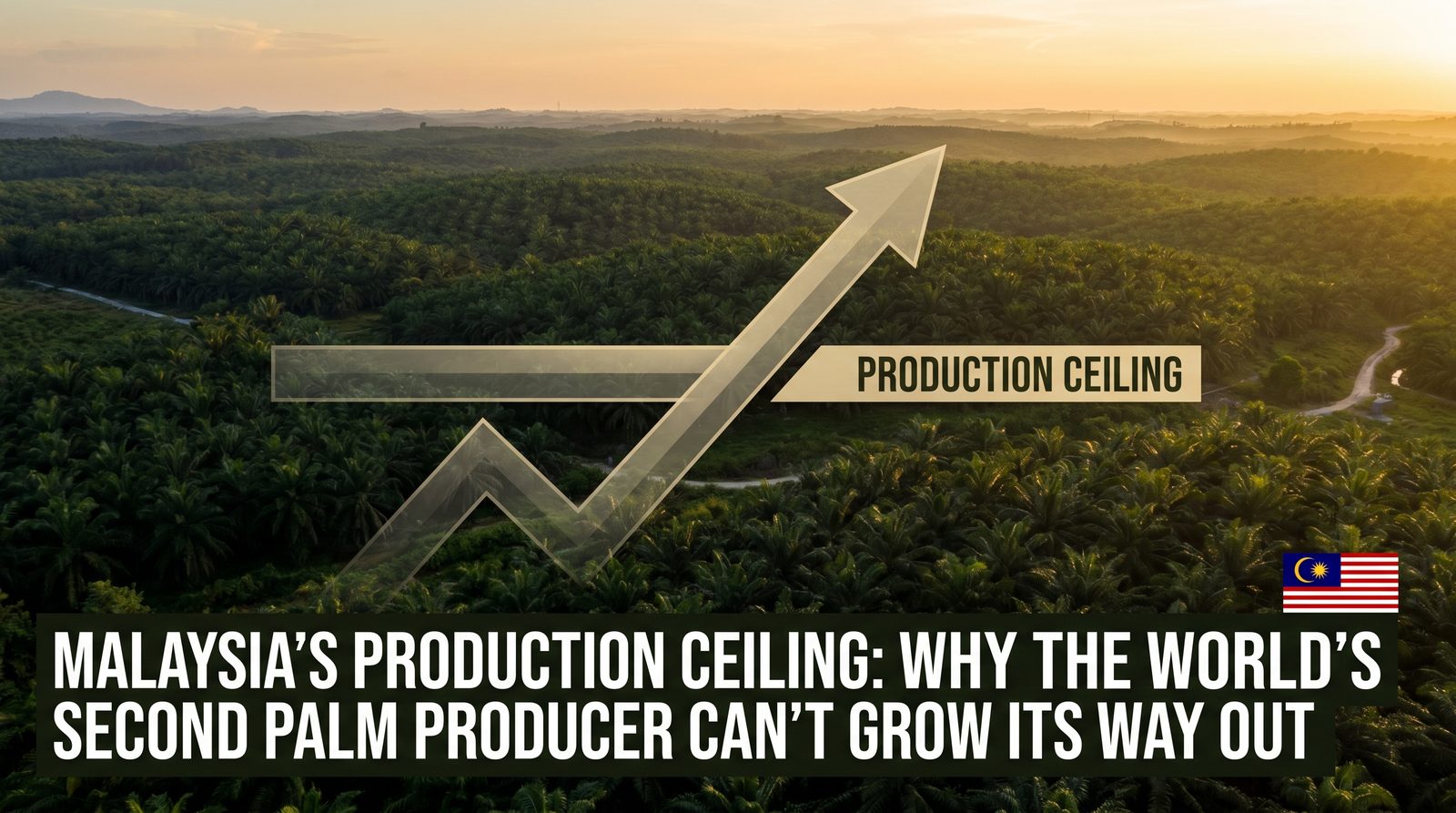
In this analysis: Malaysia's palm oil production is projected at approximately 19.87 million tonnes in 2026, according to Oil World's Thomas Mielke's February 2026 presentation at Palm Oil Conference Malaysia. That number is flat to marginally below 2025 and well below the country's potential output. The reasons — ageing plantations, chronic labour shortages, and structural under-investment in replanting — are not cyclical problems that will resolve with higher prices. They are long-run constraints that will cap Malaysia's contribution to global palm oil supply growth through the rest of the decade.
The numbers
Malaysia's Crude Palm Oil production peaked at around 20.1 MT in 2017. Through 2018–2025, annual production has fluctuated in an 18.3–19.9 MT range, with no sustained growth trajectory. Compare this to Indonesia, which has grown from roughly 38 MT in 2017 to 56+ MT in 2025 — a 47% production expansion over the same period during which Malaysia has held flat to declining.
The gap between the two primary producers has widened from roughly 18 MT in 2017 to nearly 37 MT in 2025. Indonesia now produces 74% of combined Indonesia-Malaysia palm oil output; Malaysia, 26%.
Why Malaysia has stalled
Three structural factors explain the flat production line.
Ageing plantations. Oil palm trees hit peak productivity between years 7 and 18. After year 22–25, yields decline materially. Malaysia's plantation age profile is heavily skewed toward older trees — recent MPOB data suggests roughly 30% of the national planted area is over 20 years old. Replanting should run at 4% annually to maintain optimal age profile. Malaysia has been replanting at roughly 2% annually — a pace that allows the ageing problem to compound rather than correct.
Labour shortages. Oil palm harvesting is labour-intensive. Fresh fruit bunches ripen quickly once cut, and the short-stem harvesting pole equipment used on mature trees requires trained manual labour. Malaysia's plantation sector has historically relied heavily on foreign workers — principally from Indonesia, Bangladesh, Nepal and India — because domestic Malaysians have moved toward urban employment and services work. Post-COVID border and labour policy tightening constrained the inflow of foreign workers, and the sector has never fully recovered. Harvest delays of 2–4 days beyond optimal cutting windows are now routine on many estates — and each delay day costs approximately 0.5–1.0% of oil extraction rate (OER), compounding across thousands of hectares.
Cost inflation. Malaysian estate operating costs have risen faster than global CPO prices over the past five years. Fertiliser prices, minimum wages, certification compliance costs, and replanting capital requirements have all moved higher. For smaller estate operators, the margin compression discourages replanting — the four to five year gap between cutting old trees and new trees reaching commercial production creates a cash flow valley that leveraged operators cannot comfortably fund.
The yield gap
Malaysian palm oil yields — measured in tonnes of CPO per hectare per year — were historically the global benchmark at 4.0+ t/ha on well-managed estates. Indonesian yields have been lower, typically 3.5–3.8 t/ha, due to a mix of smaller estate sizes, weaker agronomic practices in the smallholder sector, and more varied soil conditions.
Through 2024–2025, national-average Malaysian yields have drifted down to roughly 3.7–3.8 t/ha, converging with Indonesian performance. Some of this reflects ageing tree stock; some reflects the harvest-timing issues linked to labour shortages. For an industry whose competitive advantage over soybean oil depends fundamentally on yield-per-hectare, the compression is strategically concerning.
What it means for global balances
Marginal supply growth has to come from Indonesia. With Malaysia structurally capped at 19–20 MT annually through at least 2030, every MT of incremental global palm oil supply growth has to come from Indonesia (where supply is constrained by land-seizure risk and B50 domestic consumption) or from smaller producers (Thailand, Colombia, PNG, West Africa — none of which individually moves the needle).
Premium segregation capacity matters more. Because Malaysia's absolute volume isn't growing, its strategic value to the global market is increasingly in traceability, certification, and quality differentiation rather than raw volume. Malaysian EUDR-ready CPO trades at a structural premium over Indonesian mass-balance product, and that premium is likely to widen further once EUDR enforcement begins.
Export share dynamics. Malaysia remains less vertically integrated into biofuels than Indonesia. Malaysia's biodiesel programme is B20 blended into transport diesel, consuming roughly 1.5 MT of CPO domestically. That leaves a much higher share of production for export — Malaysia typically exports 70–75% of production, versus Indonesia's 55–60%. This makes Malaysia disproportionately important in global traded CPO volumes, even though absolute production lags.
The policy response
The Malaysian government has been working on the constraint for years, with limited success. Recent initiatives include:
Replanting incentives. MPOB (Malaysian Palm Oil Board) offers grants and subsidies for replanting, particularly targeting smallholders. Uptake has been modest — the cash flow problem is real.
Mechanisation pilots. Semi-automated harvesting equipment, drone-assisted yield mapping, and precision fertilisation trials. These help at the margin but don't substitute for the labour gap.
Foreign worker policy. Incremental easing of foreign worker recruitment for the plantation sector. Progress has been slow and is contested domestically on political grounds.
Sabah and Sarawak expansion. Limited new plantings in East Malaysia under controlled conditions. New area expansion is constrained by sustainability commitments.
None of these policies reverse the trajectory. They slow the decline. Malaysian palm oil supply will remain approximately flat through 2030 barring a major unforeseen development.
What to watch
MPOB monthly production, stock and export data: The single most important source of real-time Malaysian palm oil intelligence. Any sustained production figure above 1.8 MT monthly signals genuine recovery; sustained figures below 1.6 MT signal continuing stress.
Malaysian ringgit / USD exchange rate: Malaysian palm oil export competitiveness is directly affected. A strong ringgit compresses exporter margins and reduces realised FOB pricing.
Foreign worker policy announcements: Any material easing of plantation sector labour access could lift harvest recovery meaningfully.
Replanting grant uptake: MPOB publishes annual data. Sharp increases signal future production recovery; stagnation means the ageing profile continues to worsen.
Malaysia is the strategic linchpin of the non-Indonesian palm oil story. Its structural supply constraint is the single most important reason why global palm oil demand growth of 3–4 MT annually has to be met almost entirely from Indonesia. That concentration of supply in a single country, with all its associated policy and political risk, is the defining feature of the 2026–2030 palm oil outlook.