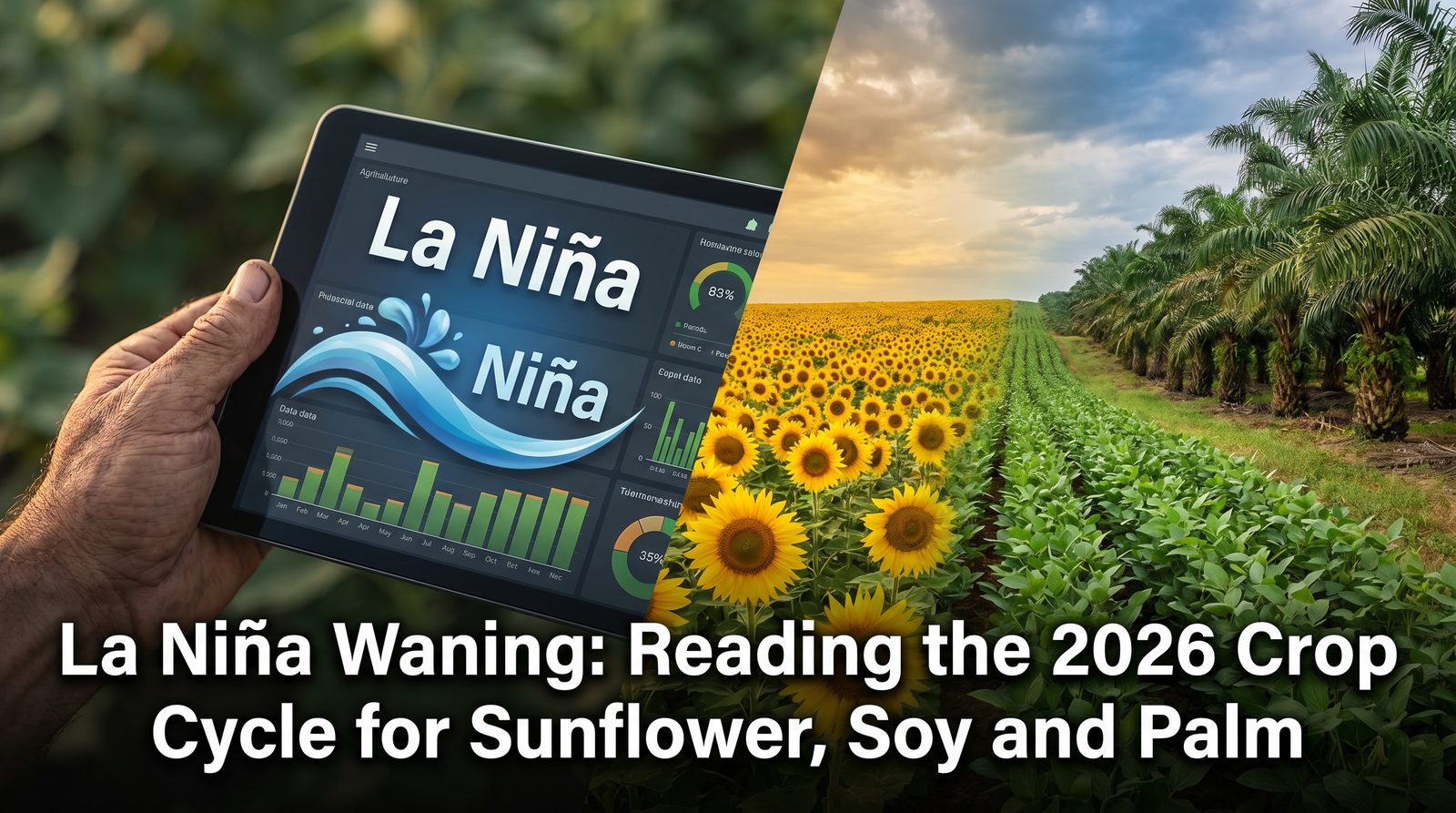
La Niña Waning: Reading the 2026 Crop Cycle for Sunflower, Soy and Palm
The La Niña pattern that developed over the October 2025 to February 2026 window is now in its waning phase, but its impact on 2025-26 crop yields in southern Brazil, Argentina, and parts of Southeast Asia will continue to shape vegetable oil supply through the second half of 2026.
For traders, refiners, and supply-chain leaders heading into the GLOBOIL India 2026 cycle, the key question is not whether La Niña affected yields — it did — but which markets are absorbing the stress and which are being cushioned by other factors.
The meteorological backdrop
NOAA had placed the probability of a La Niña development at 71% for the October-November-December 2025 window, and by early 2026 the pattern was confirmed. The phenomenon tends to bring below-average rainfall to southern South America (Argentina, southern Brazil, Paraguay, Uruguay) and above-average rainfall to parts of Southeast Asia, South Africa, and Australia.
By February 2026, the operational pattern has been less severe than the 2021-22 or 2022-23 La Niña episodes — when southern Brazil and Argentina saw soybean production losses of up to 50% in the worst-hit regions. Late-cycle rainfall from mid-December 2025 and January 2026 substantially rebuilt soil moisture in most Argentine soy-growing regions.
Brazil: record harvest likely
Despite La Niña pressure in the south, Brazil is on track for its largest soybean harvest on record. CONAB projections sit at 176 to 178 million tonnes. USDA estimates are slightly higher at 182 million tonnes. Actual harvest progress is broadly in line with the five-year average — 25 to 30% complete as of late February 2026.
The concentration of concern is in Rio Grande do Sul, where below-average rainfall affected pod-fill in late-reproducing crops. But this is a relatively small part of total Brazilian production. The northern and central Cerrado regions — now the dominant soy belt — have seen normal-to-good growing conditions.
Brazil's domestic crush is expanding in parallel, driven by the B15 biodiesel mandate that increased to 15% palm- and soy-based blend in 2025. Abiove, the Brazilian soy crushers' association, expects record crush of approximately 61 million tonnes in 2026. That absorbs into domestic biodiesel and protein meal production, cushioning the export picture.
The net export story: Brazil will have a very large soybean export programme in 2026, priced competitively — at times $0.80 to $1.00 per bushel below US Gulf values — and stretching well into the northern hemisphere's second half.
The 2025-26 harvest could have been even larger without La Niña — but record Brazilian output is still on track.
Argentina: export normalisation
Argentina's situation is quieter than headlines might suggest. The 2024-25 marketing year saw an anomalously large soybean export programme — USDA estimates topped 13 million tonnes, the highest on record, driven by temporary export-tax reductions and opportunistic buying from China during the US trade dispute.
For 2025-26, USDA forecasts Argentine soybean production at 47.5 to 49 million tonnes on a smaller planted area (farmer economics shifted some hectares to wheat and corn). But yields are better than the area reduction — 85% of soils were at ideal moisture levels heading into the main planting window, and Atlantic surface temperature patterns have been favourable.
Argentine soy export volumes will normalise in 2025-26 to roughly 6.5 million tonnes for the crop year — meaningful but not the blow-out volumes of 2024-25.
Palm oil: the indirect La Niña effect
La Niña's effect on palm oil is more subtle and operates through logistics rather than direct yield. Heavy monsoon-season rainfall in Indonesia and Malaysia — typically elevated during La Niña years — affects fresh fruit bunch (FFB) harvesting windows, causes plantation road flooding, and delays CPO transportation to ports.
Hedgepoint's market intelligence team described this as 'the biggest impact of La Niña on palm oil is in logistics' — a view echoed by traders in Kuala Lumpur and Medan. Actual FFB yield losses in 2025-26 have been modest, but transportation disruptions have periodically tightened spot CPO availability at specific Indonesian ports.
For Indian refiners, the practical implication is that arrival windows for palm shipments have been less predictable through Q1 2026. Inventory planning needs to build in one-to-two-week contingency buffers beyond normal shipping times — on top of the longer transit times already imposed by Red Sea re-routing (see separate piece: 'Cape Routing and the Palm Oil Logistics Equation').
The price implications
With Brazil delivering a record harvest, Argentina normalising, and La Niña waning rather than intensifying, the global soybean complex enters H2 2026 with abundant supply. Global stocks-to-use ratios are the most comfortable they have been in three years.
This softens the vegetable oil complex on the soy side, partially offsetting the palm tightness from B50 implementation. Traders describe the environment as 'the palm bull, the soy bear' — with price spreads between crude palm oil and crude soybean oil narrowing toward historical norms after an extended period of abnormal divergence.
The September 2026 GLOBOIL price-outlook session, featuring Dorab Mistry of Godrej International, Thomas Mielke of Oil World, and Dr. Julian McGill of Glenauk Economics, will publish the first integrated post-harvest, post-B50 forecast. That is the price scenario to trade against for the October-2026-to-February-2027 period.