The Single Gate: How Indonesia's Export Reform Reshapes Global Palm Oil Trade
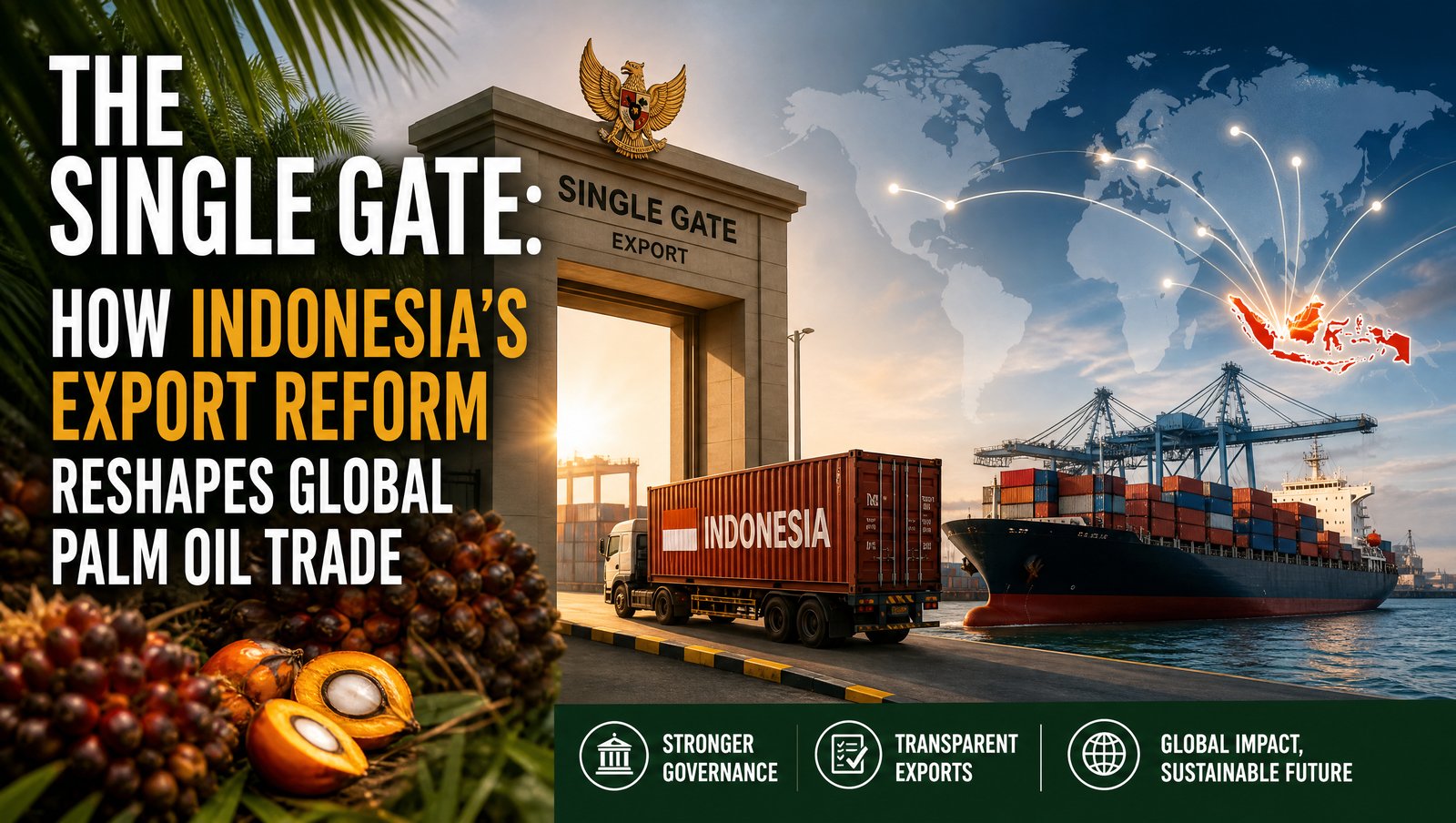
Indonesia has taken its most consequential decision in palm oil trade structure since the 2022 export ban. On 20 May 2026, in his speech to the 19th Plenary Session of the House of Representatives on the 2027 Macroeconomic Framework, President Prabowo Subianto announced that the export of strategic natural resource commodities — beginning with palm oil — will be centralised through a single state-owned enterprise, designated as the sole authorised exporter for the country. Coal and ferrous alloys are next. The framework will be issued via a new Government Regulation, and the appointed entity has been provisionally named Danantara Sumberdaya Indonesia.
The market response was immediate and violent. KPBN CPO tender prices in Indonesia fell 5.77% on 20 May alone, dropping from IDR 15,388/kg to IDR 14,500/kg, with multiple tenders ending in withdrawal. By 22 May, KPBN tender prices had fallen further to IDR 12,285/kg — a roughly 20% decline in 48 hours. Bursa Malaysia CPO futures sold off heavily on 21 May, with the June contract closing at MYR 4,403, down 112 ringgit, before stabilising in the MYR 4,403–4,528 range through the week-end. This is the most violent two-day sell-off in palm oil markets since the early days of the Iran conflict in late February.
The questions facing every Indian refiner, every Malaysian competitor, every Chinese importer, and every global vegetable oil trader this week are the same: what does this actually mean operationally, when does it activate, who controls the new gate, and how do you procure palm oil through 2026 and 2027 in a world where one Indonesian SOE sits between the world's largest producer and its export markets?
What was actually announced
Prabowo's direct quote, translated from the parliamentary speech: "The sale of all our natural resource products, beginning with palm oil, coal, and ferroalloys, will be required to go through designated SOEs as the sole exporters appointed by the Indonesian Government."
The justification is fiscal sovereignty. Prabowo has repeatedly cited a $908 billion figure — Indonesia's claimed cumulative tax revenue loss over 34 years from under-invoicing, transfer mispricing, and export manipulation across natural resource commodities. Palm oil specifically has been flagged for systematic under-declaration of export values at the port of departure, with the gap captured by intermediaries operating in offshore jurisdictions.
The mechanism is procurement consolidation. Rather than the current system — where roughly 200 licensed exporters compete for buyer relationships globally — all palm oil export transactions would funnel through a single state-appointed entity. This entity would handle pricing, allocation, contracting, and revenue collection. Domestic producers and refiners would sell into the entity. The entity sells onward into export markets.
The timeline is unspecified. The Government Regulation has not yet been issued. Implementation will be phased. Industry consensus is that an initial pilot programme could activate within 90 days, with full rollout extending into 2027.
The 2022 comparison
Indonesia's last major intervention in palm oil trade structure was the April 2022 export ban — a 23-day prohibition on all palm oil shipments, intended to stabilise domestic cooking oil prices, that triggered a 50% collapse in CPO futures within months and contributed to one of the most volatile years in vegetable oil trading on record.
The 2026 single-gate plan is a different mechanism but draws from the same playbook: use Indonesia's roughly 60% share of global palm oil supply as a policy lever, accept short-term market disruption in exchange for structural revenue gains.
The differences matter. The 2022 ban was emergency, reactive, and time-limited. The single-gate is structural, planned, and indefinite. The 2022 ban directly removed Indonesian supply from the market. The single-gate doesn't remove supply — it changes who controls how that supply is sold and at what price. The 2022 ban was a supply shock. The single-gate is a price-discovery shock.
For commercial buyers, the 2026 framework is in many ways more concerning. A 23-day ban could be hedged through inventory buffers. An indefinite restructuring of the pricing mechanism cannot be hedged through inventory alone — it requires fundamental reassessment of long-term procurement strategy.
Industry pushback in Indonesia
The announcement has triggered immediate criticism from Indonesian palm oil farmer associations and civil society organisations. POPSI (Persatuan Organisasi Petani Sawit Indonesia), the umbrella association for Indonesian palm oil farmer cooperatives, issued a sharply worded statement within 24 hours.
POPSI Chairman Mansuetus Darto: "We question why such a significant policy is being discussed without involving oil palm farmers. Palm oil is not just about exports; it directly impacts the livelihoods of millions of farming families and local economies across Indonesia."
Darto explicitly compared the proposed framework to the 1990s-era BPPC clove monopoly, run by the Soeharto regime's Clove Marketing and Buffer Agency, which centralised clove procurement through a single state-linked entity and ultimately devastated farmer incomes through monopsony pricing power. The historical comparison carries weight in Indonesian political discourse.
Sawit Watch, the country's most prominent palm oil-focused civil society watchdog, raised separate concerns. Executive Director Achmad Surambo: "Creating a single export gate for CPO effectively places smallholders in a vulnerable position. Without competition among buyers and exporters, farmers will lose their bargaining power."
Sawit Watch noted that the policy direction contradicts the government's own targets in the 2027 KEM-PPKF, which call for the Farmer Welfare Index to rise from 0.7731 in 2026 to 0.8038 in 2027.
The internal political tension matters because Indonesia's palm oil sector is built on smallholder participation — roughly 41% of Indonesian palm oil planted area is held by smallholder farmers and cooperatives. A policy that visibly disadvantages this constituency creates real implementation friction, regardless of headline announcements.
What this means for Indian importers
India imported 3.97 million tonnes of palm oil in the Nov 2025–Apr 2026 half-year — nearly double the 2.74 million tonnes imported in the same period a year earlier, per SEA of India data released 13 May. Of this volume, the substantial majority originated from Indonesia.
Under the single-gate framework, every Indian refiner — Adani Wilmar, Patanjali Foods, Marico, Ruchi Soya, Bunge India, Cargill India, Olam, Wilmar India — would in time procure Indonesian palm oil through a single state-controlled counterparty rather than through the dozens of private trading and producer relationships currently in place.
The operational implications are significant: contract terms could become more standardised but less flexible; pricing transparency may improve, but spot-market arbitrage opportunities would diminish; counterparty risk concentration rises sharply; and the relationship-based dynamics that have characterised India-Indonesia palm oil trade for three decades fundamentally shift.
Several large Indian refiners have already begun internal scenario planning for accelerated Malaysian palm oil sourcing, increased domestic crush of soybean and rapeseed, and renewed evaluation of South American soybean oil contracts. None of these alternatives can fully replace Indonesian palm oil at scale in the short term — but the procurement diversification conversation has been triggered.
What this means for Malaysia
Malaysia is the structural near-term beneficiary. As the world's second-largest palm oil producer with approximately 19.6 million tonnes of annual output, Malaysia is now the only major palm oil supplier operating under a conventional market-based export structure.
The Malaysian export levy structure is significantly lower than Indonesia's — and Indonesia's CPO export levy was already raised from 10% to 12.5% effective 1 March 2026, with potential for further increases under the new framework. The Malaysian discount is now structural rather than cyclical.
Malaysian Plantation and Commodities Ministry signals through May suggest accelerated preparation: the B15 biodiesel mandate confirmed for 1 June 2026 has been positioned as a strategic complement to capturing global market share that Indonesia's policy direction may vacate.
Three scenarios for the next 6 months
Scenario A — Phased smooth rollout (probability: 45%). The Government Regulation is issued within 60 days. A pilot phase activates with limited transaction volumes through Q3 2026. Full rollout extends into 2027 with continuous industry consultation. CPO prices initially soften 8–12% on supply uncertainty, then stabilise as procurement processes adapt. Indian refiners maintain Indonesian sourcing at reduced volumes during transition, supplementing with Malaysian palm. Bursa CPO range MYR 4,200–4,600 through H2 2026.
Scenario B — Implementation friction (probability: 35%). Internal Indonesian political pressure from farmer associations and exporter groups delays the Government Regulation. Pilot phase repeatedly postponed. Market uncertainty persists for 4–6 months. CPO trades in a wide range with elevated volatility. Bursa CPO oscillates MYR 4,000–4,800 with frequent 5%+ daily moves on policy news.
Scenario C — Disorderly execution (probability: 20%). Implementation proceeds aggressively without adequate operational infrastructure at the new state entity. Export documentation backlogs, contract disputes, and physical cargo delays trigger a 2022-style temporary export disruption. Indonesia loses near-term export market share to Malaysia and South American soybean oil. Bursa CPO spikes 15–25% within 30 days on speculation, then retraces sharply. Indian retail edible oil inflation accelerates.
What Indian refiners should be doing this week
- Stress-test forward palm oil procurement contracts for force-majeure exposure tied to Indonesian export regulation changes
- Initiate or accelerate Malaysian palm oil supply agreements to diversify origin concentration
- Run scenario analysis on domestic soybean and mustard seed crushing capacity utilisation through H2 2026
- Engage with sourcing teams on inventory build during the implementation uncertainty window
- Establish or refresh direct relationships with Indonesian producer groups in anticipation of new procurement architecture
- Update risk management committees on counterparty concentration risk under a state-monopsony scenario
What to watch through July
- Issuance of the Government Regulation (PP) implementing the single-gate framework
- Identification of the specific SOE designated as the sole palm oil exporter — Danantara Sumberdaya Indonesia is the working name
- Industry consultation outcomes with POPSI, GAPKI, Sawit Watch, and exporter associations
- Reactions from major importing markets: India, China, EU, Pakistan, Bangladesh
- CPO export levy adjustments — the levy was raised to 12.5% in March, with further increases possible under the new framework
- Malaysian export volumes and market share data through June and July
The convening point
GLOBOIL India 2026 lands at The Westin Mumbai Powai Lake from 29 September to 1 October 2026 — approximately 130 days after Prabowo's announcement, and at the precise moment when the operational reality of Indonesia's new export structure begins to crystallise in actual cargo flows and counterparty arrangements.
Senior representatives from CPOPC, MPOC, GAPKI, SEA of India, the Indonesian Ministry of Trade, and major refiners across India and Southeast Asia will share the stage. Dorab Mistry's annual price outlook and Thomas Mielke's Oil World forecast will frame H2 2026 against the new export architecture.
The 29th Edition of GLOBOIL India is positioned at the most consequential inflection point in global palm oil trade structure since 2022 — and Mumbai is where the post-reform framework gets debated, contested, and ultimately set.
The single gate has been opened. What flows through it — and at what price — becomes one of the defining questions of the global edible oil industry for the next 24 months.
Editorial analysis by the GLOBOIL Intelligence Desk based on Indonesian Government, GAPKI, KPBN, Bursa Malaysia, MPOB and SEA of India data through 25 May 2026. Not investment advice.