Indonesia's 12.5% Levy: How Jakarta's April Rulebook Is Reshaping Global CPO Flows
In this analysis: Indonesia's April 2026 CPO reference price has climbed to USD 989.63/MT — up 5.41% from March — pushing the combined export duty and levy burden on Indonesian shippers past USD 270/MT on the base grade. For buyers in Rotterdam, Mumbai, Karachi and Lagos, this is no longer a subsidy story. It is a structural repricing of the world's largest palm oil tap.
What the rulebook now says
The April 2026 reference price was fixed by Indonesia's Ministry of Trade at USD 989.63 per tonne for the April 1–30 shipping window. The calculation, governed by Trade Regulation 35/2025, uses the median of three reference markets — the Indonesian Commodity and Derivatives Exchange (ICDX), Bursa Malaysia Derivatives and Rotterdam CIF — whenever the spread between them exceeds USD 40. In the February 20 – March 19 window that set the April number, Rotterdam was trading at USD 1,319.84/MT while ICDX sat at USD 896.94/MT and Bursa at USD 1,082.31/MT. That is a USD 420 spread between origin and destination — one of the widest gaps of the past three years, and a clean signal of how much the demand pull from Europe, India and China has outstripped origin-market pricing.
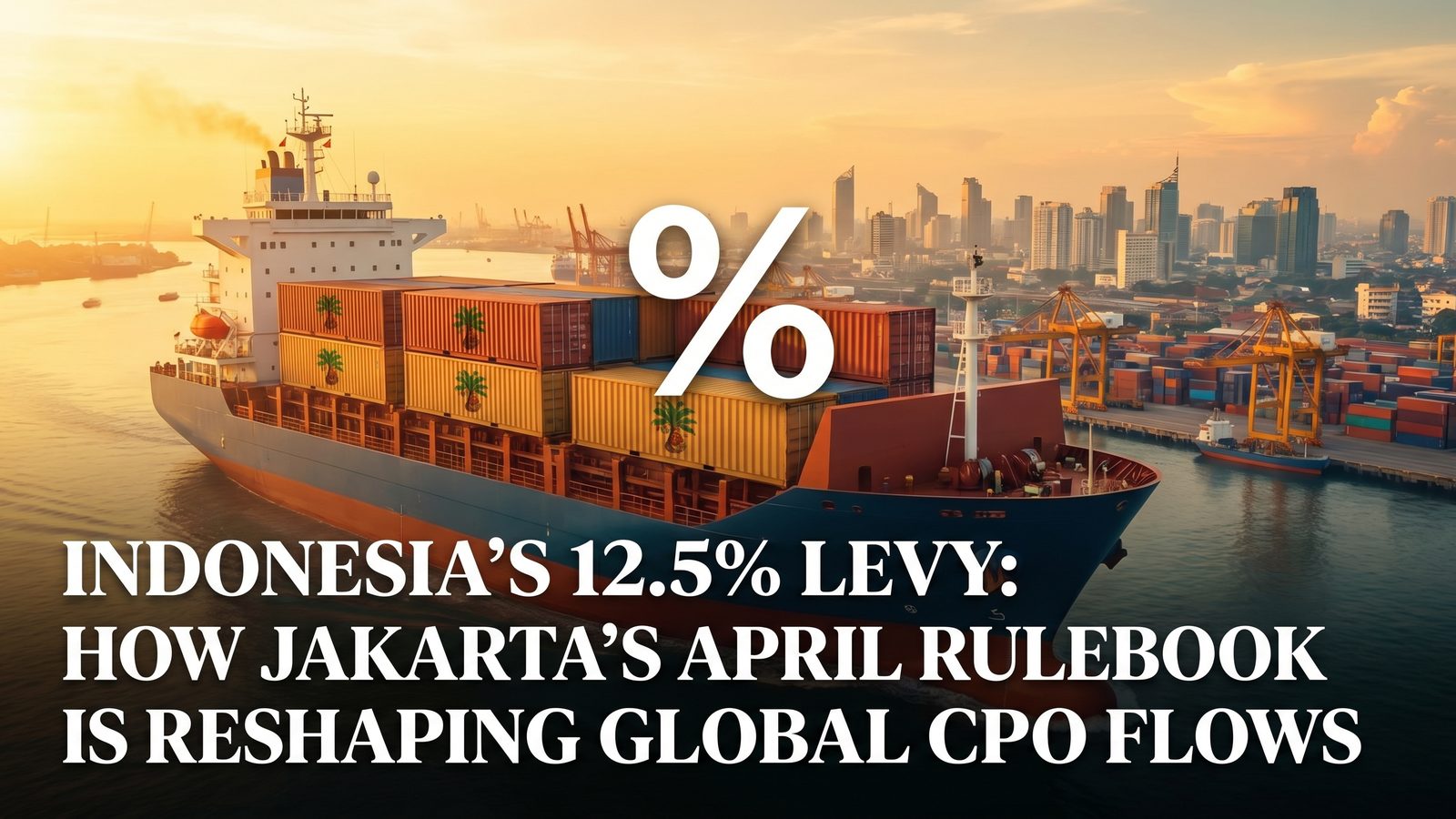
On top of the reference price sits the export duty (BK), set at USD 148/MT for April under Column 8 of Ministry of Finance Regulation 38/2024 (as amended by 68/2025). And on top of that sits the export levy — raised in March 2026 to 12.5% of the reference price, up from 10%, under PMK 9/2026. At the April reference, that levy adds another USD 123.70/MT. Combined burden on a tonne of CPO leaving Dumai or Belawan: roughly USD 272/MT, or about 27.5% of the reference value.
This is the headline number every global buyer, broker and refiner should have at the top of their March–July 2026 operating model.
Why Jakarta raised it — and why the timing matters
The 10% → 12.5% hike is not a revenue grab. It is a funding mechanism. Indonesia's Badan Pengelola Dana Perkebunan Kelapa Sawit (BPDP) — the plantation fund — channels roughly 90% of levy receipts into biodiesel subsidies and the remaining slice into replanting and smallholder programmes. With B40 already consuming around 12.6 million tonnes of CPO annually and B50 confirmed for a 1 July 2026 launch requiring an additional 2–2.5 MT, BPDP's subsidy bill will scale sharply as the Palm Oil–Gasoil (POGO) spread widens or tightens.
When the POGO spread collapsed to a 41-month low of USD 292/MT in late March 2026 after Middle East crude rallied above USD 100/bbl, the economics of B50 became workable. But workable is not free — the government still needs to top up the price gap between CPO (at roughly USD 1,000 FOB) and gasoil (at roughly USD 950) for the portion of the biodiesel pool that isn't fully self-financing. The levy funds that gap. If crude softens and POGO widens back out, the levy has to rise further. This is the mechanical relationship every trader needs to hold in their head: higher crude → narrower POGO → cheaper subsidy → room for levy to fall. Lower crude → wider POGO → expensive subsidy → pressure to raise levy.
The Indonesian smallholder pushback
The Indonesian Oil Palm Farmers Union (SPKS) has opposed the 12.5% levy on the basis that it translates downward into FFB (fresh fruit bunch) prices at the plantation gate. University of Indonesia's Prananta Center estimates each 1% increase in the CPO export levy pulls FFB prices down by roughly IDR 333 per kilogram — implying the 2.5 percentage-point hike could shave around IDR 1.2 trillion annually from smallholder income across Indonesia's 4.2 million hectares of independent plantations.
This matters globally because it is the single biggest political constraint on Jakarta's ability to keep scaling biodiesel mandates. If smallholder incomes come under sustained pressure through 2026–27, expect pushback against further levy increases and — more consequentially — against any move to B55 or B60, both of which have been floated for 2027–28.
What it means for buyers
For Indian refiners: The effective FOB cost on Indonesian CPO has moved up roughly USD 27/MT since January 2026. With India's own import duty structure unchanged (the 20% BCD + AIDC framework that took effect May 2025 remains in place), the landed cost at Kandla and JNPT is now USD 1,100–1,120/MT CIF. At that level, refining margins on palm olein are compressed to USD 40–55/MT — still positive, but uncomfortably thin for leveraged refiners.
For European buyers: Post-EUDR delay to 30 December 2026, Rotterdam CIF premiums for traceable, segregated CPO have widened to USD 180–220/MT over mass-balance product. The Indonesian levy does not apply differentially to EUDR-compliant volumes, but it does interact with the origin country's willingness to certify. Expect Indonesian exporters to lean more heavily on Malaysian mass-balance and Colombian/Guatemalan segregated supply for EU-bound shipments, reserving the cheapest Indonesian CPO for buyers without traceability demands.
For African buyers: Nigeria, Kenya and Egypt — which together imported roughly 2.4 MT of Indonesian CPO in 2025 — face the sharpest relative impact. These markets don't have the duty flexibility of India or the premium appetite of Europe. Expect partial switching to Malaysian supply (where the export duty framework is lower) and increased demand for smaller origins like Papua New Guinea and the Solomon Islands.
The Malaysia arbitrage
Malaysia's export duty structure — set monthly by the Malaysian Palm Oil Board — has been running materially below Indonesia's combined burden through Q1 2026. The April 2026 Malaysian export duty was set at 10% of the reference price of RM 4,643/MT (roughly USD 1,020), giving a burden of around USD 102/MT. That's USD 170/MT lighter than Indonesia's combined load. For every tonne of CPO that can be sourced from Malaysia instead of Indonesia without delivery penalties, traders are pocketing the spread.
Expect this arbitrage to compress through May–June 2026 as Malaysian production seasonally peaks and Bursa futures soften. But the structural picture for 2026 is clear: Malaysia will out-export Indonesia on a per-tonne-of-production basis through H1, and Indonesia's 2026 total export volume is likely to come in at 24–25 MT against 2025's 27.1 MT — a decline driven more by policy than production.
What to watch next
May 2026 reference price: If it prints above USD 1,020, expect the duty bracket to shift up another tier (Column 9), pushing the combined burden toward USD 300/MT. Import parity for India begins to break down above that level.
B50 launch data (July 2026): The first month of mandatory 50% blending will tell the market whether the 2.3 MT of incremental demand is real or whether technical bottlenecks (plant capacity, diesel engine compatibility, cold-start issues) force a de facto B45 reality.
BPDP fund balance: Indonesia's Finance Ministry publishes BPDP accounts quarterly. If the fund shows signs of strain by Q2 2026, expect a levy revision within 60 days.
US soy oil biofuel policy: The Trump administration's posture on the Renewable Fuel Standard and the 45Z tax credit will set the ceiling on how much soy oil competes for global biofuel demand. Any pull-back on US mandates loosens the global veg oil complex and gives Indonesia breathing room to hold or reduce the levy.
The Indonesian levy is now the most important single lever in global edible oils. Every buyer, trader and refiner should be tracking it at the same cadence they track Bursa futures.