870g of Trickery: How India's Cooking Oil Aisle Became a Maze, and What Delhi Is Doing About It
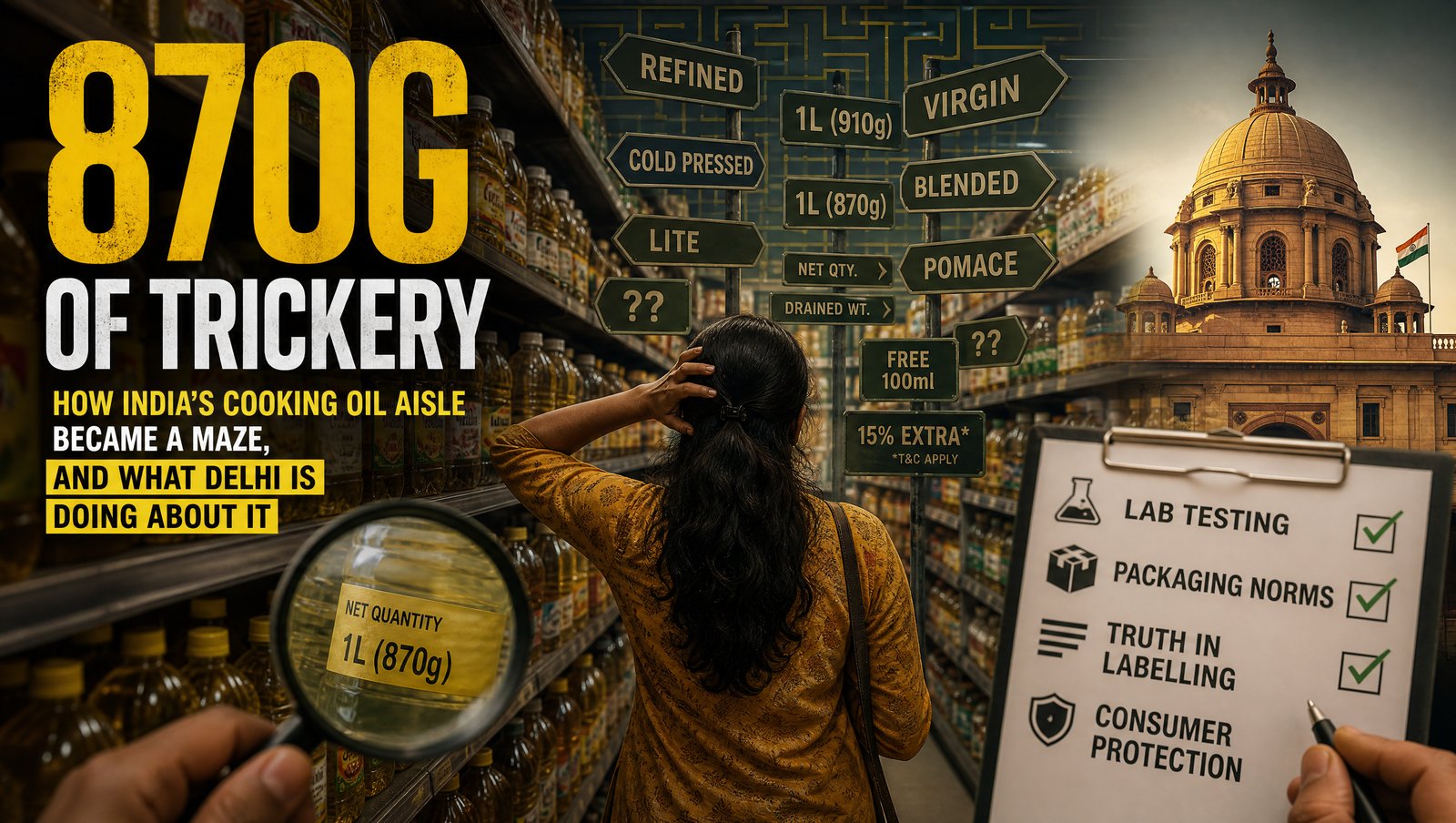
If you have ever stood in an Indian grocery aisle holding two bottles of cooking oil with identical labels but mysteriously different quantities — one at 870 grams, the other at 810 grams, neither at a round number — you have already encountered one of the most quietly contentious questions in Indian retail right now.
On Tuesday evening at 7:04 PM, the Department of Consumer Affairs put out a press release that confirms what every shopper has suspected for years: the cooking oil aisle is engineered to be confusing, and a coalition of industry associations representing 90 per cent of the sector has now formally asked the government to do something about it.
The proposal, discussed at a Department of Consumer Affairs meeting on 20 May chaired by the Secretary, is to mandate nine standard pack sizes for major edible oils under the Legal Metrology framework. The standardised sizes would be 200ml, 500ml, 1L, 2L, 3L, 4L, 5L, 15L/15kg and 20L/20kg. The proposal covers ten oils — palm oil, palm olein, soybean, sunflower, mustard/rapeseed, groundnut, sesame, rice bran, cottonseed, corn, and blended edible oils. If introduced, it applies equally to domestic and imported product. A three-month transition window is proposed.
It is, on its face, a deeply unglamorous policy intervention — pack sizes, after all, are the kind of thing that animates nobody at a dinner party. But the politics here are unusually layered. The industry is asking the government to constrain its own pricing flexibility. Consumers stand to win clarity but might lose the ₹85 small packs that fill the kirana shelves of every Tier-3 town in the country. And the move arrives at the precise moment when global vegetable oil prices are being repriced by the Indonesian export reform, the Modi 10% reduction directive, and a potential import duty hike. If you wanted to design a moment of maximum scrutiny for the cooking oil industry, this would be it.
The 870-gram problem
The Department's release is unusually candid by PIB standards. Industry representatives "pointed out that edible oils are currently sold in several package quantities such as 650 g, 700 g, 810 g, 850 g and 870 g." The implication, stated almost matter-of-factly, is that "similar-looking packs with different quantities can make it potentially misleading to compare prices and make informed choices."
This is the polite version of what insiders have been saying privately for years. Walk into any modern trade outlet in Mumbai, Bengaluru or Delhi and look at the cooking oil shelf. You will find the same brand selling 810g, 850g, 870g, 910g and 1L SKUs of what is essentially the same product. The MRPs are positioned at price points that obscure direct per-unit comparison. A shopper checking ₹185 for an 810g pack and ₹199 for a 1L pack of a competing brand needs to do four-step mental arithmetic — convert to per-100g, adjust for the density difference between weight and volume — to determine which is cheaper. Few do. Most simply pick whichever pack looks cheapest at a glance.
This is not accidental. It is a marketing technique called "size-based price obfuscation," and it is well-documented in consumer-behaviour academic literature. The 2025-26 SOPA letter to the Department, referenced in earlier industry reporting, called the practice "deliberately misleading." That is unusually direct language for an industry association to use about its own members, and it tells you something about how the conversation has shifted. Even the players who benefit from confusion now want to end it — because the alternative is letting one or two aggressive operators destroy trust in the entire category.
The five who showed up
The associations at the 20 May meeting represent a meaningful share of the supply chain: the Indian Vegetable Producers Association (IVPA), the Solvent Extractors' Association (SEA), the Soybean Processors Association of India (SOPA), the Central Organisation for Oil Industry and Trade (COOIT), and the Mustard Oil Producers Association (MOPA). Collectively, by their own count, they represent 90 per cent of the country's edible oil sector.
That number matters. When a 90 per cent industry coalition arrives at the regulator asking to be regulated, three things are usually true. First, the players doing the unethical thing are not in the room — they are the 10 per cent. Second, the larger players have done the math and concluded that price clarity helps them more than it hurts them, because their brands trade on trust. Third, there is a defensive crouch in play: standardisation is preferable to the alternative, which would be public consumer revolt, viral social media exposure, or — worst case — a sudden, unilateral regulatory crackdown without industry input.
It is the third logic that probably explains the timing. The Modi government has been on an austerity-and-import-substitution tear through May 2026. Gold duty has gone from 6 per cent to 15 per cent. The Prime Minister has personally and repeatedly urged citizens to consume less edible oil. An edible oil import duty hike is under active consideration. In that climate, the industry's calculation is straightforward: better to be seen acting on consumer interest than to be the subject of the next surprise notification.
What India is proposing, in plain terms
The nine pack sizes proposed are sensible and align broadly with what consumers actually buy. 200ml addresses the small-pack segment without ceding it entirely. 500ml and 1L cover the urban household weekly purchase. 2L, 3L and 5L cover middle-income monthly purchase patterns. 15L and 20L bulk packs cover commercial kitchens, dhabas, sweet shops and HORECA — a segment that accounts for roughly 40 per cent of Indian edible oil consumption.
The carve-outs are well-targeted. Packs below 200ml stay outside the standardisation regime, preserving the affordability of the ₹10 and ₹20 sachets that small kirana stores depend on. Minor edible oils — coconut, almond, walnut, niche cold-pressed products — are exempt. A three-month transition allows manufacturers to use up existing inventory of non-standard packaging materials, reducing waste and avoiding sudden price shocks. The reach is broad: ten oils, both domestic and imported, mandatory across all channels. If implemented as proposed, this would be the most significant edible oil labelling reform in India since the introduction of unit-price disclosure in 2022.
What the rest of the world actually does
Here is where the conversation gets interesting — and where the global standards comparison upends a few assumptions. The European Union went the exact opposite direction in 2007. Under Directive 2007/45/EC, the EU comprehensively deregulated pack sizes for nearly all food and consumer products. Only wines and spirits retained mandatory nominal quantities. The reasoning, set out in the directive's preamble, was twofold: first, that mandated pack sizes created barriers to innovation and to small and medium enterprises entering new markets; second, and more importantly, that the consumer protection objective was better served by mandatory unit-price disclosure (Directive 98/6/EC) than by constraining pack sizes themselves. If every shelf tag must show price-per-litre or price-per-kilogram in legible type, the EU's logic ran, the consumer can compare a 750ml bottle with a 1L bottle without any cognitive load — the per-litre price is on the shelf. The Commission evaluated the directive in 2016, almost a decade after it took effect, and concluded that the deregulation had worked. Pack-size proliferation increased, but consumer complaints about misleading pricing did not. The unit pricing rule, properly enforced, had done the job.
The United States operates a hybrid system. The Fair Packaging and Labeling Act (FPLA) requires net quantity declaration in dual units (US customary plus metric), positioned in the lower 30 per cent of the principal display panel, in font sizes proportional to package area. There is no mandate on specific pack sizes themselves — manufacturers can sell 12oz, 16oz, 18oz, 20oz, 24oz, whatever they like. But the FPLA, combined with state-level unit pricing laws in places like New York, Connecticut and Massachusetts, ensures that consumers see price-per-fluid-ounce on every shelf label. Canada similarly mandates net quantity declaration under the Safe Food for Canadians Regulations, with specific font sizes and placement requirements, but allows manufacturers full flexibility in choosing pack sizes. The UK, post-Brexit, retained the inherited EU pack-size deregulation but has tightened unit pricing enforcement through the Price Marking Order. Tesco, Sainsbury's and Asda all carry per-100ml price labels on their cooking oil shelves.
The pattern, across the world's most consumer-protection-active jurisdictions, is therefore clear: mandated pack sizes are out, mandated unit pricing is in. The Western consensus is that consumers are best protected not by forcing manufacturers into a narrow set of bottle sizes, but by forcing retailers and manufacturers to make per-unit pricing impossible to miss. This raises an uncomfortable question for the Indian proposal: if the global consensus is that unit pricing solves the problem, why is India going the other way?
Where I come out on this
The honest answer is that the Indian situation is genuinely different, and the global consensus, while elegant, doesn't quite apply. Let me unpack why I think the Indian proposal is, on balance, the right call for India — even though it would be the wrong call for Europe.
Unit pricing in India has not worked as advertised. When the rules were tightened to require per-millilitre and per-gram pricing on cooking oil labels, the response from some manufacturers was creative compliance: print the unit price in tiny font, in paise with two decimal places — "24.72 paise per millilitre" — in a position on the label that requires deliberate searching. The 2024 SOPA letter to the Consumer Affairs Department made exactly this point: that the average Indian retail consumer does not, in practice, calculate the price per millilitre or per gram and convert it to the common unit of a litre or a kilogram, especially when displayed in paise with decimals. The cognitive load is too high. The disclosure regime exists on paper but fails to inform behaviour.
Indian retail infrastructure differs structurally from Western markets. The shelf-edge price tag that makes EU unit pricing effective — large, prominent, refreshed daily by modern-trade chains — does not exist in the millions of kirana stores and neighbourhood Provision shops that account for the majority of Indian edible oil sales. A consumer in a Patparganj kirana store is not reading shelf-edge labels. They are reading the bottle label, and the bottle label is what the manufacturer controls. In a market where 70 per cent of grocery sales still happen through unorganised retail, regulating the bottle is more enforceable than regulating the shelf.
Pack-size proliferation in India has crossed the threshold from market segmentation to deliberate confusion. 650g, 700g, 810g, 850g, 870g — these are not natural consumer-driven SKU developments. They are reverse-engineered from competitor MRP positioning, designed specifically to break apples-to-apples comparison. The EU experience suggests that pack-size diversity is generally consumer-beneficial because it allows for innovation. The Indian experience suggests that, beyond a certain threshold, it is consumer-harmful because it deliberately breaks price discovery.
The price-comparison friction is regressive. A high-income urban consumer with a smartphone, a Blinkit subscription, and the patience to do mental math is largely unaffected by 870g packs — they have other ways to compare. A lower-income consumer in a smaller town, buying at a kirana store from a bottle they have to physically pick up to read, is paying a hidden tax of confusion. The pack-size standardisation, more than almost any other consumer protection measure, would benefit lower-income consumers disproportionately. That is rare in regulation, and it deserves weight.
So my view: the Indian proposal is the right answer to a real Indian problem, even though the European model is theoretically more elegant. Sometimes the answer to "what works best in theory" is not the same as "what works best given the conditions on the ground."
The harder question: who pays for it?
The reactions on industry WhatsApp groups since Tuesday evening have not been universal applause. The pushback comes from a few directions and is worth taking seriously.
Refiners with non-standard tooling face real capital costs. The 870g pack exists because somebody bought bottle-blowing equipment for an 870g format. A three-month transition is short — possibly too short for the smallest refiners to amortise tooling investments before they have to retire them. The proposal accommodates this partially by allowing manufacturers to move to standard sizes earlier on a voluntary basis, but the cost of compulsion remains real for sub-scale operators.
The 10 per cent of the industry outside the coalition is where the resistance will be loudest. The five associations represent 90 per cent of the sector — meaning 10 per cent did not sign on. That 10 per cent, in the Indian regulatory tradition, will find ways to extract carve-outs, delays, or implementation softening through bureaucratic channels. Watch the next 60 days carefully.
Consumers benefit from clarity, but lose optionality. If 870g is genuinely the right pack size for a specific use case — say, a particular size of stainless steel container in middle-income households — its elimination is a small welfare loss. Mandating standard sizes always involves some loss of consumer choice in exchange for greater price comparability. The trade-off here looks favourable, but it is a trade-off.
There is a transmission risk to retail prices. When manufacturers consolidate from 870g to 1L packs, the absolute price point rises even if the per-millilitre price falls. A shopper accustomed to a ₹165 pack now sees ₹190 on the shelf. The framing matters: even a per-unit price reduction, presented as a higher headline number, can feel like inflation. The Department will need to manage public communication carefully when implementation begins.
What this means for global vegetable oil markets
For international producers and traders — the Indonesians, Malaysians, Ukrainians, Argentines, Brazilians, Americans selling palm, sunflower, soybean and corn oil into the Indian market — the pack-size standardisation, on its own, is barely material. The decision applies "equally to both domestically manufactured and imported edible oils," meaning import volumes are not directly affected. The size of the pack on the Indian retail shelf does not change what arrives at Kandla or Mundra.
But the second-order effects matter. Standardised pack sizes make retail pricing more transparent, which sharpens consumer sensitivity to absolute price levels. Sharper price sensitivity makes any future price increase — whether driven by import duty hikes, currency depreciation, or global supply shocks — more politically visible. In a market where the Prime Minister has already weighed in on edible oil prices, sharper consumer visibility creates sharper political feedback loops. For Indonesian exporters facing the single-gate reform, for Malaysian players gaining market share, for US soybean exporters watching the duty arbitrage — the Indian retail environment is becoming more responsive to price moves at the consumer end. Strategies that relied on absorption through complex SKU structures will find less room to operate. Pricing has to be defensible in per-litre terms, because per-litre terms are what consumers will see.
What to watch through Q3
- The Department's formal notification. Press releases like Tuesday's are signals, not commitments. The Legal Metrology amendment must be drafted, vetted, and notified before it carries legal force. Industry-friendly modifications during the drafting process are typical. Watch for whether the 200ml floor holds, whether the ten-oil list narrows, and whether the three-month transition extends.
- Reactions from the 10 per cent. The associations that did not sign on to the joint proposal will lobby through their own channels. Expect carve-out requests in the next 30-60 days.
- Modern trade vs general trade response. Reliance Retail, DMart, Big Bazaar will move quickly to standard sizes — they prefer SKU rationalisation for inventory management. The 6 million-plus kirana stores will be slower. The implementation challenge is real.
- Consumer awareness campaigns. A pack-size standardisation without a parallel consumer awareness push is half a policy. Watch whether the Department pairs the rule with media campaigns, FSSAI participation, or in-store signage requirements.
- Price elasticity data. Six months after implementation, NSO consumer expenditure data will show whether pack-size standardisation has changed purchasing patterns. The honest answer to whether the reform "worked" lies in that data, not in the policy announcement itself.
The convening point
GLOBOIL India 2026 at The Westin Mumbai Powai Lake from 29 September to 1 October will host the senior leadership of every association in the 20 May meeting — IVPA, SEA, SOPA, COOIT, MOPA. Department of Consumer Affairs representatives, FSSAI, and the Bureau of Indian Standards have all attended previous editions. The transition window for pack-size standardisation, if announced on schedule, will be in its final weeks when the gavel falls on Day 3.
For procurement teams, retail leadership, brand managers and packaging suppliers across the Indian edible oil ecosystem, GLOBOIL India 2026 is the only room where the implementation reality, the residual industry resistance, and the consumer transmission can all be debated in front of the people who will actually decide what happens next.
The 870-gram bottle, for what it has been worth, is on its way out. What replaces it — and how the industry adapts — is the question that defines the next twelve months of Indian retail edible oil strategy.
Editorial analysis by the GLOBOIL Intelligence Desk based on Department of Consumer Affairs PIB release dated 25 May 2026, EU Directive 2007/45/EC, US FDA Fair Packaging and Labeling Act, and global comparative regulatory frameworks. Not investment advice.