The Food-Versus-Fuel Debate Is Back. This Time It's Hitting the Kitchen.
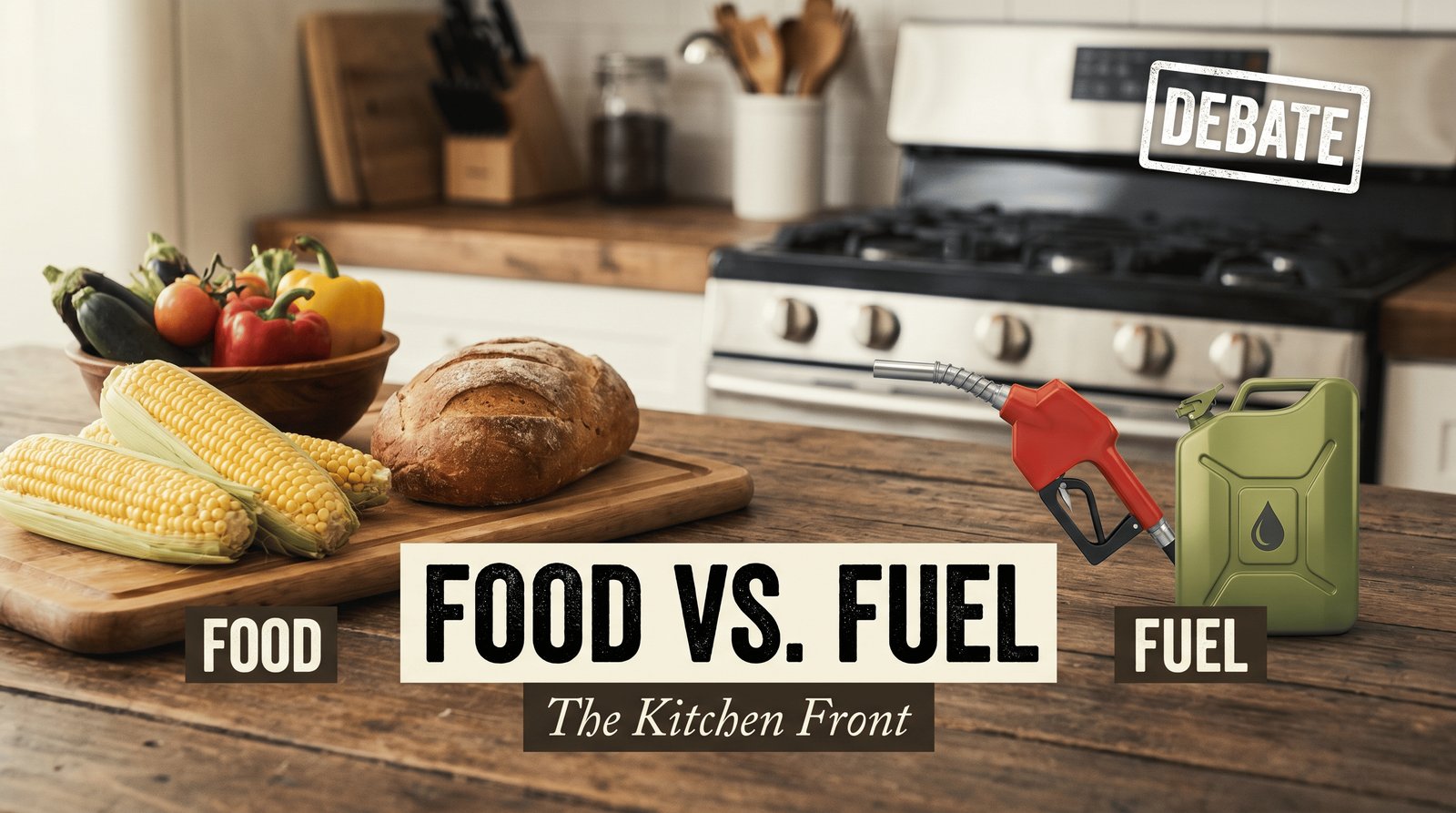
A war thousands of miles from anyone's stove is now showing up on it. The Iran conflict, the closure-and-reopening of the Strait of Hormuz, and the resulting climb in crude oil past $114 a barrel have done something the post-pandemic price spike of 2022 only partially achieved: pulled the global edible oil complex into the same gravity well as energy markets. The cost of frying, sautéing and seasoning is rising, and the line between what feeds people and what powers their cars has rarely been thinner.
The headline number tells the story plainly. The United Nations' Food and Agriculture Organization vegetable oil price index averaged 183.1 points in March 2026, up 5.1% from February and the highest reading since June 2022 — the immediate aftermath of Russia's invasion of Ukraine, when global cooking oil supply was last in genuine crisis. April data, released this week, points to further gains.
This is no longer a market story. It is a kitchen story.
How crude becomes cooking oil
The connection between a barrel of Brent and a litre of palm olein runs through one mechanism: biofuels. Every major edible oil — palm, soybean, sunflower, rapeseed, even used cooking oil itself — can be processed into biodiesel or sustainable aviation fuel. When crude is cheap, biofuels are uneconomic without subsidy. When crude is expensive, biofuels become competitive on their own merits, and the producing countries scale them up.
Crude at $114 changes the arithmetic. Indonesia, the world's largest palm oil producer, has signalled that its long-deferred B50 biodiesel mandate — which would blend 50% palm-derived diesel into transport fuel — is now economically viable for the first time. Implementation in the second half of 2026 would absorb an additional 2.2–2.5 million tonnes of crude palm oil annually, removing that supply from the global food market. Brazil is reviewing an upgrade from B14 to B15. The United States, despite political churn around the 45Z tax credit, is on track to consume 6.5–7.0 million tonnes of soybean oil equivalent in renewable diesel and SAF this year, up from 5.8 million in 2025. Malaysia has reopened the conversation on B20.
Each of these mandates pulls vegetable oil out of the food pool and into the fuel pool. With global vegetable oil consumption already forecast to outpace production in the 2025/26 marketing year, the structural deficit is now widening rather than narrowing. The FAO's most recent Food Outlook puts the gap at roughly 3 million tonnes — and that estimate predates the latest crude rally.
Where the bill is landing
Japan offers the clearest illustration of how fast wholesale moves transmit to retail. Showa Sangyo, one of the country's largest agricultural processors, raised cooking oil shipment prices on six product lines by more than 25% effective April 2026 — the second major hike in twelve months. Nissin Foods, Morinaga and several smaller producers have followed with selective increases of 6–40% across edible oil and processed food categories. A Teikoku Databank analysis estimates that under a sustained crude-price scenario at current levels, Japanese household annual consumption costs will rise by ¥25,000–50,000 ($170–340) — with the heaviest burden falling on households earning under ¥2 million annually, which already spend over 95% of income on essentials.
India transmits the global price rise through a slightly different channel. Diesel at the pump has remained stable at ₹90.03 per litre through April 2026 thanks to government-managed retail pricing — but that stability is being subsidised at the wholesale and refining level, and pressure is building. The bigger pass-through to households is happening through cooking oil itself. Refined sunflower oil retail prices in major Indian cities have firmed 8–12% since January, and refined palm olein has moved 6–9% in the same window. For the millions of street-food vendors, dhaba operators, mithai shops and small caterers who form the operational backbone of urban Indian food culture, the squeeze is now active. A Mumbai vada-pav vendor frying in palm oil has seen input costs rise on two axes simultaneously — the oil itself, and the LPG cylinder used to heat it. Margins on a ₹15–₹20 product compress quickly when both inputs move 10% higher.
Europe, where rapeseed oil is the dominant culinary fat and biodiesel feedstock, is seeing supply tightness in both directions. Black Sea sunflower oil flows have been disrupted intermittently throughout 2026, and rapeseed oil prices have firmed on stronger biofuel demand from German and French refineries. Wholesale food manufacturing prices in the EU are tracking 4–5% higher year-on-year in cooking-oil-intensive categories.
The United States has seen a less acute consumer story but a sharper political one. With roughly 40% of US corn going to ethanol and the renewable diesel sector now consuming meaningful soybean oil volumes, the perennial American food-versus-fuel debate has reignited around the dining table. Soybean oil futures on CBOT are trading at multi-quarter highs, and packaged food manufacturers from major snack brands to commercial bakeries are warning of margin pressure into Q3.
The rule-of-thumb economists keep quoting
The numerical relationship between vegetable oil prices and broader food inflation is one analysts have refined over the past three crises: the 2007–08 spike, the 2010–11 commodity rally, and the 2022 post-invasion shock. The current consensus rule of thumb: every 10% rise in vegetable oil prices adds roughly 0.2 to 0.4 percentage points to global food inflation, with the impact concentrated in import-dependent emerging economies.
The FAO Vegetable Oil Index has risen approximately 12% since January 2026. That implies a 0.25–0.50 percentage-point uplift to food CPI globally over the past four months — a meaningful contribution at a moment when most central banks were expecting cooling rather than reacceleration. In countries like India, the Philippines, Pakistan, Egypt and Nigeria — all of which import the majority of their edible oil consumption — the multiplier runs higher. India's Reserve Bank is already factoring in elevated vegetable oil pass-through risk in its monetary policy commentary, with food inflation having become the most volatile component of the country's headline CPI through 2025–26.
What the agriculture economists keep saying
The core argument from the academic side is now well rehearsed but still not fully internalised in mainstream policy debate. Agricultural land is finite. Vegetable oil yield per hectare varies from roughly 0.4 tonnes (soybean) to 4 tonnes (well-managed mature oil palm). Every tonne of oil diverted to fuel is a tonne not available for food, and the substitution is not theoretical — it is mechanically observable in the FAO data each month.
Maximo Torero, FAO Chief Economist, framed it directly in the November 2025 Food Outlook: "Behind these numbers lie persistent risks, from extreme weather to fragile trade relations, that can quickly reshape global supply and access." The November report flagged that vegetable oil consumption was forecast to outpace production for the marketing year. The April 2026 data confirms it has.
The political economy is harder. Indonesia's B50, the US Renewable Fuel Standard, Brazil's biodiesel mandate, and the EU's ReFuelEU Aviation framework all serve domestic energy security, climate, and rural-employment objectives that governments are reluctant to walk back — particularly when crude is at $114. Higher cooking oil prices are an indirect cost of biofuel mandates that rarely shows up in policy impact assessments, but is now showing up at the till.
What happens next
Three variables will determine whether this is the start of a sustained cooking oil price cycle or a peak that resolves through summer:
The Strait of Hormuz. If the current restrictions ease and Brent settles back below $90/bbl, the POGO spread (palm oil minus gasoil) widens, biodiesel economics weaken, and mandate enforcement will be more politically costly. Cooking oil prices would moderate within 60–90 days. If hostilities escalate further or shipping disruption persists into Q3, the current trajectory continues.
Indonesia's B50 timeline. A formal implementation announcement would lift CPO 8–12% within two weeks based on prior policy precedent. Deferral to 2027 would soften the market modestly.
The 2026/27 South American soy harvest. Brazil's recently completed crop has been broadly supportive, but Argentina's crush capacity continues to underperform. A weak Argentine 2026/27 outturn — which is increasingly being signalled — would further tighten the global vegetable oil balance.
For consumers, the message is uncomfortably simple. The cooking oil in your kitchen is now sharing supply with the diesel in trucks and the jet fuel in planes. When energy markets move, your grocery bill follows — and 2022 demonstrated that this transmission can run faster and further than retailers, governments or households are typically prepared for.
For the global edible oil industry, the stakes are higher and the conversation more urgent. At the Westin Powai, Mumbai, from 29 September to 1 October 2026, the 29th edition of GLOBOIL India will convene the analysts, policymakers, refiners and traders who price these flows for a living — Dorab Mistry's annual outlook, Thomas Mielke's Oil World forecast, and senior voices from CME Group, CPOPC, MPOC, USSEC, SEA of India and Glenauk Economics. The 2026 theme — "At the Inflection Point: Energy, Sustainability & India's Demand Future" — was set six months ago. The market has now caught up to it.
The food-versus-fuel debate is no longer abstract. It is on the stove.
Editorial analysis based on FAO, USDA, OPEC and exchange data as of 5 May 2026. Not investment advice.