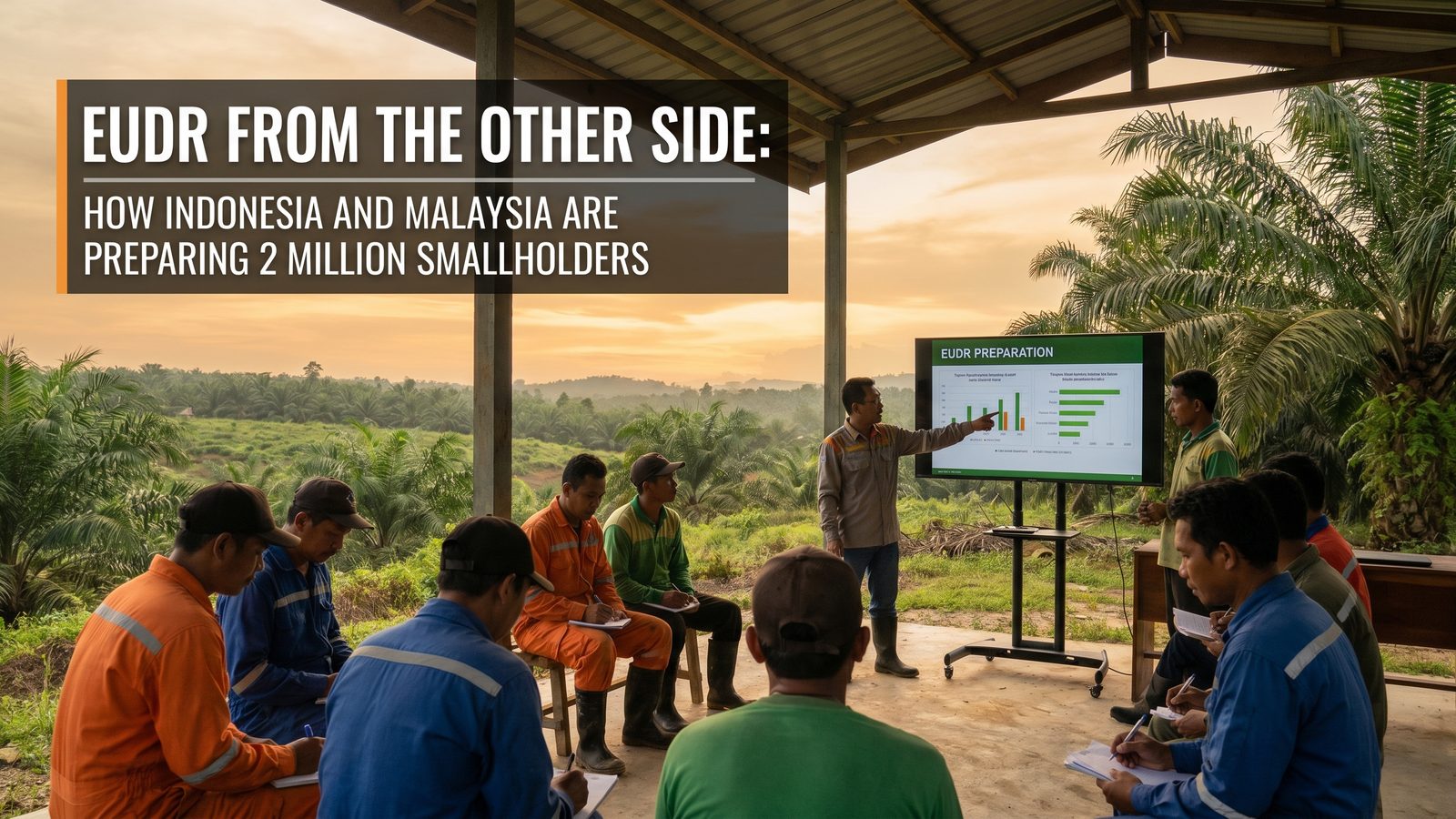
EUDR from the Other Side: How Indonesia and Malaysia Are Preparing 2 Million Smallholders
In this analysis: The EU Deforestation Regulation enters enforcement on 30 December 2026. The public conversation has focused on what European importers need to do. The harder story — and the one that matters more for global palm oil supply — is what Indonesia's 2.4 million palm oil smallholders and Malaysia's 300,000 smallholders are doing to qualify their hectares for continued access to the world's second-largest edible oil buyer. Progress is uneven, the cost is being borne disproportionately by origin countries, and the supply implications for 2027 onwards are significant.
The scale of the smallholder challenge
Indonesia's 16.4 million hectares of oil palm plantations are roughly split: 60% corporate (large-scale estates with integrated mills, generally well-positioned for EUDR geolocation compliance), and 40% smallholder (independent farmers on plots typically 1–4 hectares). That smallholder segment — approximately 6.6 million hectares across 2.4 million households — produces around 35% of Indonesian CPO.
Malaysia has a different structure: roughly 5.7 million hectares total, with 40% classified as smallholder (including both FELDA settlers and genuine independents). The FELDA share is structurally easier to bring into compliance because the plots are organised under a single mill and cooperative framework. Genuine independent Malaysian smallholders — roughly 300,000 farmers across 1.2 million hectares — face a similar challenge profile to Indonesian independents.
What EUDR requires at the plot level
Every tonne of palm oil placed on the EU market after 30 December 2026 must be accompanied by a Due Diligence Statement that includes the geolocation coordinates of the plot or plots where the oil was produced. For plots larger than 4 hectares, full polygon coordinates are required. For plots smaller than 4 hectares (which covers the overwhelming majority of smallholders), a single point coordinate is sufficient. The geolocation must be cross-referenceable against a reference deforestation map showing the state of forest cover as of 31 December 2020.
In practice, this means every smallholder plot connected to an EU-bound supply chain needs:
- A verified GPS coordinate (ideally collected in the field, not estimated from mill records)
- A documented land-use history demonstrating no deforestation after 31 December 2020
- Integration into a mill-level traceability system that can tie specific tonnes of fresh fruit bunches to specific plots
The Indonesian progress picture
Indonesia's national approach has been driven by the Kementerian Koordinator Bidang Perekonomian (Coordinating Ministry for Economic Affairs) working alongside GAPKI (the palm oil producers' association) and the ISPO (Indonesian Sustainable Palm Oil) certification framework. The updated ISPO standard, published in early 2026, now incorporates EUDR-aligned geolocation and deforestation cut-off requirements for all certificate holders.
The numbers so far:
- Approximately 18–22% of Indonesian independent smallholder hectares have verified geolocation data integrated into mill supply chains as of Q1 2026.
- Large-scale corporate estates, by contrast, are largely compliant — over 85% have complete geolocation and documented land-use history, driven by RSPO, ISPO and corporate sustainability commitments.
- The gap — roughly 5 million hectares of smallholder land without verified EUDR documentation — represents the core constraint on EU-facing Indonesian supply from January 2027.
Cost estimates: Indonesian government and industry studies put the cost of bringing a typical smallholder plot into EUDR compliance at USD 80–150 per hectare, covering GPS mapping, plot boundary verification, documentation upload, and mill-level integration. For 5 million hectares, that is USD 400 million to USD 750 million in direct compliance cost — money that is almost entirely borne inside Indonesia.
The Malaysian approach
Malaysia has moved faster, partly because the plantation base is smaller and more consolidated, and partly because the MSPO (Malaysian Sustainable Palm Oil) certification scheme was made mandatory nationwide in 2019 — giving Malaysia a five-year head start on systematic supply chain documentation.
MSPO 2.0, released in 2022 and progressively strengthened, now incorporates geolocation requirements aligned with EUDR's 31 December 2020 cut-off. As of Q1 2026, Malaysia estimates that roughly 55–65% of independent smallholder hectares have the data infrastructure needed for EUDR compliance. FELDA settler schemes are substantially further along — close to 85%.
Malaysia's differentiating advantage is plot-size distribution. Malaysian smallholder plots average 2.5 hectares, compared to Indonesia's 1.8 hectare average. Larger plots reduce the per-hectare administrative cost of documentation, and Malaysia's cooperative mill structure (particularly in Peninsular Malaysia) creates natural aggregation points for geolocation data.
The third-country problem
Not all palm oil smallholders are in Indonesia and Malaysia. The regulation applies equally to imports from Papua New Guinea, the Solomon Islands, Thailand, Colombia, Guatemala, Honduras, Ecuador and several West and Central African producers. For these origins, EUDR compliance is a far greater challenge:
- Infrastructure for plot geolocation is weaker
- Certification bodies are smaller and less funded
- Domestic regulatory frameworks equivalent to ISPO/MSPO either don't exist or are nascent
Expect a progressive concentration of EU-facing palm oil supply to larger, better-documented origins. Colombian CPO — which has invested heavily in RSPO compliance and traceability — is well positioned. Papua New Guinea, supplying New Britain Palm Oil's fully traceable estate volumes, is already heavily EU-oriented. Smaller West African origins face a gradual crowd-out.
What it means for the global market
Two-tier pricing is becoming structural. EUDR-compliant palm oil is trading at USD 150–220/MT premium over mass-balance or non-compliant product. This premium is likely to widen further once enforcement begins in December 2026, as genuine compliant volume remains constrained while EU demand holds firm at roughly 6.5 MT of palm oil annually.
The non-EU market gets the surplus. Volumes that cannot document EUDR compliance will flow to India, China, Pakistan, Egypt, Nigeria, Kenya and other non-EU destinations. This is good for those buyers at the margin — more supply optionality, slightly softer pricing than they would otherwise see. But it also means origin countries lose the price premium that compliant supply would have earned.
Indonesian levy interaction. Indonesia's export levy applies equally to compliant and non-compliant CPO. But Jakarta has signalled willingness to consider tiered levies that reward EUDR-documented exports — a policy decision that would materially affect the economics of compliance for mill operators and smallholders. No formal move has been made as of April 2026, but the political architecture for it is being built.
What to watch
EU Commission enforcement guidance: The Commission is expected to publish final enforcement guidance in Q3 2026, including country risk classifications (low/standard/high risk). These classifications drive the intensity of due diligence required and affect the cost of compliance dramatically.
RSPO certificate growth: The Roundtable on Sustainable Palm Oil publishes monthly certificate data. Sharp increases in certified smallholder hectares signal faster-than-expected EUDR readiness.
GAPKI and MPOC data releases: Both industry bodies publish quarterly updates on mill-level traceability integration. These are the best leading indicators of origin-country supply availability for EU markets in 2027.
Indonesian tiered-levy signals: If Jakarta moves toward differential levies rewarding EUDR compliance, it would sharply reshape global palm oil flow patterns within quarters.
The EUDR story, seen from Jakarta and Kuala Lumpur, is not primarily about European environmental values. It is a massive, origin-country-funded infrastructure project to rewire the documentation backbone of the global palm oil supply chain. Progress has been real but uneven. The compliant supply that does emerge from 2027 onwards will command premium pricing — and the hectares that don't qualify will find their way to non-European markets, reshaping global flows for years to come.