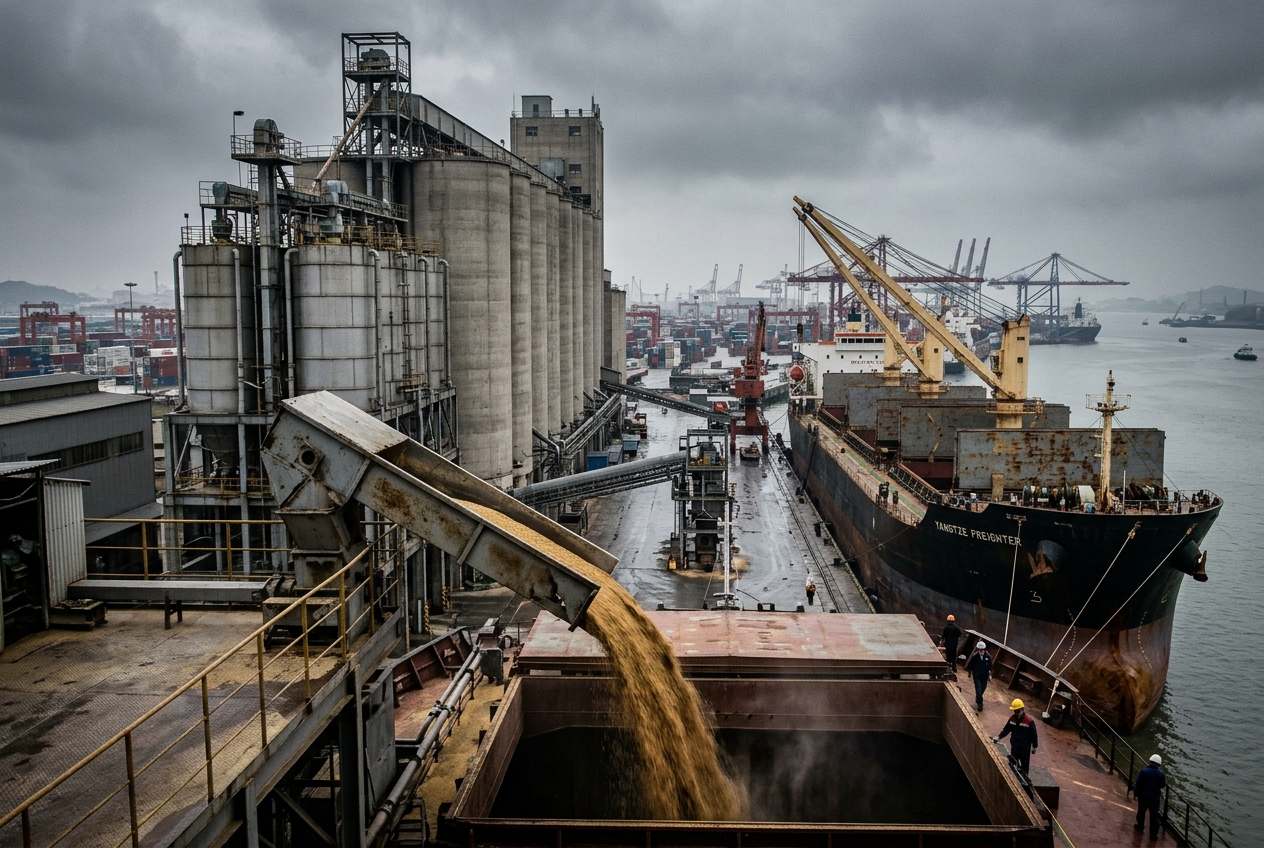
The Bean Stays Outside: China Opens the Door to US Soyoil and Meal, but Not the Seed
Key takeaway: On September 28, 2026, China published a list of US farm goods due for tariff cuts that includes soyoil and soymeal but excludes soybeans, which still carry an additional 10% duty. State buyers can absorb that cost. Private crushers mostly can't, so China's fourth-quarter crush may run light and its domestic soyoil output with it. That is a risk for importers competing for the same oil, India included.
China has cut tariffs on the soybean's products and left the soybean itself paying extra. The list published by the commerce ministry on Monday covers sorghum, corn, wheat, meat, dairy, and a range of vegetable oils and meals, soyoil and soymeal among them. Soybeans are not on it. They remain subject to the extra 10% tariff that traders say private processors cannot absorb.
The list comes days after the September 23-25 summit in Washington between the Chinese and US presidents. Beijing says more than 90% of the covered products will drop back to most-favoured-nation rates with no additional tariffs. It has not said when the cuts start. Trade in the listed goods came to roughly $17 billion in 2024, which happens to be about the size of the purchase commitment Washington says China made, once soybeans are left out.
Markets read it as a non-event for beans
Chicago made its judgement quickly. November soybeans traded at $13.04½ a bushel on Monday, down 14½ cents or 1.1%. October soyoil closed 15 points lower at 67.11 cents a pound. In Asia, Dalian's most-active soyoil contract lost 0.84% and its palm oil contract fell 1.6%. Bursa Malaysia's December palm oil contract dipped 0.19% to 4,663 ringgit a tonne, after a 4.61% drop the previous week.
Firmer crude after the stalled US-Iran talks, along with a softer ringgit, limited palm's losses. Still, the complex drew no support from the trade news, and that is a signal in itself.
Two kinds of Chinese buyer
To see why the omission matters, look at who is actually buying. State buyers have taken more than 12 million tonnes of US soybeans, close to half of the 25 million tonnes a year the White House says China pledged through 2028. These purchases are policy, and the 10% surcharge doesn't stop them.
Private crushers run most of China's processing capacity, and they are the ones stuck. Earlier this month analysts put theoretical crush margins for October-December shipments at 150 to 230 yuan a tonne below zero, and that was before the tariff, for Brazilian and US beans alike. At that point importers had booked about 4.8 million tonnes for November, around 60% of expected needs, and had barely started on December and January.
Brazil can't easily fill the gap. Farmers there had sold an estimated 85% of the 2025/26 crop, domestic processors have been bidding above export parity, and the next harvest won't arrive until early 2027. With US beans priced out for private buyers, the fallback options are auctions from state reserves or running the plants at lower rates.
The oil side of a thin crush
The meal story gets most of the attention, since China's pig herd is being cut back and feed demand is soft. The oil story matters just as much to this market. Every tonne of beans China doesn't crush is roughly 180-190 kg of soyoil it doesn't produce. If private plants slow down through the fourth quarter, domestic soyoil supply tightens exactly when winter demand builds.
The tariff cut on US soyoil does little to plug that hole. Under a biomass-based diesel obligation of 9.07 billion RIN gallons for 2026, American soyoil is largely used at home, so there is not much left to export whatever tariff it faces. In our view, cheaper access to US oil is mostly symbolic. If China needs more vegetable oil this winter, it will more likely have to buy palm, South American soyoil or Black Sea sunflower oil, competing with every other importer for the same cargoes.
Why India should watch Beijing
This is where the India link comes in. On September 24, New Delhi cut the basic customs duty on crude palm and crude soybean oil to 5% and scrapped it on crude sunflower oil, with the aim of cooling retail prices before the festival season. That cut only works if imported oil stays affordable. A stronger Chinese bid for soyoil from Argentina and Brazil would tighten India's main alternative to palm.
Sunflower oil offers little slack. Ukraine shipped about 131,000 tonnes in the first half of September, around 62% of what normal logistics would allow, with seaborne routes still restricted. Argentina's scheduled cuts to soy product export taxes don't begin until January 2027.
The risk runs both ways. If the trade council Washington and Beijing have agreed to set up eventually lowers the soybean duty, Chinese crush would recover, domestic oil output would rise, and Chinese import demand for oil would fall back. That would be bearish for soyoil and palm and good news for Indian buyers. Until then, the tariff structure favours a lighter crush in China and a more active Chinese buyer in the oil market.
What to watch next
- Effective date. Beijing has published a product list without a start date. The timing affects Q4 bookings.
- Soybean treatment. The new trade council's first task is to discuss reciprocal cuts on $30 billion of goods. Any move on beans would change the calculation quickly.
- US data. Quarterly grain stocks on September 30 and the USDA supply-demand report on October 9.
- Chinese reserve auctions. Heavy auctions would show that private crushers still can't get beans at a workable price.
- December-January bookings. A late rush for Brazilian beans, or the absence of one, will show how thin the winter crush is going to be.
None of this is investment advice. Our reading is that Monday's list leaves China less self-sufficient in soyoil than the headlines suggest, and that affects India's winter import bill.
GLOBOIL India 2026. When US-China trade policy and Indian import duties both move within a week, the traders and analysts who price that risk need to be in the same room. GLOBOIL India 2026, the 29th edition of the world's leading edible oil and agri-trade conference, runs 29 September to 1 October 2026 at The Westin Mumbai Powai Lake, Mumbai. Soyoil flows, Chinese crush economics and India's post-duty-cut sourcing strategy will all be on the table.