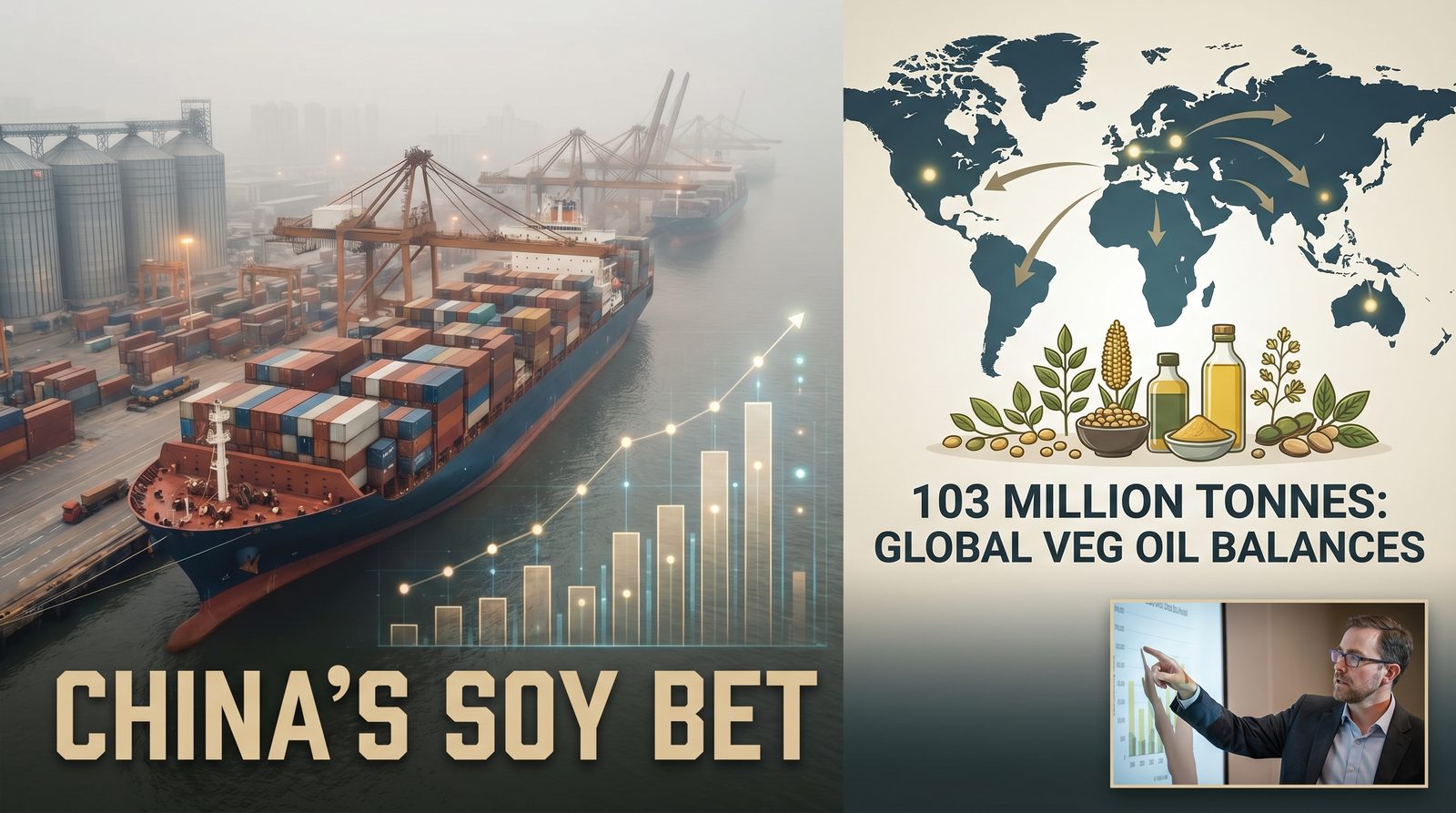
China's Soy Bet: What 103 Million Tonnes of Imports Mean for Global Veg Oil Balances
In this analysis: China is on track to import over 100 million tonnes of soybeans in 2026 for the third consecutive year. The sheer scale of that flow — and the crush economics that follow — is the single most important demand signal in global oilseed markets. For soy oil, soy meal, palm oil and sunflower oil, Chinese crush decisions in 2026 create the baseline against which every other global supply-demand calculation has to be made.
The scale
Chinese soybean imports for the 2025/26 marketing year (October 2025–September 2026) are projected at 103 million tonnes by USDA, with some private analysts (COFCO International, CNGOIC) suggesting the final figure could reach 105 MT if crush margins remain supportive through H1 2026.
For context: China accounts for roughly 60% of global soybean imports. The next largest importer, the EU, takes around 15 MT. Every 5 MT swing in Chinese annual imports is equivalent to nearly half of total EU demand. Decisions made in Zhengzhou and Dalian — where China's commodity exchanges sit — move CBOT Chicago soybean futures within hours.
The origin split
In a typical marketing year, China sources approximately:
- 60% from Brazil (peak flow March–September)
- 30% from the United States (peak flow October–February)
- 10% from Argentina, Paraguay, Uruguay and Canada combined
That split has shifted structurally since 2018. Brazilian share has expanded from roughly 50% pre-2018 to 60%+ today. US share has contracted correspondingly. The shift is partly a function of Brazil's production growth, partly tariff dynamics around the 2018–19 US-China trade tensions, and partly the greater diplomatic and commercial reliability China associates with Brazilian supply.
For 2025/26, the Brazilian share is running even higher than normal — closer to 65% — driven by the record Brazilian crop and competitive pricing. US soybean export sales to China through the US harvest window were soft, and the US 2025/26 soybean ending stocks are accumulating as a result.
Why it matters for palm
China's soybean crush produces soy oil and soy meal in roughly an 18.5% / 77% ratio. The primary driver of crush decisions is soy meal demand from China's domestic animal feed industry (pigs, poultry, aquaculture). Soy oil is, in crush economics, the secondary product — the byproduct of meal crushing rather than the target.
This matters because Chinese soy oil supply to the global market fluctuates with feed demand, not with global oil pricing signals. When Chinese hog and poultry production expands (as it has through 2025–26 post-ASF recovery), crush volumes rise and soy oil output rises with them. Some of that soy oil stays in China (used in domestic food service and manufacturing), but any surplus enters the global export basket — primarily to Southeast Asia, India and Europe.
Chinese domestic soy oil production for 2025/26 is projected at 18–19 MT. Domestic consumption is expected at 16.5–17.5 MT. The surplus of 1.5–2.0 MT flows to export markets, acting as an additional competitive pressure on palm oil in those destinations.
The soy meal dimension
China's soy meal demand is itself shaped by protein economics in the animal feed sector. When corn prices are high, soy meal substitution in feed rations increases. When corn is cheap, feed formulators dial back soy meal inclusion.
Corn pricing in China through Q1 2026 has been moderate — the 2025 Chinese corn crop was relatively strong, domestic stocks are adequate, and Ukrainian corn imports (restricted by Black Sea logistics) have been partially backfilled by Brazilian and Argentine corn. This moderate corn environment is mildly supportive of soy meal demand — not explosive, but steady.
Expect Chinese soybean crush volumes in 2025/26 to land in the 97–100 MT range, producing roughly 18.5 MT of soy oil and 76–77 MT of soy meal. These are large but not record numbers.
The price transmission
For palm oil buyers, the Chinese soy oil surplus is the clearest near-term source of downward pressure on CPO pricing. Every additional MT of Chinese soy oil entering the Southeast Asian or Indian market displaces a notional MT of palm oil demand.
Through Q1 2026, Chinese soy oil offers to India have been active. Indian refiners — who historically preferred domestic soy oil processing — have taken advantage of the pricing delta, with Chinese soy oil CIF Kandla landing at USD 1,040–1,070/MT against Indian mill gate soy oil pricing of USD 1,100–1,130/MT equivalent. The arbitrage is not massive, but it is persistent.
For Indian soy oil refiners, this creates real margin pressure. Domestic crushing capacity utilisation has softened through Q1 2026 as imported soy oil and soy oil substitutes compress spreads.
The trade policy dimension
Every significant US-China development affects Chinese soy flows. The Trump administration's posture on trade with China through H2 2026 is the single largest uncertainty in the model:
Hardened tariff scenario: If US tariffs on Chinese exports rise further and China retaliates by further constraining US soybean purchases, Brazilian share grows to 70%+ and Argentine share rises meaningfully. US 2025/26 and 2026/27 ending stocks bloat, Chicago soybean futures decline, US soy oil prices weaken. The effect on global palm: bearish, through soy oil substitution.
De-escalation scenario: If the US and China reach a framework agreement that restores US soybean market access (in the mould of the 2018–19 Phase One deal), US soybean sales to China rebound sharply. The Brazilian share moderates. CBOT soybean futures firm. US soy oil prices strengthen. The effect on global palm: marginally supportive, through tighter soy oil balances.
Status quo scenario: Trade tensions stay roughly where they are, Brazil maintains its 60–65% share, US share stays compressed. This is the central case as of April 2026 and is broadly bearish for soy oil prices through 2026/27 and — by extension — for palm oil.
What to watch
USDA export sales data (weekly): The most timely signal on US-China soy flow. Any material surge or collapse moves the market within days.
Chinese Dalian Commodity Exchange soybean meal and soy oil futures: The clearest pricing signal for Chinese crush economics.
COFCO commentary: China's state grain trader publishes periodic commentary on soybean import intentions that often leads policy announcements by weeks.
Chinese State Council agricultural guidance: Any signal from Beijing on strategic stock policies affects annual import projections materially.
China's soy bet is the largest single demand position in global agricultural trade. Every other market — palm, sunflower, rapeseed, soy meal itself — orbits around it. For 2026, the message is that Chinese import volumes remain structurally high, and the bearish pressure on global soy oil (and by substitution, palm oil) is real but not catastrophic.