Indonesia B50: The Complete Guide to the World's Largest Biodiesel Mandate
SEO EVERGREEN · BIOFUELS & ENERGY
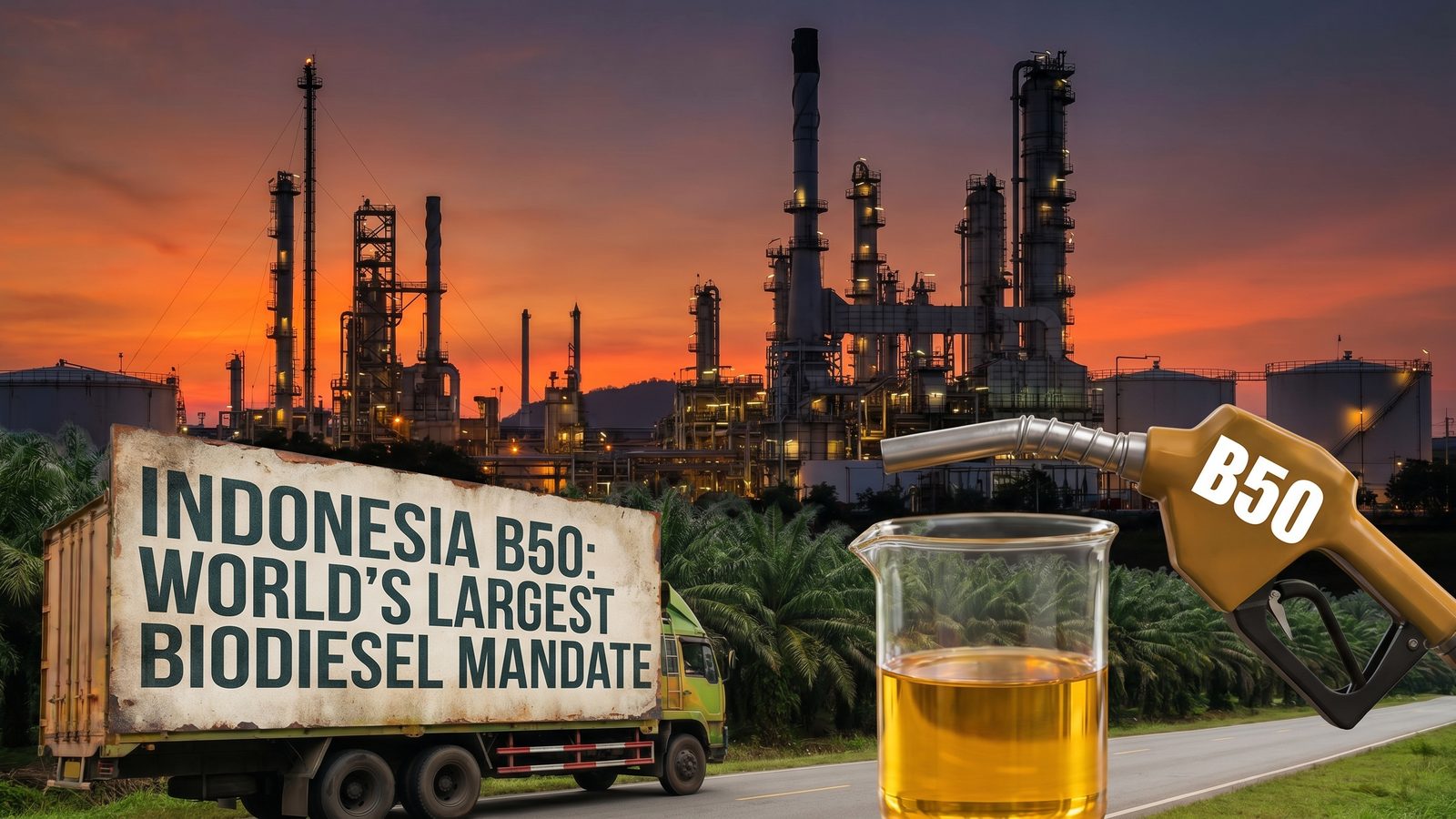
Biodiesel mandates — legal requirements that diesel fuel sold domestically contain a specified percentage of biodiesel blend — have become one of the most significant structural drivers of global edible oil demand. Indonesia**'**s B50, launching 1 July 2026, is the most consequential current example. This guide lays out the full landscape: what biodiesel mandates exist, how they work, and how they affect global edible oil supply.
What is biodiesel?
Biodiesel is a renewable fuel produced from vegetable oils (primarily palm oil, soybean oil, rapeseed oil, or used cooking oil) through a chemical process called transesterification, which converts the oil into fatty acid methyl esters (FAME). FAME can be blended with conventional diesel fuel in varying proportions.
A 'B' designation followed by a number indicates the percentage of biodiesel in the blend:
-
B5: 5% biodiesel, 95% conventional diesel
-
B20: 20% biodiesel, 80% conventional diesel
-
B40: 40% biodiesel, 60% conventional diesel
-
B50: 50% biodiesel, 50% conventional diesel
-
B100: Pure biodiesel
Why governments mandate biodiesel
Biodiesel mandates serve multiple policy objectives simultaneously:
-
Reduce fossil fuel imports and improve energy security
-
Support domestic agricultural commodities and rural economies
-
Reduce net carbon emissions from transport
-
Create domestic industrial capacity in biofuel production
The trade-off is higher food prices: when vegetable oil is redirected to fuel, less is available for food, and food prices rise. This food-vs-fuel tension has been a persistent policy debate.
Country-by-country mandate landscape (2026)
Indonesia: B40 (operating) → B50 (1 July 2026)
Indonesia is the world's largest biodiesel mandate in absolute volume terms. The current B40 mandate absorbs approximately 12-13 million tonnes of CPO annually into domestic biodiesel. B50 implementation from 1 July 2026 is projected to absorb an additional 2.3-3 million tonnes. Full B50 at steady state would absorb approximately 15-18 million tonnes of CPO annually.
Malaysia: B10 (active) → B20 (under discussion)
Malaysia's biodiesel mandate is smaller than Indonesia's in both percentage and volume terms. B10 is currently active for transport diesel. B20 is under discussion for 2027 or later.
Brazil: B15 (active) → B20 pathway
Brazil's biodiesel mandate is primarily soy-based, though palm is used at the margin. B15 was reached in 2025, with a planned pathway toward B20. Brazil absorbs roughly 8 million tonnes of soy oil into biodiesel annually under the current mandate.
United States: Renewable Fuel Standard (RFS)
The US RFS sets volumetric mandates for biofuels including biodiesel and renewable diesel. US biodiesel feedstock is primarily soy oil and used cooking oil. Renewable Diesel, a more advanced variant, is growing rapidly and absorbs significant soy oil and UCO volumes.
European Union: RED III
The EU's Renewable Energy Directive III sets transport fuel renewable energy targets. Palm-based biodiesel is being phased out of EU mandate eligibility under indirect land-use change (ILUC) provisions. Rapeseed, soy, used cooking oil, and advanced biofuels are the main feedstocks.
India: B20 target by 2030
India's National Biofuels Policy targets 20% ethanol blending in petrol (E20) and increasing biodiesel blending. Current biodiesel blend levels are below 5% due to feedstock availability constraints. Used cooking oil is emerging as a significant domestic feedstock.
Thailand, Argentina, Colombia
Smaller but operational mandates in the 5-10% range, using palm oil (Thailand, Colombia) or soy oil (Argentina).
Indonesia's B40 + B50 programmes absorb more CPO into biodiesel than most countries'** total palm oil consumption.**
The global biodiesel demand arithmetic
Total global vegetable oil consumption in biodiesel applications for 2025-26 is approximately:
-
Palm oil: 15-18 million tonnes (primarily Indonesia)
-
Soy oil: 15-17 million tonnes (primarily US, Brazil, Argentina)
-
Rapeseed oil: 9-11 million tonnes (primarily EU)
-
Used cooking oil: 7-9 million tonnes (globally, growing rapidly)
-
Other (palm kernel, animal fats, etc.): 3-5 million tonnes
Total biodiesel-directed vegetable oil demand: approximately 50-60 million tonnes out of global vegetable oil production of approximately 227-230 million tonnes. Biodiesel now accounts for 22-25% of global vegetable oil demand — a share that has roughly doubled over the past decade.
How biodiesel mandates affect edible oil prices
Biodiesel mandates create a price floor for vegetable oils because they guarantee baseline demand that would not exist in a pure food market. They also create volatility because mandate changes (either implementation accelerations or delays) translate directly into demand shifts of multi-million tonne scale.
Practical implications for Indian importers and consumers:
-
Indonesian B50 implementation reduces global palm export availability, pushing up CIF India palm prices.
-
Brazilian B15 absorbs soy oil into domestic biodiesel, reducing Brazil's soy oil export surplus.
-
US renewable diesel growth absorbs US soy oil into domestic biofuel, affecting global soy oil availability.
-
EU RED III phasing palm oil out of biodiesel eligibility has marginally eased global palm food demand — but the effect is small relative to other demand drivers.
The B50 deep dive
Indonesia's B50 is worth a detailed look because it represents the single largest near-term shift in biodiesel demand globally.
What is planned
-
Start date: 1 July 2026
-
Biodiesel blend: 50% palm-based FAME, 50% conventional diesel
-
Sectors: Initial rollout to transport diesel, phased expansion to industrial and rail sectors
-
Palm oil absorption (full implementation): 17-18 million tonnes annually vs 12-13 million tonnes under B40
What is likely in practice
-
Infrastructure constraints: Only 3 of 5 required large-scale biodiesel plants are fully operational. Full B50 capacity is 2027 or later.
-
Realistic H2 2026 absorption: 2.0-2.5 million tonnes of additional CPO versus B40 baseline
-
Realistic full-year 2027 absorption: 4-5 million tonnes of additional CPO versus B40 baseline
-
Price implications: Structural support for CPO prices through 2026-27, with magnitude dependent on implementation pace and offsetting soybean supply
What this means for India
India, the world's largest palm oil importer, is directly exposed to Indonesian B50 dynamics. Three Indian sub-markets bear the impact differently:
-
Refiners: Need to build forward cover further out, lock in supply agreements earlier, and hedge against B50 implementation surprises.
-
Food manufacturers: Higher input costs for palm-intensive products (baked goods, instant noodles, confectionery), requiring either price pass-through or margin compression.
-
Retail consumers: Gradual upward drift in palm oil retail prices through H2 2026 and 2027, potentially triggering government duty cuts to moderate the impact.
Further reading
GLOBOIL India 2026 includes a dedicated 'B50 Post-Launch Reality' stream led by speakers including Eddy Martono (Chairman, GAPKI), Mdm. Izzana Salleh (Secretary General, CPOPC), and Indonesian policy representatives. This is the first major industry forum held after B50 goes live, providing real-time data on implementation progress and market impact. The conference runs 29 September – 1 October 2026 at The Westin Mumbai Powai Lake.