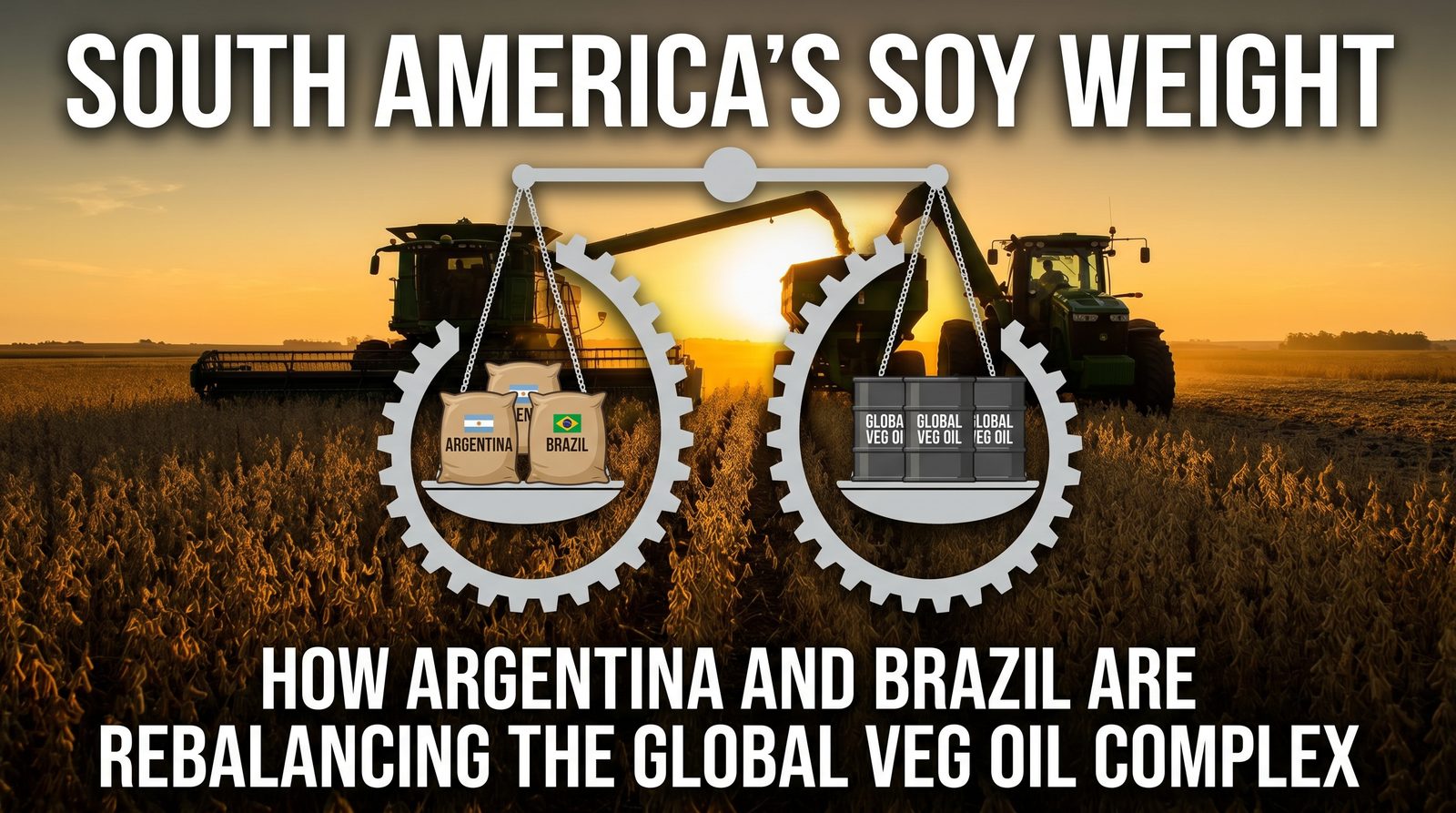
South America's Soy Weight: How Argentina and Brazil Are Rebalancing the Global Veg Oil Complex
In this analysis: The 2025/26 South American soy harvest is shaping up as the largest on record, with Brazil alone producing roughly 175 million tonnes of soybeans. That volume is now flowing into global soy oil markets, pressuring palm oil prices and creating an unusual arbitrage window for Indian and European buyers through Q1–Q2 2026. The competitive dynamic between South American soy and Southeast Asian palm is the biggest near-term rebalancing factor in the global veg oil complex.
The production picture
Brazil's 2025/26 soybean crop is estimated at roughly 175 million tonnes, up from 169 MT in 2024/25. Argentina's crop is recovering strongly from the drought-hit 2022/23 season, with current estimates in the 50–52 MT range — the highest since 2020/21. Paraguay, Uruguay and Bolivia contribute another 15 MT combined. The South American soy total lands near 240 MT for the 2025/26 cycle.
That translates — at a roughly 18.5% oil extraction yield from soybean — to around 44 MT of potential soy oil supply from South America alone, before deducting what goes to soymeal-focused crush plants and domestic Brazilian biodiesel demand.
Argentina's crush infrastructure, concentrated along the Paraná River at the Rosario complex, remains the single largest soy processing cluster in the world. Argentine soy oil exports for 2025/26 are projected at 5.5–6.0 MT — a 15–20% increase over the drought-constrained 2024/25 figure.
The Indian arbitrage
India's 2026 import basket is rotating. Through February and March 2026, Indian refiners have been increasing soy oil imports from Argentina at the margin, attracted by two factors:
Price competitiveness. Argentine soy oil FOB Rosario has been trading USD 40–60/MT below Indonesian CPO FOB Belawan. After freight, Argentine soy oil CIF Kandla landed at USD 1,060–1,080/MT in late March 2026 — highly competitive against Indonesian CPO CIF Kandla at USD 1,100–1,120/MT.
No export levy noise. Argentina's export tax structure for soybean products is stable at 33% for beans, 31% for oil and 31% for meal — set and largely unchanged. Indonesian policy, by contrast, is fluid: reference prices reset monthly, levies have moved twice in eight months (to 10% in May 2025, to 12.5% in March 2026). For Indian buyers with monthly procurement cycles, Argentine soy oil offers something Indonesian CPO currently doesn't: price predictability.
The flow data tells the story. Indian sunflower oil imports through Q1 2026 were roughly flat year-on-year, CPO imports were down 8% on import parity pressure, and soy oil imports were up 22%. Argentina and Brazil accounted for nearly all of the soy oil increase.
The European picture
European soy oil demand is driven by three factors: food manufacturing (biscuit, snack and baked goods producers substitute between soy, rapeseed and palm based on price), biodiesel blending (Germany, France and Spain consume significant volumes), and the ongoing rapeseed oil supply tightness from a smaller-than-expected 2025 EU rapeseed crop.
European buyers have leaned heavily on Brazilian soy oil through Q1 2026. Rotterdam soy oil imports from Brazil were up approximately 18% year-on-year in January–February 2026. The pricing has been attractive — Brazilian FOB Paranaguá was running USD 20–40/MT below Argentine pricing in early 2026 due to larger production volumes and a weaker real.
For European buyers, soy oil also carries a traceability advantage. Brazilian and Argentine soy industries have invested substantially in sustainability documentation and deforestation-monitoring (including the ABIOVE and CIARA-CEC industry platforms). While not fully equivalent to EUDR compliance for palm oil's supply chain complexity, soy oil traceability is in many cases easier to document than palm oil — another factor tilting European buyers toward South American soy.
Dorab Mistry's February call
At Palm Oil Conference Malaysia 2026 (February), Dorab Mistry of Godrej International presented a more cautious CPO price outlook than many expected. His core argument: the flood of South American soy oil in Q1–Q2 2026 would keep CPO in a RM 3,800–4,300 range through July, with specific downside risk of CPO printing below RM 4,000 by April on soy oil competition pressure in India.
The Mistry thesis was superseded in early April by the B50 confirmation and the POGO spread collapse, which together pushed CPO toward RM 4,778. But the underlying analytical framework — that South American soy oil is the primary near-term bearish force on palm — remains intact. The effects simply became temporarily masked by the biodiesel policy shock.
If B50 implementation goes smoothly from 1 July and South American soy continues to flow at the expected pace, Mistry's bearish framework re-asserts itself in Q4 2026 once the biodiesel boost is priced in. CPO in the RM 3,900–4,400 range through late 2026 is a plausible central case.
The downside risks for South America
Three factors could compress the South American supply story through the year:
Argentine politics and peso volatility. The Milei administration's economic reforms have stabilised the peso, but the currency remains sensitive to political developments and IMF programme milestones. A disruptive devaluation — while probably net-bullish for Argentine export volumes — would create temporary price volatility that unsettles international buyers.
Chinese soybean demand. China imports roughly 100 MT of soybeans annually, the largest single flow in global agriculture. Any shift in the US-China trade posture, or in Chinese domestic stock policy, materially affects how much South American soy flows to crush versus whole-bean export to Chinese ports. A surge in Chinese whole-bean buying tightens Latin American crush availability and narrows the South America soy oil arbitrage to India and Europe.
La Niña / El Niño transitions. Weather models suggest a La Niña pattern through much of 2026 before a possible neutral-to-El Niño shift in late 2026/2027. La Niña generally favours South American soy production. An earlier-than-expected transition could affect the 2026/27 planting cycle.
What to watch
USDA WASDE monthly: The World Agricultural Supply and Demand Estimates report is the single most influential scheduled data release for soy markets. Any material revision to Brazilian or Argentine production estimates moves Chicago soy oil futures within hours.
Argentine soy oil export tax: Stable at 31% currently, but any signal from Buenos Aires that this could shift would reshape soy oil pricing globally.
Brazilian biodiesel blend: Held at B14 through 2026 but under review. Any move to B15 or higher absorbs domestic soy oil and tightens export availability.
China trade policy: US-China agricultural trade dynamics directly affect South American soy crushing economics.
The South American soy oil story is the global veg oil complex's single most important counterweight to Southeast Asian palm in 2026. For buyers, the message is clear: diversification of sourcing across origins and oil types has moved from a good practice to a competitive necessity.