EUDR: A Complete Guide for Indian Palm Oil Refiners
SEO EVERGREEN · SUSTAINABILITY & COMPLIANCE
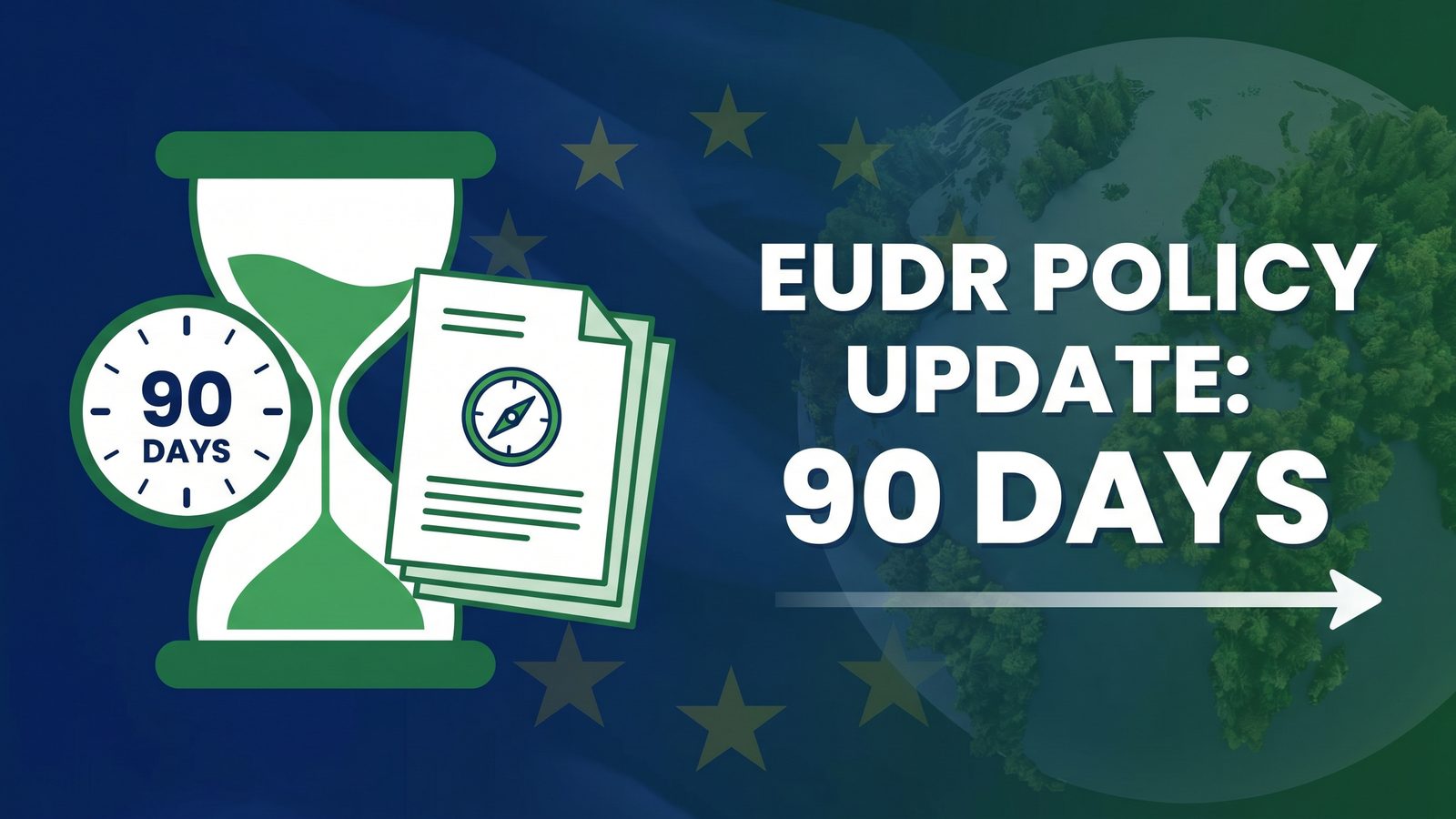
The EU Deforestation Regulation (EUDR) applies to any Indian company exporting palm oil, palm oil derivatives, oleochemicals, or soy-based products to the European Union. With large and medium operator enforcement beginning 30 December 2026, this guide lays out exactly what Indian refiners need to have in place — and by when.
Does EUDR apply to you?
EUDR applies if any of the following are true for your business:
-
You export palm oil, palm olein, palm stearin, palm kernel oil, or palm fatty acid distillate (PFAD) directly to EU-based buyers.
-
You export oleochemicals (fatty acids, glycerol, fatty alcohols) derived from palm oil to the EU.
-
You export soy oil, soy meal, or soy derivatives to the EU.
-
You supply palm or soy to Indian traders who are the first operator placing the product on the EU market.
-
You supply to a downstream EU operator who requires upstream due-diligence data.
If you only sell domestically in India or export to non-EU markets, EUDR does not directly apply. However, global buyers outside the EU are increasingly requiring EUDR-equivalent documentation, so the infrastructure investment may still be commercially justified.
The core compliance requirements
EUDR requires three things for regulated products placed on the EU market:
1. Deforestation-free
Products must not originate from land deforested after 31 December 2020. This cut-off date has remained constant across all EUDR timeline revisions.
2. Legal compliance
Products must be produced in accordance with the legislation of the country of production — covering land tenure, environmental permits, labour laws, tax obligations, and indigenous rights.
3. Due Diligence Statement (DDS)
A formal statement filed in the EU's TRACES system, linking every commodity shipment to specific plots of land with high-precision geolocation coordinates. For plots above 4 hectares, full polygon boundaries are required. Below 4 hectares, point coordinates may be acceptable.
The simplified structure (post-December 2025 amendment)
The December 2025 EUDR simplification package clarified several operational elements:
-
Only the 'first operator' placing a regulated product on the EU market must submit a full DDS.
-
Downstream operators who trade products already placed on the EU market have reduced DDS obligations.
-
Small and micro primary operators may submit a simplified one-time declaration.
-
Large and medium operators: 30 December 2026 enforcement
-
Small and micro enterprises: 30 June 2027 enforcement
For Indian refiners, the critical question is who the 'first operator' is in your supply chain. If you ship palm oil derivative directly to a European customer, you may be the first operator. If you ship to an Indian trader who then ships to Europe, the trader is likely the first operator. If you ship to a Middle Eastern trader who ships to Europe, the Middle Eastern trader is likely the first operator.
The 'first operator' is the entity placing the product on the EU market for the first time — that's who files the DDS.
Practical compliance roadmap — 9 months to deadline
Assuming this guide is being read between April and May 2026, with 7-9 months to the 30 December deadline:
Month 1: Scoping
-
Identify your EU-exposed product lines
-
Identify who the 'first operator' is for each product flow
-
Establish your compliance lead (internal or external)
Months 2-3: Supplier engagement
-
Map your upstream supplier network (plantation, mill, refinery)
-
Request and collect plot-level geolocation data
-
Identify data gaps and prioritise high-volume/high-risk supply chains
Months 3-4: Data infrastructure
-
Choose a DDS management platform (internal build vs third-party)
-
Integrate geo-coordinate data into your ERP or compliance system
-
Test DDS generation end-to-end
Months 5-6: Legal compliance
-
Collect documentation on production-country legal compliance from suppliers
-
Audit high-risk suppliers via third-party verification
-
Update supplier contracts to include EUDR warranties
Months 7-8: Pilot and refine
-
Submit pilot DDS for a single shipment in TRACES
-
Identify bottlenecks and system errors
-
Refine documentation and process
Month 9: Go-live readiness
-
Final testing, staff training, customer communication
-
Post-deadline, begin filing DDS for all regulated shipments
Common pitfalls to avoid
-
Assuming your supplier has the data: Many Indonesian and Malaysian smallholder suppliers do not have plot-level geo-data. Your ability to comply depends on your ability to either get this data or substitute suppliers.
-
Assuming 80% is good enough: EUDR requires 100% traceability to compliant plots. Non-compliant volume cannot be placed on the EU market at all.
-
Treating EUDR as a one-time project: It is an ongoing operational obligation. DDS must be filed for every shipment.
-
Ignoring the audit trail: EU competent authorities will audit. Retain documentation for at least 5 years.
-
Not pricing the compliance: If your compliance costs are not reflected in your EU-bound pricing, you are subsidising the EU market at the expense of your other markets.
The pricing opportunity
For Indian refiners who invest adequately in EUDR compliance infrastructure, the regulation creates a pricing opportunity. Verified EUDR-compliant CPKO is commanding a $350-400 per tonne premium over non-compliant volumes in Q1 2026 European trade. Compliant palm olein is trading at narrower but still significant premiums.
For refiners with EU volumes above 10,000 tonnes per year, treating EUDR compliance as a premium revenue tier rather than a defensive cost centre is economically justified. Below that threshold, the compliance investment needs to be evaluated against alternative market strategies.
Helpful resources
-
European Commission EUDR portal: green-business.ec.europa.eu/deforestation-regulation
-
EU TRACES system: webgate.ec.europa.eu/tracesnt
-
RSPO (for palm-specific certification pathway): rspo.org
-
MSPO (Malaysian Sustainable Palm Oil Certification 2.0): mspo.org.my
-
ISPO (Indonesian Sustainable Palm Oil): ispo-org.or.id
Further reading
GLOBOIL India 2026 features a dedicated EUDR Countdown stream, with direct engagement from RSPO (Dr. Inke van der Sluijs, Director of Market Transformation), CPOPC (Mdm. Izzana Salleh, Secretary General), and Indian refining industry leadership. The conference runs 29 September – 1 October 2026, exactly 90 days before the EUDR enforcement window opens — the last major industry forum where the final compliance push can be coordinated.