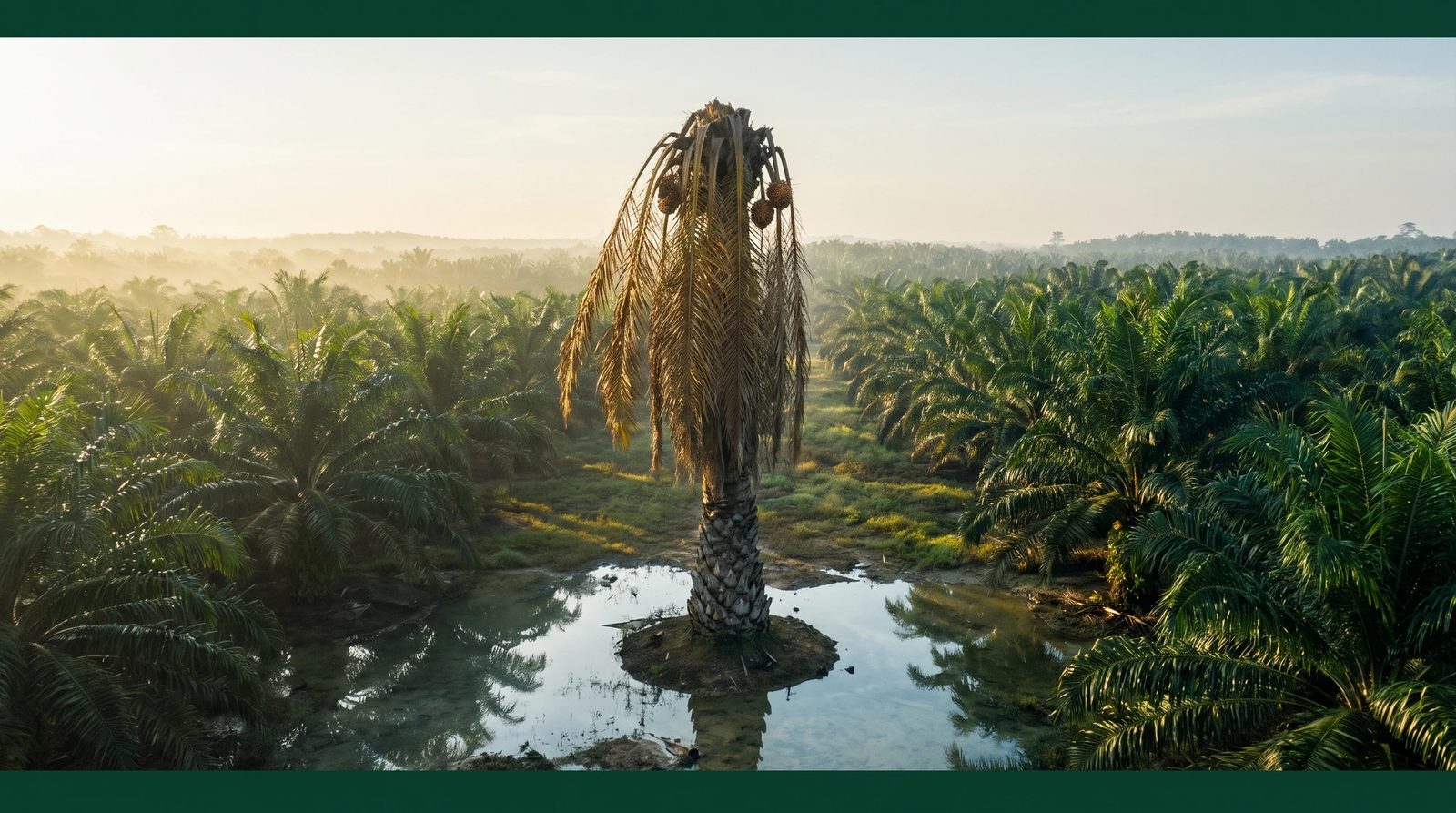
The Constraint on Palm Supply Nobody Is Modelling Is Not the Weather
Malaysian crude palm oil output rose just 1.39% in August, to 1.81 million tonnes, in a month with no significant weather disruption. Analysts assessing the resulting eight-month-high stock build noted that downside in prices may stay cushioned if biological tree stress continues to constrain production growth. That is a different supply risk from the El Niño story the market has been trading, and it deserves to be separated from it.
Two constraints are being folded into one number, and they behave in opposite ways.
Two different things called "supply risk"
The first is weather. Dryness associated with El Niño reduces yields with a lag, and it is the basis on which the USDA trimmed its forecast for Malaysian 2026/27 production to 19.7 million tonnes. Weather risk is forecastable, reversible and priced continuously — every rainfall model update moves it.
The second is physiological. Oil palms that carry a heavy crop in one cycle tend to produce less in the next. The tree allocates finite resources; a period of intense fruiting draws down reserves that then have to be rebuilt. The effect is lagged, it operates independently of current conditions, and critically it does not reverse when it rains.
That distinction matters because the market treats them as one input and hedges them the same way. They are not the same trade.
What August actually showed
Look at the month again with that frame.
Output at 1.81 million tonnes was the highest since December, which reads as strength. But the month-on-month gain was 1.39%, an increase of 24,903 tonnes, in what should be a seasonally firm stretch. Palm kernel output rose 1.97%. These are not the numbers of a crop accelerating into its peak.
Analysts expect production to remain seasonally firm in coming months, while noting that a meaningful recovery in exports matters more for clearing inventory than anything happening on the supply side. That framing is worth sitting with: the people looking closely at this are describing production as adequate rather than abundant, in a period when abundance is normal.
If output is only managing 1.39% growth when conditions permit more, the question is what is capping it. Weather is not the answer for August. Tree condition is the explanation being offered.
Why this matters for how 2027 gets priced
The consensus bull case for palm in 2027 rests on El Niño. It is a weather story, and weather stories have a specific failure mode: they can simply not happen. Forecasts get revised, rain arrives, and the premium comes out of the curve in a week. We have watched exactly that dynamic play out twice this year in the energy leg of palm's support.
A physiological constraint does not fail that way. If trees are genuinely carrying stress from prior cropping cycles, that shows up in yields regardless of how favourable the next twelve months are. It is a slower, duller and considerably more reliable constraint than a weather forecast — and it is being mentioned in research notes rather than headlines, which is usually where the underpriced variables live.
The honest caveat is that this is harder to verify from outside. Rainfall is measured publicly. Tree condition across millions of hectares is inferred from yield data after the fact, and one month of modest output growth is not proof of anything. It is a hypothesis that fits the observation.
The interaction nobody has priced
Here is where it becomes interesting. If both constraints are real, they compound in a way that a single supply forecast does not capture.
A stressed crop entering a dry period does not simply add the two effects. Trees under physiological strain have less reserve capacity to withstand water stress, which is why drought years following heavy-cropping years tend to disappoint more than drought years following light ones. The Malaysian industry projection of ending stocks falling from 2.8 million tonnes in 2025/26 to 2.56 million in 2026/27 assumes a particular production path. If that path is already constrained before the weather arrives, the downside to it is not symmetric.
None of this changes the near-term picture. Stocks are at 2.82 million tonnes, September exports are tracking down 11.7% to 17.5%, and the market is correctly focused on whether India comes back to the table. Supply is not the current problem.
The read for buyers
The practical implication is about which risk you are actually hedging when you extend cover into 2027.
A buyer who covers because of El Niño is buying weather insurance and should expect it to expire worthless reasonably often. A buyer who covers because the productive base may be structurally constrained is buying something else — and if that is the real story, the cover looks cheap at today's prices precisely because everyone is pricing the weather.
The tell over the next two quarters will be simple. If Malaysian output keeps posting low-single-digit monthly growth through what should be the seasonal peak, without a weather excuse, the tree-stress explanation gains weight. If output accelerates normally, it does not, and the 2027 supply case reverts to being purely a rainfall bet.
Watch three things: monthly output growth rates against seasonal norms rather than against last year, whether yield per hectare data shows the same pattern, and whether other producing regions report similar constraints.
Forward-looking views here are analysis, not investment advice.
GLOBOIL India 2026
The variables that move markets in eighteen months are rarely the ones in today's headlines — they are the ones sitting in research notes and plantation agronomy reports. Surfacing them early is what GLOBOIL India 2026 is for: the 29th edition, 29 September to 1 October 2026, at The Westin Mumbai Powai Lake, Mumbai. The world's leading edible oil and agri-trade conference puts planters, agronomists, analysts and buyers in the same room while 2027 cover is still being written.