India's Palm Oil Paradox: Why the World's Largest Buyer Is Cutting Imports While Prices Rise
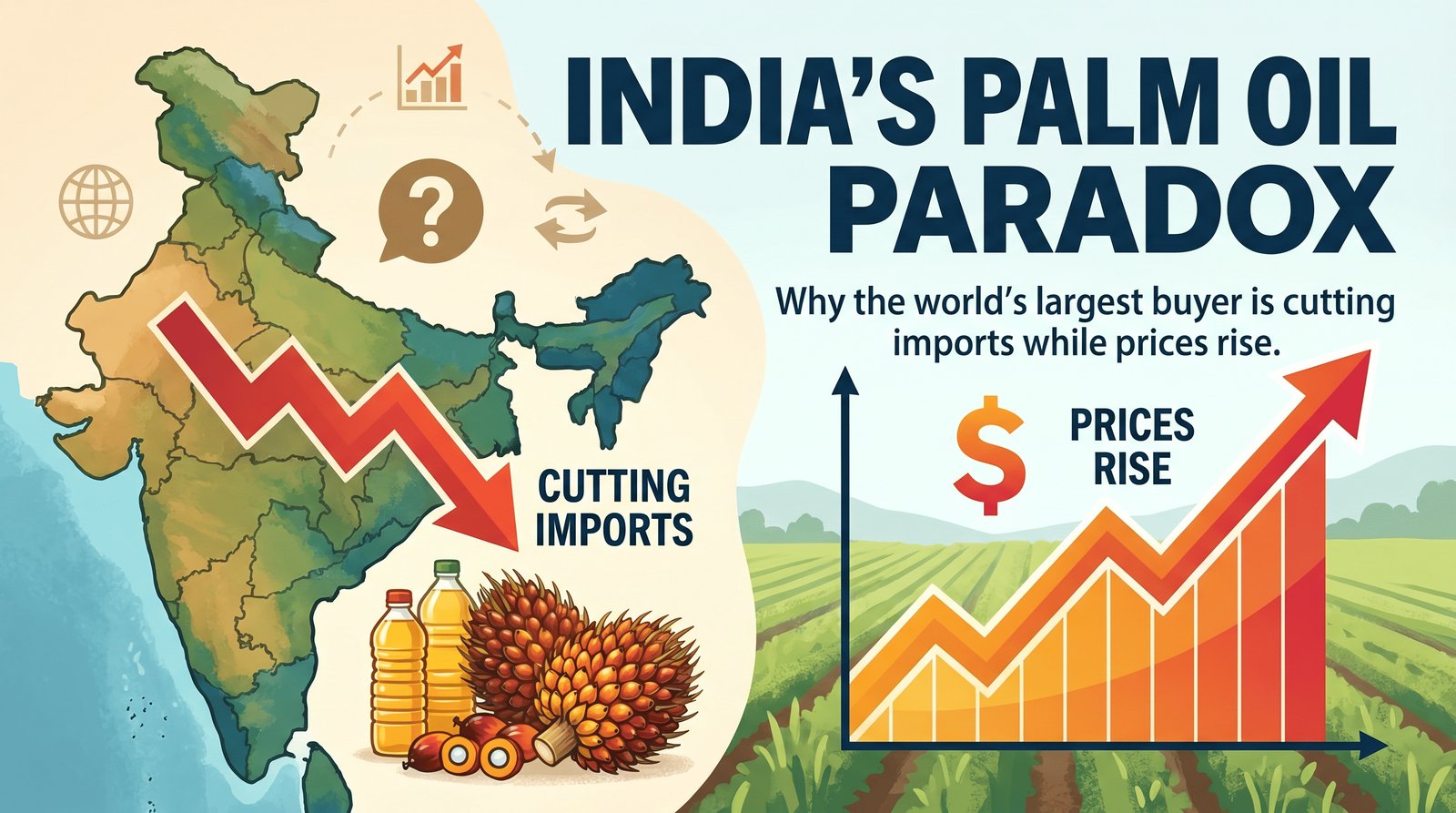
While global edible oil markets are framing 2026 as a structural bull case, the data coming out of India this week tells a more uncomfortable story: the world's largest vegetable oil importer is in the middle of a textbook demand destruction event, driven not by price but by an energy infrastructure crisis. April 2026 palm oil imports have collapsed to a 12-month low. CIF Mumbai prices for crude palm oil, soybean oil, and sunflower oil are all softer on a month-on-month basis — even as Brent crude trades above $114. This divergence is the most important signal in global edible oils right now, and most of the market is missing it.
The data point everyone's underweighting
According to dealer estimates released this week, India's palm oil imports in April 2026 fell to their lowest level in twelve months. Total edible oil imports rose 10.4% month-on-month to roughly 1.3 million tonnes — the highest since January — but the composition has shifted dramatically. Sunflower oil and soybean oil purchases jumped. Palm oil collapsed.
The Solvent Extractors' Association of India price sheet for the week ending 30 April 2026 confirms the pricing footprint of that demand shift. Crude palm oil C&F Mumbai is at USD 1,260/MT, down 0.40% week-on-week and 1.56% month-on-month. Soya degum crude CIF Mumbai is at USD 1,320/MT, down 1.49% week-on-week and 5.71% month-on-month — the sharpest near-term softening on the international oils sheet. Sunflower oil crude CIF Mumbai is at USD 1,410/MT, down 1.40% week-on-week and 2.42% month-on-month.
In a market where global crude has rallied 30%+ from the April lows, where the FAO Vegetable Oil Index has hit its highest reading since June 2022, and where every analyst desk is calling structural deficits — Indian landed prices are softening. That is not a market in equilibrium. That is a market where physical demand is breaking faster than supply tightness can support pricing.
The cause: an LPG crisis, not a price ceiling
The mechanism is gas. India is in the middle of its worst cooking gas shortage in decades, a direct consequence of the Iran conflict and the Strait of Hormuz disruption. As the world's second-largest LPG importer — sourcing the majority of its supply from the Persian Gulf — India is receiving fewer cargoes, and the government has prioritised household supply by sharply curtailing allocations to commercial users.
This is where the chain breaks. Approximately 40% of India's vegetable oil consumption flows through the HORECA channel — hotels, restaurants, catering, and the vast street-food economy that defines urban Indian eating. From the dosa stalls of Bandra to the kachori carts of Old Delhi, deep-frying is not optional, and palm oil is the dominant medium because of its heat stability and price point.
When restaurants and street vendors cannot get LPG cylinders at commercial prices, two things happen: kitchens scale back operating hours, and operators switch to alternative fuels like wood, charcoal, and induction where possible — neither of which suits high-volume frying. Industry estimates put the resulting decline in vegetable oil demand at 250,000 to 300,000 tonnes per month.
Aashish Acharya at Patanjali Foods has flagged the risk of further contraction if the conflict persists. Sandeep Bajoria at Sunvin Group has framed the dynamic plainly: eateries facing cooking gas shortages are reducing palm oil consumption, and the import numbers are catching up to that demand reality.
The net effect: while every supply-side narrative remains intact — Indonesian B50 ambitions, Malaysian production constraints, Black Sea sunflower disruption, US biofuel pull — the demand-side floor for the world's largest importer has dropped through the trapdoor of energy infrastructure failure.
The substitution story inside the data
What's happening underneath the headline import collapse is more interesting than the import collapse itself. Indian consumers and processors are not simply consuming less oil. They are shifting which oils they consume, and that shift is showing up in the SEA domestic price data with unusual clarity.
Domestic oilseed prices are firming sharply. Soybean seed at Indore is trading at ₹61,000 per tonne, up 5.17% week-on-week and 37.47% year-on-year. Rape and mustard seed in Rajasthan is at ₹72,500/tonne, up 14.52% YoY.
The implication: with HORECA palm oil demand destroyed, household demand is shifting toward bottled cooking oils — and Indian crushers are pulling forward seed inventory to meet that demand.
Domestic crushed oil prices are exploding. Soya extract ex-Indore (48/2.5) is at ₹48,000/tonne, up 7.14% week-on-week and 51.86% year-on-year. Rapeseed extract ex-Rajasthan is at ₹22,700/tonne, up 6.57% week-on-week. Sunflowerseed extract ex-Maharashtra/Karnataka was the biggest weekly mover on the entire SEA sheet at +13.33% in seven days.
This is what substitution looks like in a price tape: the imported product softening, the domestic crushed equivalent ripping.
Soymeal exports are surging. Soyabean extract Bulk Yellow Ex-Kandla in the export FAS column is at USD 505/MT, up 8.60% week-on-week and 30.15% year-on-year. Soyabean extract export FOR Kandla is at ₹47,000/tonne, up 11.37% week.
India is becoming a net soymeal exporter at the same time it is becoming a net oilseed importer — a structural imbalance that traders should be modelling, not assuming away.
The cottonseed and rice bran complex is showing pressure too. Rice bran extract ex-Punjab at ₹16,250/tonne is up 5.86% week and 89.46% YoY. Cottonseed extract ex-Guntur is at ₹33,000/tonne, down 1.49% week but up 20.42% YoY. The minor oils are absorbing some of the household substitution flow.
Why the market hasn't priced this yet
Three reasons. First, the data is genuinely fresh — dealer estimates of April imports landed within the past 48 hours, the formal SEA April release is mid-May, and most Western desks haven't yet updated their India demand assumptions. Second, the bullish narrative is institutional. Every major bank, broker and ratings agency has CPO at RM 4,500–5,200 in their H2 2026 base case; pivoting to "but India just stopped buying" is not a comfortable note to publish. Third, the LPG link is genuinely surprising. The transmission from Hormuz tensions to a Mumbai vada-pav vendor isn't on most analyst dashboards.
The risk-asymmetric position is now obvious. If the LPG crisis resolves quickly — through diplomatic de-escalation, alternative supply routing, or an emergency drawdown of Indian strategic LPG reserves — pent-up HORECA demand snaps back, palm imports rebound, and the bullish base case re-asserts itself. If the crisis persists into Q3 2026, India's structural demand profile is being permanently reset toward higher domestic crush and lower imported palm intake — and Bursa CPO has materially less ground to stand on than the consensus assumes.
What it means for the price outlook
The honest read of the SEA 30 April price sheet is that the market is in a two-track equilibrium:
Track 1 — Global tightness: Brent at $114, Indonesia's B50 incentive economically alive, Malaysia structurally capped, Black Sea sunflower fragile, US renewable diesel pulling. Bullish.
Track 2 — Indian demand destruction: April imports at a 12-month low for palm, CIF Mumbai prices softening across all four major oils MoM, HORECA demand off 250,000–300,000 tonnes/month, household substitution running into domestic crushed oils. Bearish for imported palm specifically.
Track 1 supports the BMD CPO complex on the supply side. Track 2 challenges Indian-specific landed pricing on the demand side. The Indian discount to the global benchmark — visible in the 5.71% MoM softening on Soya Degum CIF Mumbai while Chicago soy oil futures rallied — is not noise. It is the market beginning to price the demand shock.
For Indian refiners, the implication is operational: margins on palm refining have expanded modestly because international CPO has softened more than the rupee has weakened, but throughput is the constraint, not margin. Plants that historically ran flat-out for HORECA-bound palm olein are now running below capacity. Crushers processing domestic soy and mustard seed are running flat-out. The capital allocation shift that this implies — and that several mid-sized Indian refiners are already executing — is the underrated trade of Q2 2026.
For international traders, the signal is more nuanced. Bursa CPO and CME CBOT soybean oil should not be priced off the headline FAO Vegetable Oil Index alone. Indian demand has historically been the swing variable; right now, it is swinging downward in the world's most important import market, and the price tape is starting to register it.
What to watch through May and June
Mid-May SEA April release. The formal Solvent Extractors' Association data drop will confirm or revise the dealer estimate of palm oil imports falling to a 12-month low. If confirmed, expect the bearish framing to enter mainstream desk commentary within ten days.
LPG cargo arrivals at Mumbai, Mundra and Kandla. Real-time port data will show whether the gas crisis is structurally resolving or simply rolling forward. Resolution accelerates HORECA recovery; persistence deepens demand destruction.
Domestic mustard and soybean MSP commentary. With seed prices firming hard YoY, government procurement decisions for the Kharif and Rabi cycles become more politically charged. Any signal of expanded domestic procurement support firms domestic crush margins further.
The HORECA reopening data. When restaurant footfall and small-vendor operating hours stabilise, palm oil imports rebound first and fastest. This is the cleanest leading indicator of demand normalisation.
The Westin Powai, Mumbai, 29 September – 1 October 2026. The 29th edition of GLOBOIL India arrives at the precise moment this two-track market needs resolution. Dorab Mistry's annual price outlook, Thomas Mielke's Oil World forecast, the SEA leadership panel, and senior voices from Patanjali Foods, Adani Wilmar, Ruchi Soya, Marico, CME Group, Glenauk Economics, CPOPC, MPOC, and USSEC will set out the H2 2026 framework for India's edible oil complex when it matters most. Every desk modelling Indian demand for Q4 will need to be in the room.
Bottom line
The simple bullish story everyone is selling is wrong in one important way. India is not the demand-inelastic floor that a normal year of edible oil modelling assumes. When energy infrastructure fails, the world's largest cooking oil buyer can — and just did — drop demand by 300,000 tonnes a month in eight weeks, with no policy intervention required. That is not a footnote to the bullish case. That is the bullish case's biggest single risk.
The SEA price sheet for the week ending 30 April 2026 is the data point that confirms it. The market hasn't fully priced it. It will.
Editorial analysis based on SEA of India data (week ending 30 April 2026), dealer estimates of April 2026 import flows, FAO Markets & Trade data, and exchange filings. Not investment advice.