When the Discount Dies, So Does the Habit: India's June Oil Imports Sink 29%
Key takeaway: India's vegetable oil imports fell 29 percent year on year in June 2026 to 11.46 lakh tonnes, the lowest of the current oil year, because palm oil's discount to soybean and sunflower oil collapsed to under 50 dollars a tonne. With refiners no longer rewarded for buying palm, the government is now weighing higher import duties — a move that would land right before peak festival demand.
India bought 29% less vegetable oil in June as palm lost its price edge over soft oils. A tariff hike now sits on the desk, and the timing points straight at the festival season.
India runs on cheap palm oil. For most of the last two decades, palm's steep discount to soft oils has made it the default fill for the country's refiners, blenders and bulk consumers. In June that logic stopped working, and the import numbers show exactly how quickly Indian buyers respond when the price signal flips.
The month the arbitrage closed
Total vegetable oil imports dropped to 11.46 lakh tonnes in June, down 29 percent from a year earlier and the weakest monthly figure since the oil year began in November. Palm carried most of the fall. Palm oil imports slid about 10.5 percent month on month to 487,000 tonnes, a 14-month low. Soybean oil was not spared either, sliding roughly 23 percent to 381,000 tonnes from 494,000 in May.
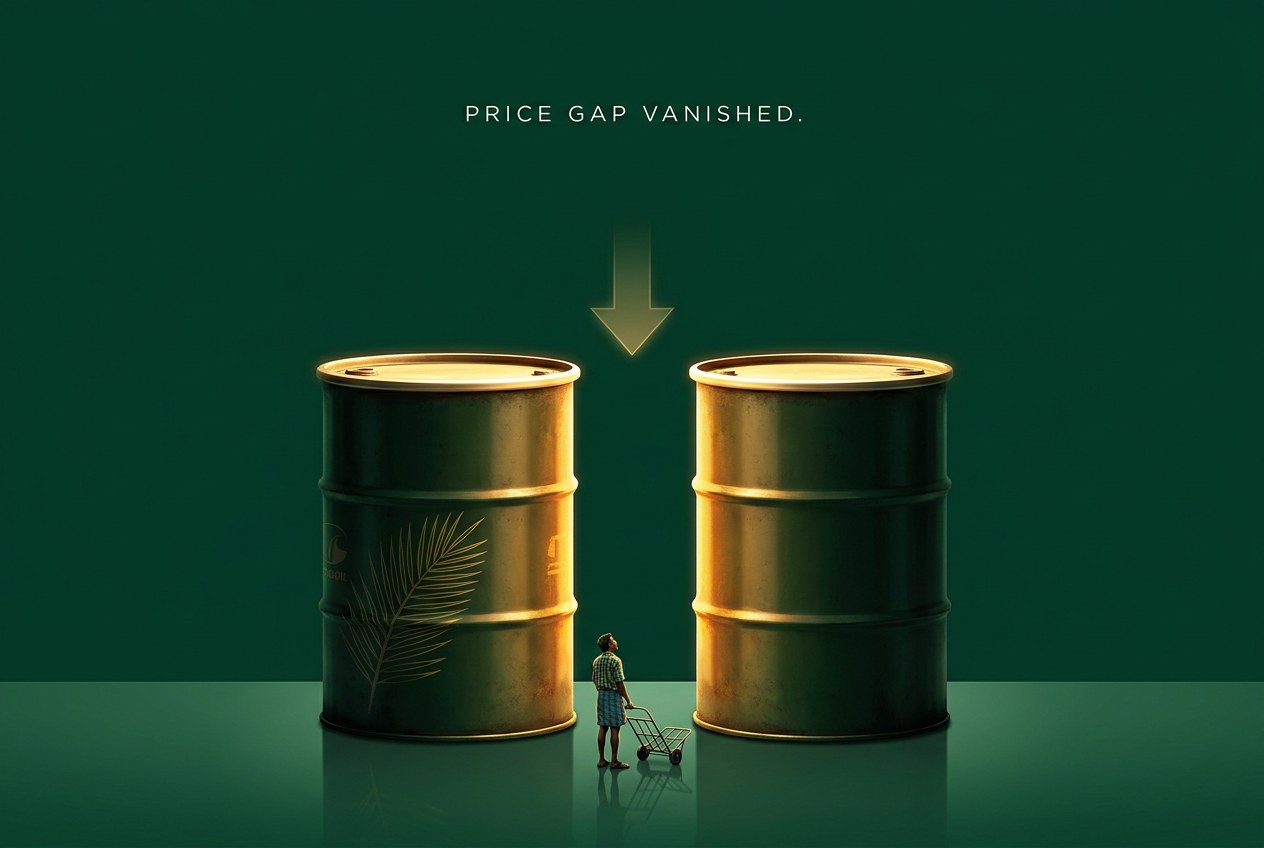
The mechanism is straightforward. Palm normally trades at a healthy discount to soybean and sunflower oil, and that gap is what pulls Indian demand toward it. In June the discount narrowed to below 50 dollars a tonne. At that spread, palm loses its core advantage. Buyers who can substitute simply wait, draw down existing stock, or shift blend ratios toward soft oils, and imports fall across the board rather than rotating neatly from one oil to another. That is what happened.
It is worth keeping the month in perspective. Cumulative imports for the first eight months of the 2025-26 oil year, November through June, still sit at 105.7 lakh tonnes, up from 99.55 lakh tonnes a year earlier. India has not stopped importing. It has paused a single expensive month and let inventories do the work.
The duty question changes the calculus
Into that soft-demand backdrop comes a policy signal that could reset the whole board. The government is examining a request from the domestic processing industry to raise import duties on edible oils, with the stated aim of lifting prices for domestic oilseed farmers. No decision has been taken. But the fact that it is under active review at a moment when imports are already weak is the development worth tracking.
The move would cut two ways, which is why it is not a simple win for the farm lobby. A higher duty supports domestic oilseed prices and, in theory, encourages local crush. It also raises the landed cost of the imported oil that supplies the overwhelming majority of Indian consumption, feeding straight into retail food inflation. That tension is the reason previous duty changes have often been reversed or fine-tuned within months.
There is also a leakage the tariff math has to reckon with. Refined oil continues to flow into India from Nepal at zero duty under the South Asian free-trade framework, with roughly 338,854 tonnes shipped between November 2025 and April 2026. Any duty differential between crude and refined imports, or between trade partners, tends to redirect volume rather than reduce it. A blunt duty hike risks handing share to duty-free refined flows unless the structure is carefully drawn.
Why the timing is the story
The calendar is what makes this urgent. India's edible oil consumption climbs into the festival stretch that runs through the back half of the year, and refiners typically build cover well ahead of it. A duty decision taken now would shape the cost base for exactly that restocking. Buyers face a genuine dilemma: secure cargoes at current landed costs and risk a subsequent duty cut, or wait for policy clarity and risk chasing a tighter, pricier market into peak demand.
The external picture argues against complacency on price. Global vegetable oil values are firm, with the FAO oil index up 23.3 percent year on year in June. Indonesia's move to a higher biodiesel blend threatens to thin the palm export supply India leans on. If that tightening arrives at the same time as a domestic duty increase, the cost of India's festival-season oil could rise from both directions at once.
For now, the read is that June was a discount-driven air pocket, not a demand collapse. Indian buying will return when the arbitrage reopens or stocks run low, whichever comes first. The variable that turns a soft month into a structurally more expensive year is the duty pen in New Delhi. Watch the tariff notification, the palm-to-soft-oil spread, and Indonesian export availability together. Any two of the three moving the same way would set the tone for India's import bill into 2027.
The convening point
GLOBOIL India 2026 returns for its 29th edition from 29 September to 1 October 2026 at The Westin Mumbai Powai Lake, Mumbai. The world's leading edible oil and agri-trade conference convenes precisely as India's festival-season procurement and any duty decision collide. If you import, refine, blend or trade oil into this market, GLOBOIL is where the duty outlook, the palm-soft spread and India's demand recovery get argued out face to face with the people setting the prices.