The Meal Reversal: How a Shipping Lane and a Price Gap Unwound India's Oilmeal Export Story
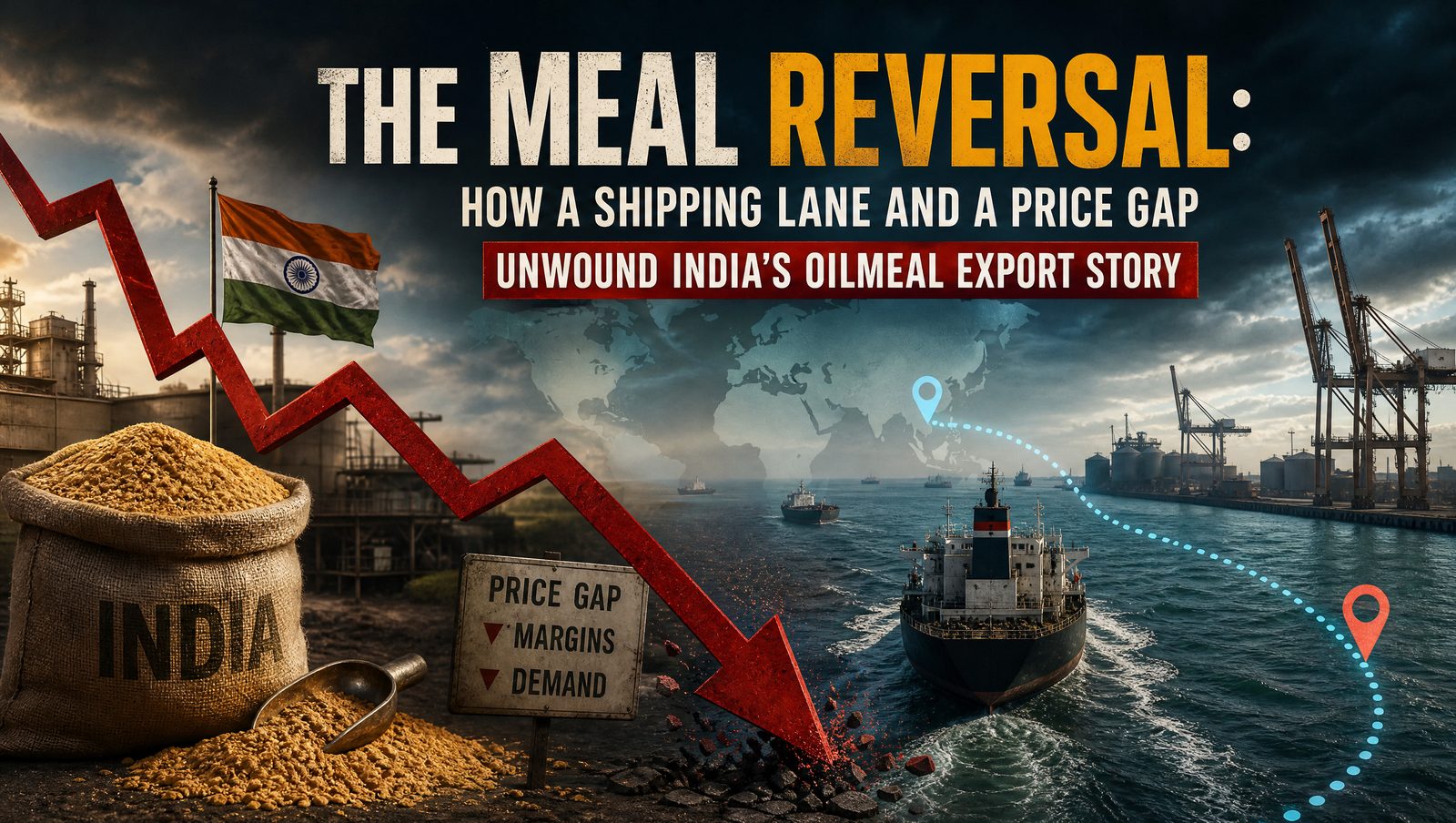
For years, oilmeal was one of the quieter success stories in India's agri-export ledger — a steady, high-volume trade that turned the byproduct of the domestic oilseed crush into foreign exchange. In the 2025-26 marketing year, that story went into reverse, and the reasons say as much about the Red Sea as they do about the soybean.
According to the Solvent Extractors' Association of India (SEA), India's oilmeal exports fell 13.22% to 37.68 lakh tonnes in 2025-26, down from 43.42 lakh tonnes the year before. In value terms the decline was steeper: exports dropped to ₹9,340 crore from ₹12,171 crore, a fall of roughly 23%. The gap between the volume decline and the value decline is itself revealing — it tells you that Indian exporters were not only shipping less, but realising less on what they did ship.
SEA Executive Director B.V. Mehta attributed the slide to a combination of market and logistical pressures that compounded each other through the year. Two forces stand out: a shipping route in crisis, and a price gap that Indian meal could not close.
The shipping problem
The first and most acute pressure was the disruption of the Red Sea corridor. With vessels forced to bypass the Suez route and detour around the Cape of Good Hope, voyage times to West Asian and European destinations lengthened by 10 to 15 days. That detour rippled straight into the economics of the trade — container shortages, inflated freight costs, and the working-capital drag of cargo spending an extra fortnight at sea.
The exposure was material. By SEA's account, roughly 20% of India's oilmeal exports are destined for West Asia and another 15% for Europe — meaning around a third of the trade runs directly through the corridor most affected by the disruption. For a commodity that competes on thin margins, two extra weeks of freight and the associated cost inflation is often the difference between a workable deal and one that does not close.
The price problem
The second pressure was structural and arguably more durable: Indian soybean meal is simply uncompetitive on global markets against Argentina and Brazil. South American meal, produced from larger crops at greater scale and shipped from origins without India's freight handicap, has consistently undercut Indian offers. When buyers can source the same protein more cheaply elsewhere, Indian meal moves only when those origins are constrained — not as a first choice.
The pressure showed up at home, too. Mehta noted that domestic livestock feed makers have increasingly shifted toward cheaper alternatives — notably DDGS (distillers' dried grains with solubles), a byproduct of the ethanol industry — at the expense of soymeal and other oilmeals. India's ethanol push, in other words, is quietly reshaping the domestic feed ration and eating into soymeal demand from the inside. High domestic soybean prices and a consequent drop in crushing activity reduced the volume of meal available to ship in the first place.
Who kept buying
Against that backdrop, the destination map tells its own story. China remained the largest importer of Indian oilmeals in FY26, taking 8.78 lakh tonnes — a flow driven less by Indian competitiveness than by Chinese trade politics. Beijing's 100% tariff on Canadian rapeseed/canola products effectively shut out a major competing origin, and Indian rapeseed meal stepped into the gap. It is a useful reminder that in oilmeal, one country's tariff war can do more for your export book than any amount of price-cutting.
South Korea became the second-largest buyer at 3.5 lakh tonnes. The next tier — Kenya (1.87 lt), Germany (1.78 lt), Nepal (1.67 lt) and France (1.37 lt) — rounds out the list. Bangladesh, normally a dependable buyer of Indian soybean and rapeseed meal, cut its intake by nearly 50% in 2025-26, a decline Mehta linked to the political disturbances in the neighbouring country.
The forward signal: from meal exporter toward bean importer
The FY26 export decline is the settled, backward-looking picture. The more provocative question is what the same forces are setting up for the season ahead — and here the early signals point in a direction India rarely travels.
With domestic soybean prices elevated and crushing margins squeezed, Indian traders have reportedly begun unwinding soymeal export commitments for May–June shipment and, more strikingly, exploring soybean imports to relieve the domestic crush. Reported deals point to African-origin beans — from non-GM origins such as Benin, Niger, Togo and Nigeria — at around $700–760 per tonne CIF, with talk of imports scaling toward record levels by the time the new crop arrives in September–October.
This forward story should be read with appropriate caution; it is a developing, trade-reported picture rather than an official SEA figure. But it is directionally consistent with everything in the verified FY26 data. A market where domestic beans are too expensive to crush profitably, where meal cannot compete abroad, and where feed buyers are defecting to DDGS is precisely the kind of market that starts looking outward for beans. The constraint, as ever, is India's non-GM-only import rule, which closes off the deep American and South American bean pools and funnels any import demand toward a thin shelf of African suppliers.
The read
Put the two halves together and the picture is coherent. India's oilmeal export engine lost roughly an eighth of its volume and nearly a quarter of its value in 2025-26, squeezed simultaneously by a shipping crisis it could not control and a price disadvantage it could not overcome. Domestic demand, meanwhile, is quietly migrating toward ethanol's byproducts. And the same tight-crop, high-price conditions that throttled exports are now, at the margin, pulling India toward the unfamiliar position of importing the very crop it has long sold to the world.
None of this is yet a structural break — a good monsoon and a strong autumn crop would ease much of it. But the FY26 numbers are a clear signal that India's comfortable self-sufficiency in the soy complex is more conditional than it looks, and that two external forces — a contested shipping lane and the relentless competitiveness of South American supply — now shape the country's oilmeal fortunes more than domestic ambition does.
For an industry that has long treated oilmeal exports as a dependable annuity, FY26 is a year worth studying closely.
The convening point
These themes — India's shifting role in the global oilmeal and oilseed trade, the Red Sea's impact on agri-logistics, and the ethanol-feed linkage — will feature in discussions at GLOBOIL India 2026, 29 September – 1 October, The Westin Mumbai Powai Lake. Senior representatives from SEA of India, SOPA, COOIT, and major refiners will share the stage. The Q4 implementation reality of a meal-export book in decline, and the early shape of an Indian soybean import market, will both be on the agenda.
Editorial analysis by the GLOBOIL Intelligence Desk. Figures sourced from the Solvent Extractors' Association of India (SEA) as reported on 28 May 2026. The soybean-import outlook reflects trade reports and remains a developing story. Not investment advice.