The Floor Is Policy: Why Edible Oil Won't Follow Crude Down, and Why July Belongs to India's Sellers
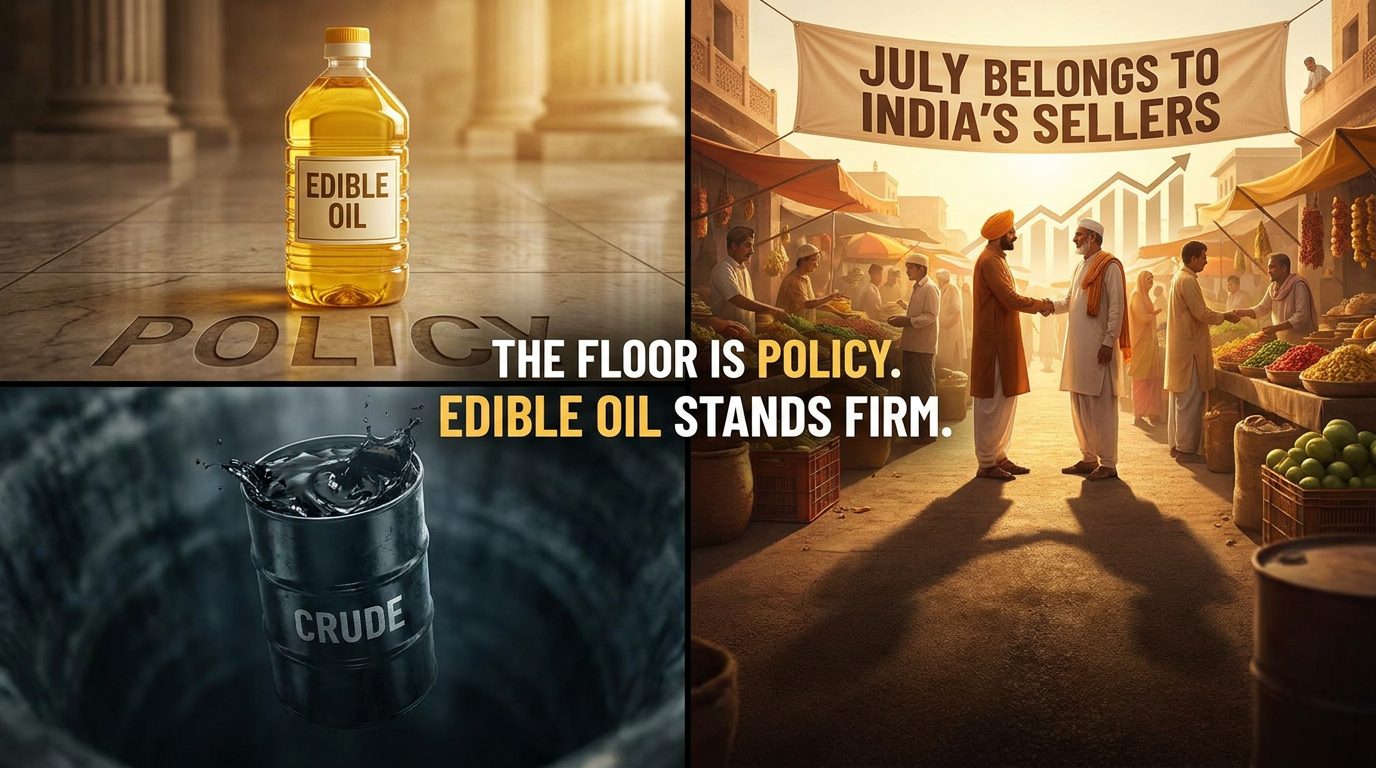
Here is the call for the next several weeks. Do not expect edible oil prices to fall, even if crude oil does. The old reflex — where crude sells off and vegetable oils follow it lower — has stopped working. The complex has decoupled from crude, policy is setting the price, and for India the calendar points to a strong month of selling.
Three things the desk is watching.
1. India's import loss is about to close
For months, bringing oil into India has meant importing at a loss. Refiners and traders carried a negative disparity, so they stopped restocking and ran their pipelines down instead. That position is set to reverse by the end of July.
Three things push it:
- Landed economics are normalizing, so the loss on fresh imports is closing.
- Festival demand is coming, and the August-to-November buying season is the heaviest of the Indian year.
- Carry stocks are near empty, because nobody wanted to hold inventory into a falling paper market.
When demand arrives and no one is sitting on oil, buyers have to come to the market together. That is how a quiet market turns brisk inside a week. Anyone waiting for prices to soften before covering the festival season is likely to be buying late, and buying in a crowd.
2. A sunflower squeeze is building for August and September
The soft-oil relief valve is jamming. Black Sea sunflower supply is thin, with very few active sellers, and India's forward coverage for August and September is poor.
That combination is the risk. Buyers who assumed they could pick up sunflower cheaply later may find little on offer when they turn to book it. A shortfall in one soft oil pushes demand into the others, so a sunflower gap does not stay contained; it lifts palm and soybean oil with it.
Sunflower has stopped being the cheap swing oil that buyers lean on. For the next two months, treat it as supply that can disappear on short notice, and cover the gap now rather than betting it fills itself.
3. Biofuel mandates are the new floor
The most important shift is structural, and it sits under everything else. Biofuel demand now works like a floor beneath vegetable oil prices.
- US biomass-based diesel mandates are at record levels for 2026.
- Indonesia's B50 blend went live on July 1, pulling more palm oil into the fuel tank and away from the export market.
- Malaysia is weighing the same move.
The clearest tell is at the bottom of the barrel. Used cooking oil and POME, the residues that used to trade at a steep discount to fresh oil, now price close to virgin oil, because the biodiesel bid has lifted them. When the waste stream costs nearly as much as the oil it came from, the fuel market has repriced the whole barrel.
That is why the complex has decoupled from crude. A cheaper barrel of oil no longer drags cooking oil down with it, because the marginal buyer of vegetable oil is now a blending mandate, not a refinery margin. Policy, not petroleum, is the driver.
What it means for July
Put the three together and the picture is consistent. Domestic demand is about to switch on, the pipeline is empty, the cheapest soft oil is the one most at risk of shortage, and the price floor is set by policy that is not going to loosen this quarter.
For India, that makes July a strong selling month across palm, soybean and sunflower oil. Sellers who have been waiting for a crude-led selloff to restock are waiting for something that is not coming. The steadier posture is to restock now, cover forward where you are short — sunflower first — and be ready for demand that shows up faster than usual once the festival calendar turns.
Be ready. The market is unlikely to hand out a cheaper entry.
This is the GLOBOIL Intelligence desk's reading of current conditions, offered as market commentary rather than trading advice. Policy and weather move fast, and any forward position carries risk.
The convening point
The forces in this note — biofuel mandates rewriting the floor, a fragile Black Sea, and India's festival demand — are the exact debates on stage at GLOBOIL India 2026. The 29th edition runs 29 September to 1 October at The Westin Mumbai Powai Lake, bringing 2,000-plus refiners, traders and policymakers from 60 countries into one room as the complex reprices around policy.