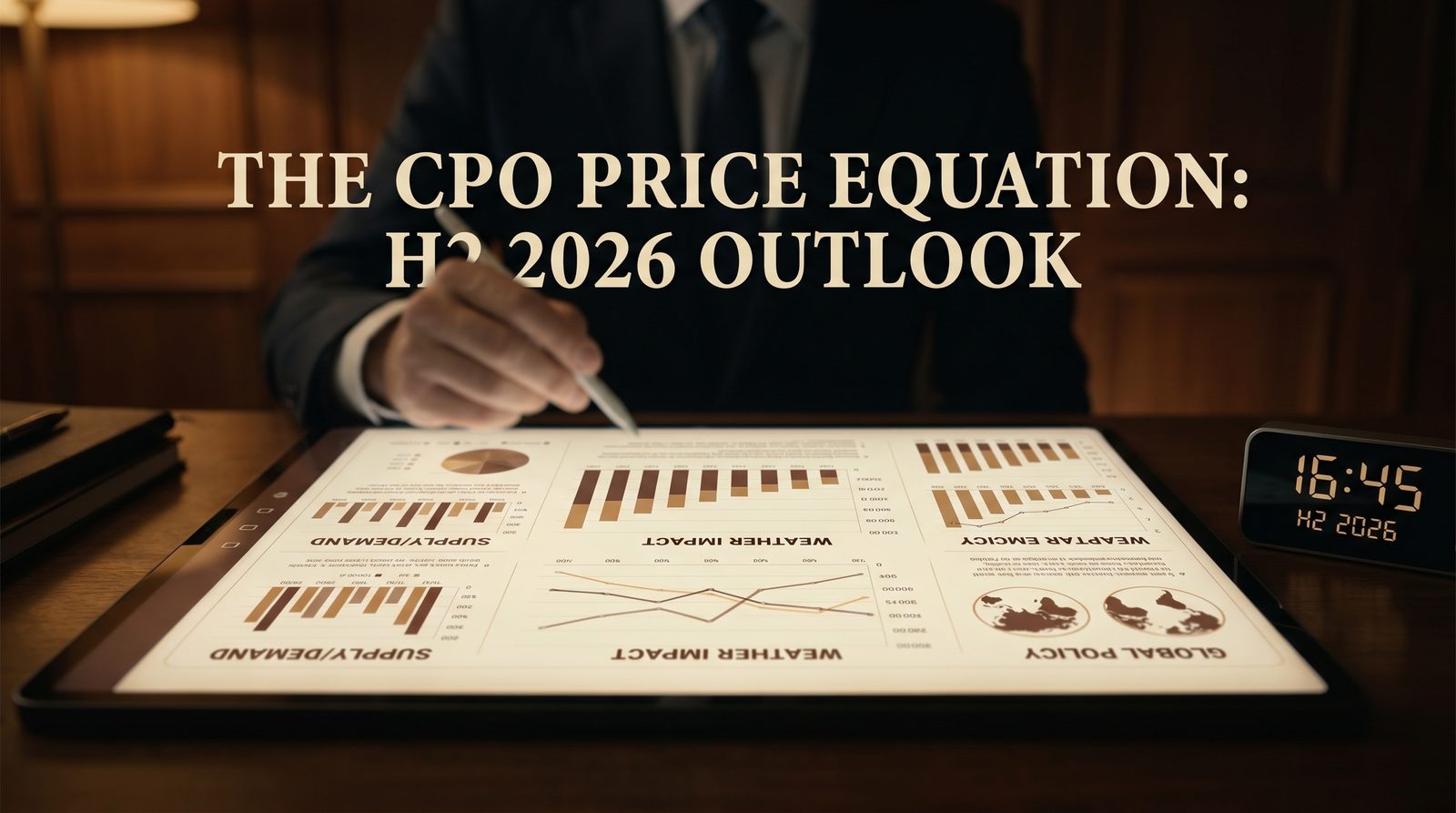
The CPO Price Equation: What Analysts Are Watching Through H2 2026
Crude palm oil futures on Bursa Malaysia Derivatives have traded between 4,200 and 4,800 ringgit per tonne through Q1 2026, with the benchmark CPO contract closing April 2026 near the upper end of that range. The price path through H2 2026 will be determined by the interaction of three forces: B50 absorption, weather, and demand destruction at the top end of the price range.
This piece synthesises what industry analysts are watching — drawing on forecasts from Dorab Mistry (Godrej International), Thomas Mielke (Oil World), Dr. Julian McGill (Glenauk Economics), and technical commentary from Bursa Malaysia Derivatives and regional brokerages. All three named analysts are confirmed to speak at GLOBOIL India 2026, where the first post-B50-launch price outlook session will be delivered on 30 September 2026.
The supply framework
Global palm oil production for 2025-26 is projected at 79 to 81 million tonnes, depending on the forecasting house. Indonesia accounts for 48 to 50 million tonnes, Malaysia 19 to 20 million tonnes, with Thailand, Colombia, and Nigeria making up most of the remainder.
The structural constraint on supply, which Dorab Mistry has emphasised in recent GLOBOIL keynotes, is productivity. Palm yield per hectare has been flat to declining across Southeast Asia since 2022, reflecting ageing plantations, labour shortages, and replanting backlogs. Malaysia's MPOB has recorded CPO yields at 3.4 to 3.6 tonnes per hectare — below the historical peak.
Indonesia's replanting programme (Peremajaan Sawit Rakyat, or PSR) covers a target 3.3 million hectares over its full run. Execution has been slower than planned, but the pipeline of replanted hectares will begin yielding through 2028-29, with productivity recovery visible in 2030-31.
Palm productivity growth has slowed to near zero globally — a structural ceiling that B50 absorption amplifies.
The demand framework
Global vegetable oil consumption for 2025-26 is projected at approximately 227 to 230 million tonnes — with palm at 79 to 81 million tonnes, soy oil at 65 million tonnes, rapeseed at 32 million tonnes, and sunflower at 21 to 22 million tonnes, alongside smaller volumes of corn, cottonseed, olive, and other oils.
Oil World's balance projection for 2025-26 shows consumption exceeding production by approximately 3 million tonnes — a deficit that is being drawn from global stocks. Stocks-to-use ratios are the tightest in three years.
Within that aggregate picture, palm is the tightest segment. B50 implementation in Indonesia absorbs incremental 2.3 to 3 million tonnes of CPO into the domestic energy system. India's palm imports are projected to hold at 9 to 10 million tonnes, supported by the current crude-oil-favourable duty regime. EU palm imports are in structural decline driven by both EUDR compliance costs and substitution toward other oils.
The three forecasting positions
As of Q1 2026 published commentary, the three most-watched analysts have established broadly aligned but nuanced positions.
Dorab Mistry (Godrej International)
Has highlighted the structural tightness thesis, emphasising that palm productivity growth is effectively zero and that B50 implementation amplifies this constraint. His GLOBOIL 2024 keynote projected CPO trading in a broad 3,700 to 4,500 ringgit range through mid-2025, with upward bias as the B50 implementation date approached. The range has played out roughly as projected, and his 2026 update will be a central focus of GLOBOIL India 2026.
Thomas Mielke (Oil World)
Maintains balance-sheet-driven analysis emphasising the 3 million tonne 2025-26 deficit. His published work has sustained a structurally bullish vegetable oils complex outlook through 2026-27, with palm the tightest sub-segment.
Dr. Julian McGill (Glenauk Economics)
Has produced granular B50 impact modelling, with scenarios showing CPO price impact ranging from +200 to +600 ringgit depending on implementation pace. His 2026 work has emphasised execution risk — that B50 may be mandated but infrastructure-constrained through late 2026.
The price path scenarios for H2 2026
Three scenarios are worth considering for the September 2026 to February 2027 price path.
Baseline (highest probability)
B50 implements on pace but with capacity constraints limiting real CPO absorption to 2.0 to 2.5 million tonnes in H2 2026. Brazil soy arrives in full volume, cushioning the complex on the soy side. CPO trades in a 4,400 to 4,900 ringgit range, with the upper bound tested during peak demand windows (Ramadan preparation in Q1 2027, Chinese New Year buying).
Bullish (moderate probability)
B50 implements aggressively with 3+ million tonnes of CPO absorption visible by Q4 2026. La Niña residuals affect Brazil's second-crop soy. Red Sea disruption tightens sunflower availability into H1 2027. CPO tests 5,200 to 5,500 ringgit, with a possible spike above that during specific demand windows.
Bearish (lower probability)
B50 implementation delays by quarters, effective absorption remains at B40 levels through 2026. Brazilian soy delivers without issue. Indian demand moderates on domestic oilseed supply. CPO drifts back to 3,800 to 4,300 ringgit.
What to trade against
For risk management and procurement planning through H2 2026, the baseline scenario — CPO trading 4,400 to 4,900 ringgit — is the most defensible planning assumption. Forward cover strategies should assume range-bound trading with upside risk skewed to the bullish scenario.
The first real-time validation of these scenarios will be the September 2026 forecasts delivered at GLOBOIL India 2026, exactly 90 days after B50 launches. By then, two months of real CPO absorption data will be in the market. The price path from that point through to Ramadan 2027 will be unusually well-informed — one of the reasons GLOBOIL India 2026 has been described as the most consequential edition of the conference in its 29-year history.